
It’s been some time since we visited Norwich.
So a trip was long overdue. And much has changed in this modern city with medieval roots.
Norwich, a fine city
That’s what the signs say as you enter the city boundary.
The quote is from 19th century author George Borrow, and it’s true, Norwich is mighty fine.
But I much prefer JB Priestley’s description:
‘What a grand, higgledy-piggledy, sensible old place Norwich is!’
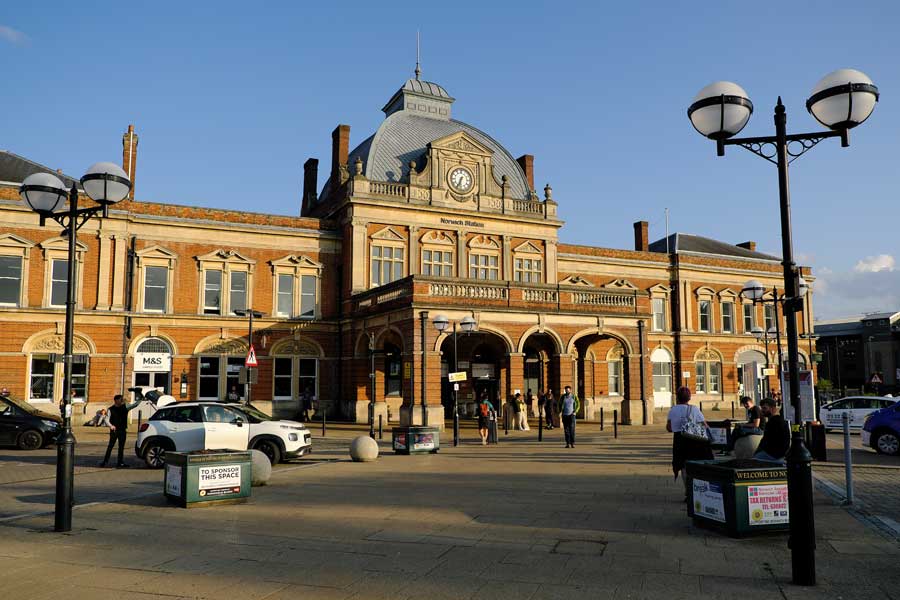
We arrived by train and the station, which I remember as a bit dark and dingy, has clearly had a makeover. Once one of three stations serving the city, this is still known by locals as Thorpe Station. Its pale-washed brickwork glows in the summer sun and the clock face is clean and bright.
On arrival we headed straight for the peace and quiet of the river bank.
And a river runs through it …
There’s something appealing (and very British) about a big, bustling city with a tranquil river at its heart.
Once an ancient Saxon capital, Norwich grew rich under the Normans and became the second most important city after London.
The industrial revolution mainly passed it by because there was no fast-flowing water to power the factories. That did Norwich a huge favour. It’s now one of the best preserved medieval cities in Britain.
And the lazy, slow-flowing River Wensum is a huge part of its charm.
Norwich Riverside Walk
There is an official circular walk which starts in the city centre near the Forum, but we decided to bumble our own way round, dropping in and out of the main sites and generally readjusting to Norfolk time.
The path has been improved enormously in recent years and is now a smooth wheelchair and pushchair-friendly walk which takes in the heart of the city’s history.
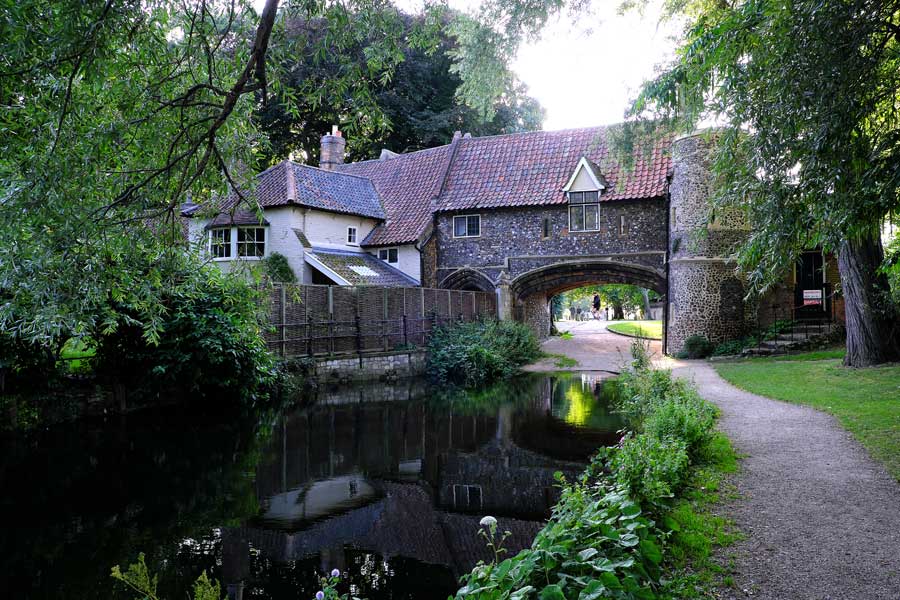
First stop, Pull’s Ferry
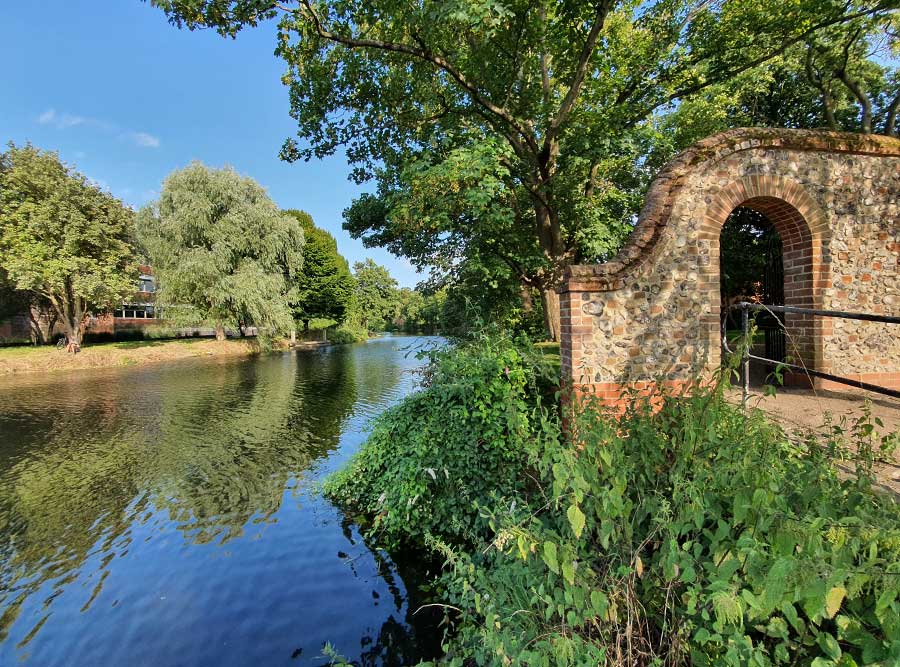
There’s been a river crossing here for centuries. The Normans brought Caen limestone from France up the rivers Yare and Wensum to build the cathedral. The local monks created a canal to run under the arch which meant the stone could be unloaded practically on site.
The landing takes its name from John Pull, who ran the ferry across the Wensum from 1796 to 1841, but the watergate actually dates from the 15th century and a ferry operated there up until 1943.
As I said, Norfolk time!
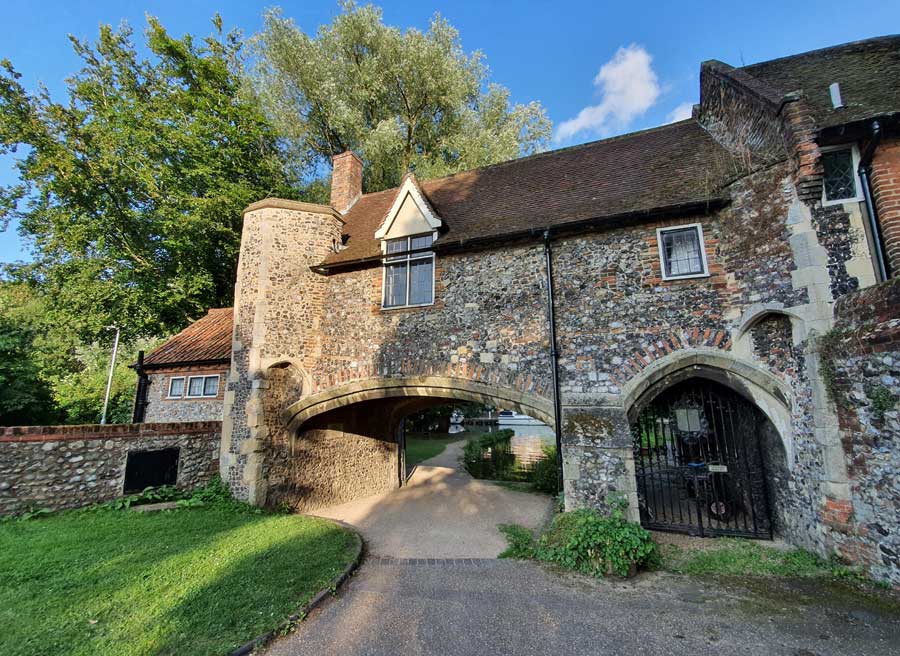
Here we were faced with a choice, continue along the river bank or swing left to visit Norwich Cathedral.
Cathedral Close
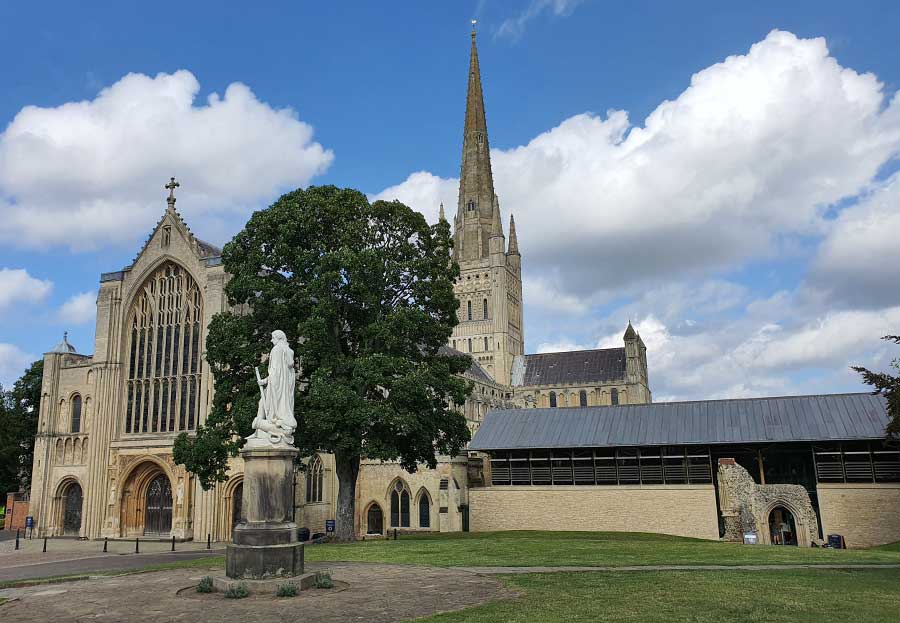
The 44 acres of cathedral grounds are the largest in Britain and the cloisters are the second largest, after Salisbury Cathedral.
Two small churches were demolished to make way for Norwich Cathedral. Work started in 1096 and the main building wasn’t finished until 1145. It was another 335 years before the 315 foot towering stone spire was complete.
And right at the very top is a 264 year old weather cock, recently restored, sparkling in the sunshine.
A little lower down, on a perilously small ledge, peregrine falcons have taken up residence. Several chicks have been successfully raised in the last few years. The Hawk and Owl Trust has cameras there during the breeding season to capture the excitement.
• Hawk and Owl Trust cathedral webcam
Lord Nelson in Norwich
Near the Erpingham Gate entrance to the cathedral grounds you’ll find a statue of Norfolk’s most famous son, Admiral Lord Nelson.
His formative years were spent in North Norfolk but the seafaring hero attended Norwich School in Cathedral Close from the age of 12.
Edith Cavell – nurse and hero
The daughter of a vicar from the Norfolk village of Swardeston, Edith was in charge of a clinic in Brussels when World War I broke out. Working for the Red Cross she treated soldiers from both sides and helped around 200 Allied soldiers escape. For this she was tried for treason and executed.
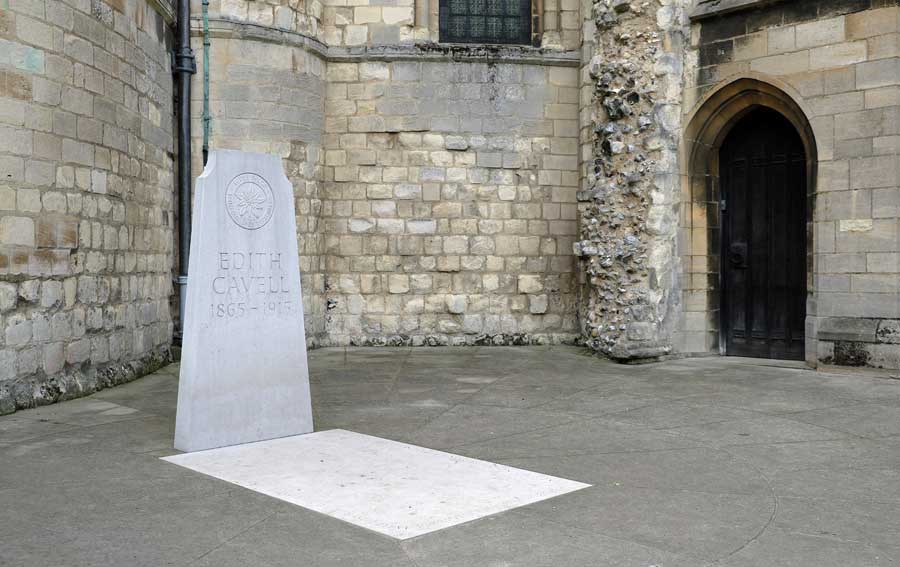
Her body was returned to Britain after the war and reinterred at Life’s Green on the east side of the cathedral.
Inside Norwich cathedral
After a quick coffee in the cathedral refectory café where the cakes looked so inviting, we were ready to head inside.
At the time of our visit Dippy The Dinosaur was ‘on tour’ visiting Norwich Cathedral from his usual home in London’s Natural History Museum. This means access to the cloisters and main nave is restricted until October 2021 unless you’re visiting Dippy.
The queue was fast-moving but very long so we opted to visit only the east end of the cathedral which remains open for worship and tourists.
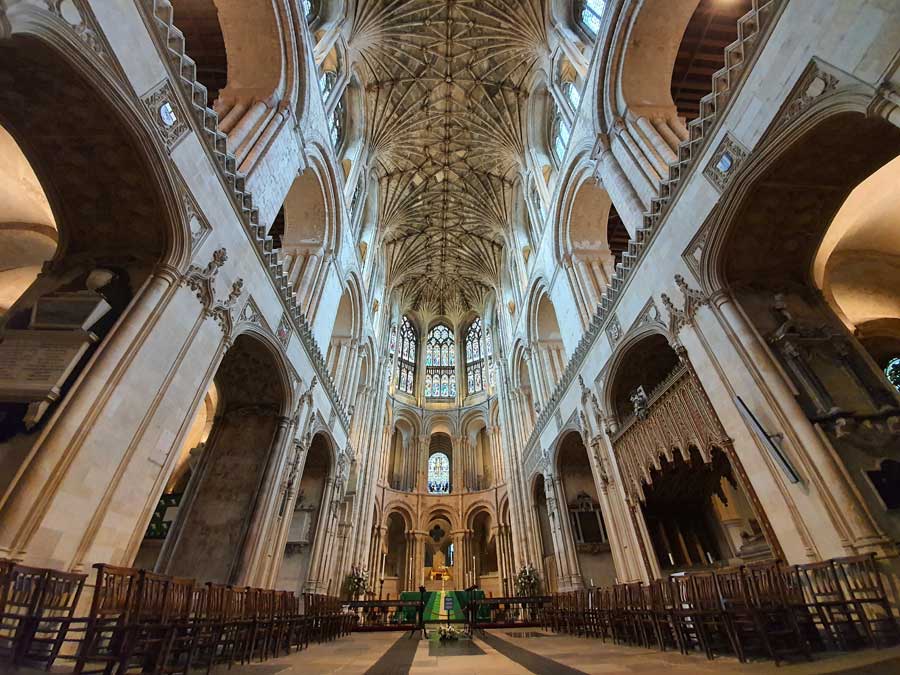
Inside the cathedral is full of treasures, old and new. If your neck’s not too stiff from admiring the spire outside, look up as you enter and you’ll see the largest collection of medieval roof bosses of any cathedral.
There are more than a thousand of them. The earliest ones are in the cloisters and aren’t at all religious. Instead they show a cross-section of medieval society – kings and peasants, musicians and soldiers, craftsmen and merchants. There’s even a ‘green man’ peering out from behind a mask of leaves.
The 225 bosses in the cathedral nave were created in the 15th century when the original wooden roof was replaced with stone vaulting. These tell the story of the Christian world from Creation to Judgement Day.
Exploring the cathedral side chapels
Taking the ambulatory – the corridor that loops around the back of the high altar – we found a number of intriguing and historic items.
There’s the Despenser Retable in St Luke’s chapel. A 14th century painting depicting the death and resurrection of Christ, it was hidden during the Puritan period in the 16th century, nailed upside down to the bottom of a table and forgotten. It was rediscovered by accident in the 1800s and restored to its rightful place.
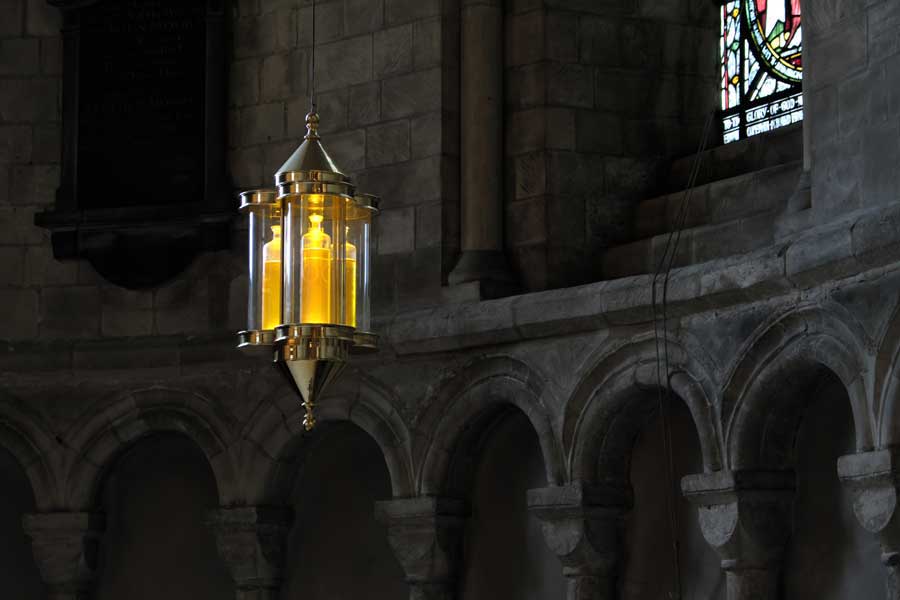
In most churches the container which keeps the oils used in baptisms, consecrations and ordinations is kept in a private area. This Chrismatory is made of silver gilt and glass and contains three vials of oil, hung in full view over the font.
It’s really beautiful.
On the wall just outside the chapel you’ll see an effigy of what is thought to be St Felix who was responsible for bringing Chrsitianity to East Anglia. The carving is nearly 1,000 years old.
Behind the Bishop’s throne above the high altar (only used on very special occasions) there is a tiny recess with a flue. Relics used to be placed there during ceremonies in the belief that their essence would rise and imbue the sitting cleric with additional holiness.
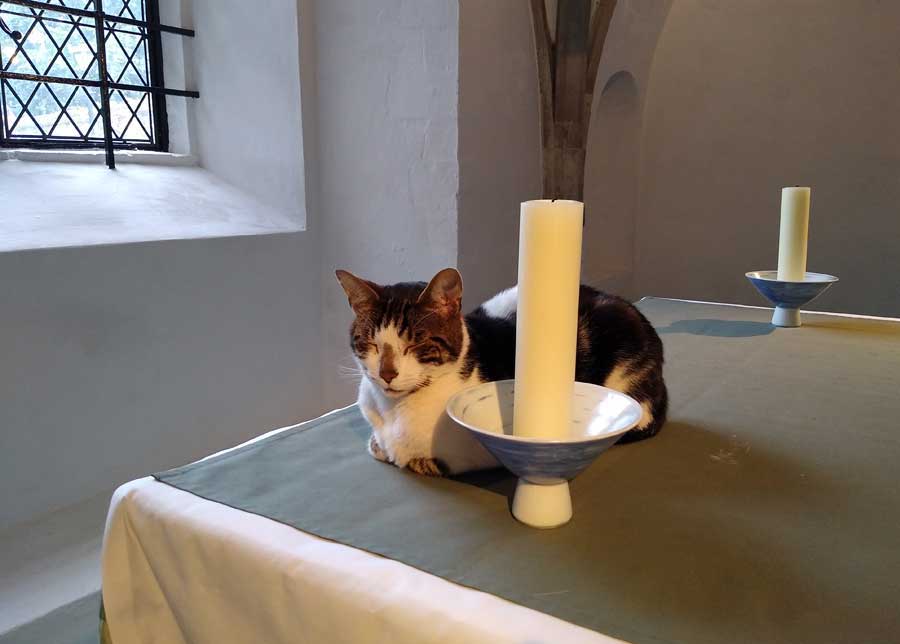
Oh and keep an eye out for the Norwich Cathedral cat as you wander – often to be found resting in quiet places away from the crowds!
Visiting Norwich Cathedral
The cathedral is open for worship and visitors on most days but access to the main nave is only for those visiting Dippy the Dinosaur until October 2021.
Do stop and chat to the volunteer guides – they are full of interesting snippets that aren’t in the guide books and clearly love to share their affection for the cathedral.
For details visit Norwich cathedral website
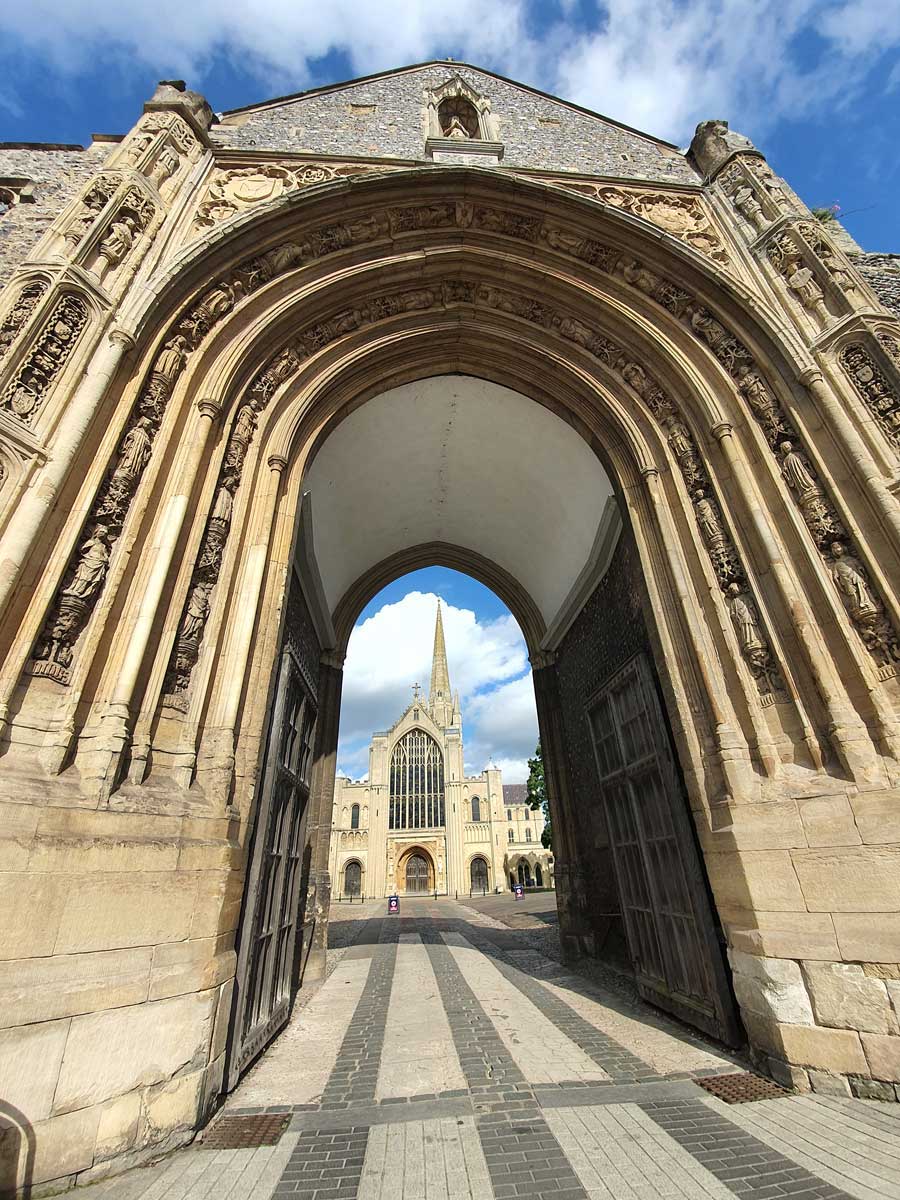
Next stop, one of the oldest and most photographed streets in the city.
Elm Hill
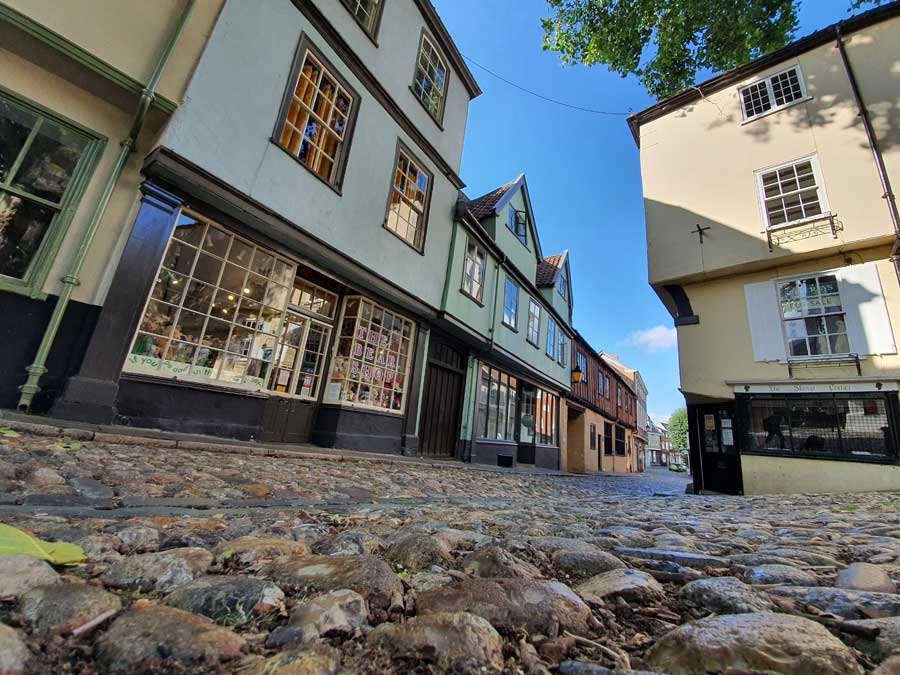
Beloved of film location scouts (check out Netflix’s 2020 festive offering Jingle Jangle and the 2007 film Stardust) this narrow, cobbled street has shops that date back to Tudor times.
The oldest, right on the corner at the top of the road, is The Britons Arms. Built in 1347 it’s thought to be Norwich’s oldest timber frame and thatched building.
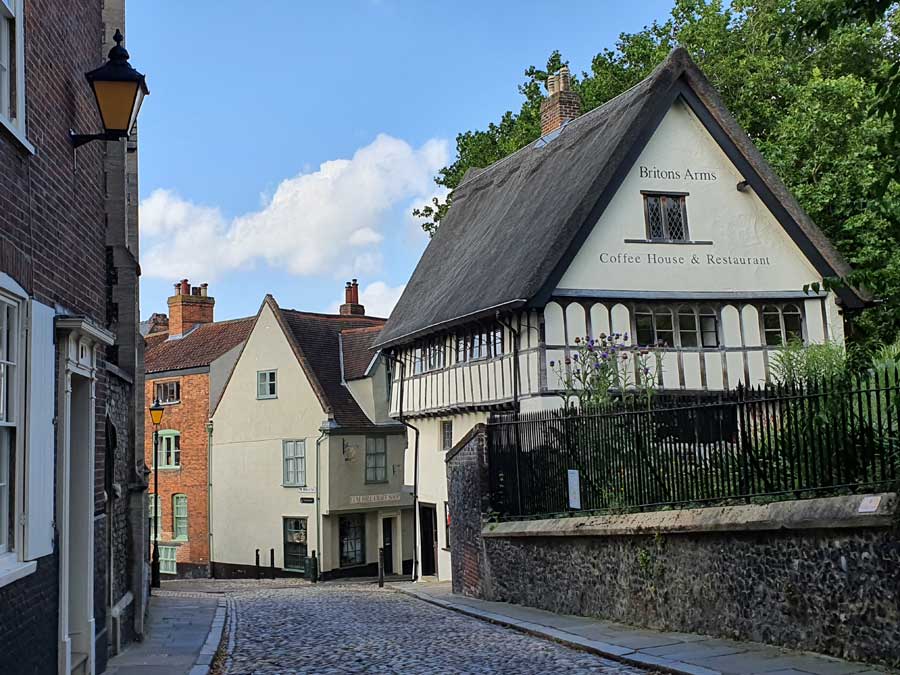
Most of the street’s other buildings were destroyed in a fire in 1507, but shops and houses soon sprang up again and are still in use today. It’s a mooching sort of place; dusty bookshops, sparkling jewellers, a cute teddy bear emporium and of course antiques and collectables make you want to linger.
Sadly the elms that gave the street its name have been wiped out by Dutch Elm disease.
But it’s a photographer’s dream.
Night and day, whatever the season, in all weather’s Elm Hill is just picture postcard pretty.
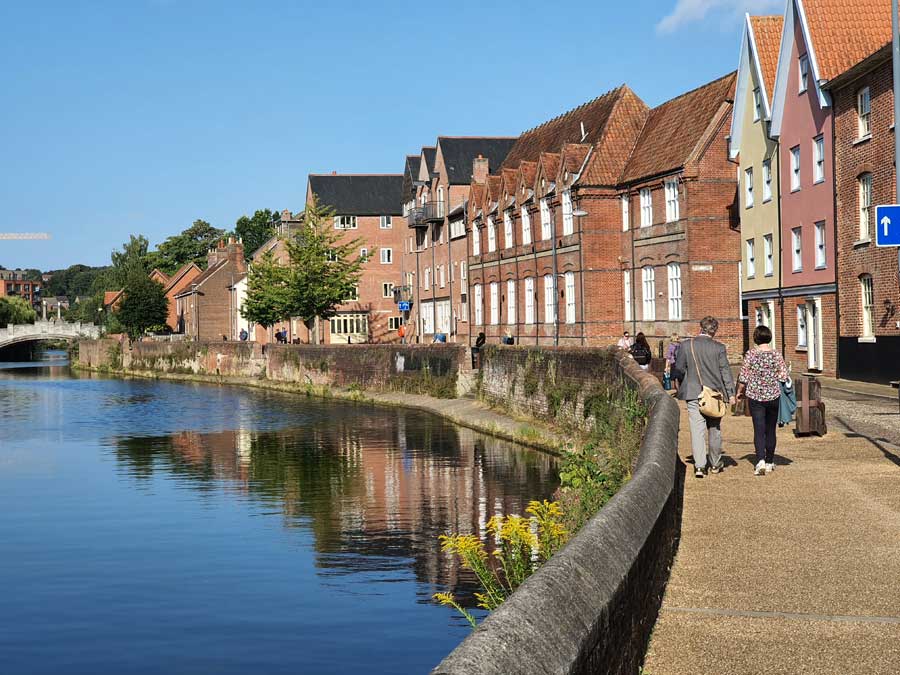
Back to the riverside walk
At the bottom of Elm Hill we turned left and headed for Fye Bridge. It’s one of the oldest river crossings in the city and site of an ancient cucking stool used to punish lawbreakers and other undesirables.
Back down to the riverside path, we passed St James Textile Mill, which was later taken over by local printing firm Jarrolds. Today its office windows look out on the lazy-flowing river below.
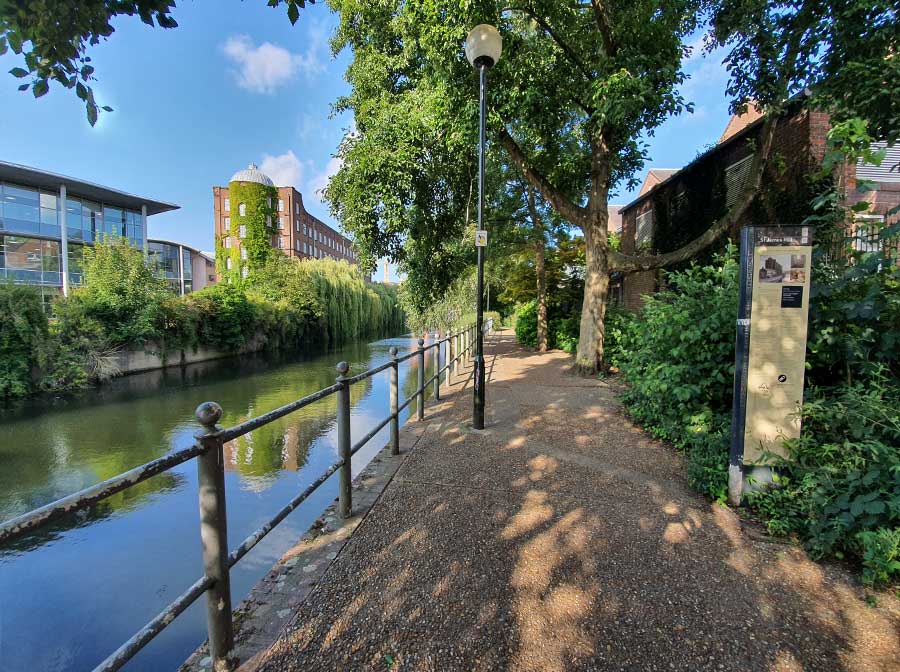
A little further on is a romantic-looking landmark, with a less than romantic name.
Cow Tower
Named because cows used to graze the meadows nearby, this artillery tower was once a vital part of the city’s defences.
From its heights a garrison of gunners could defended the city with cannon while archers rained arrows down upon any attackers.
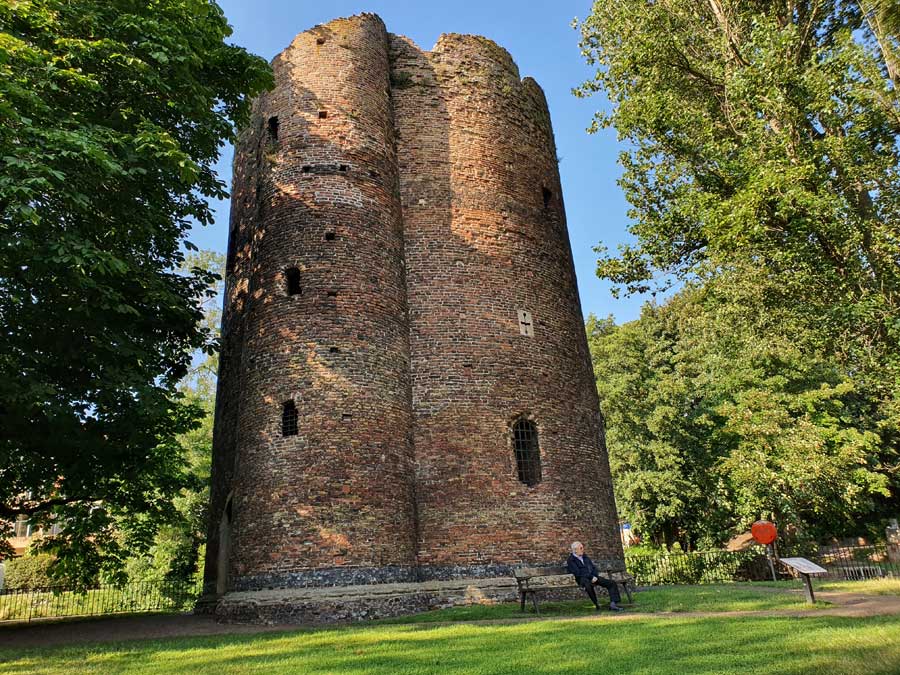
Today it stands, a little crumbling and forlorn but peaceful, amongst the trees.
Bishop Bridge
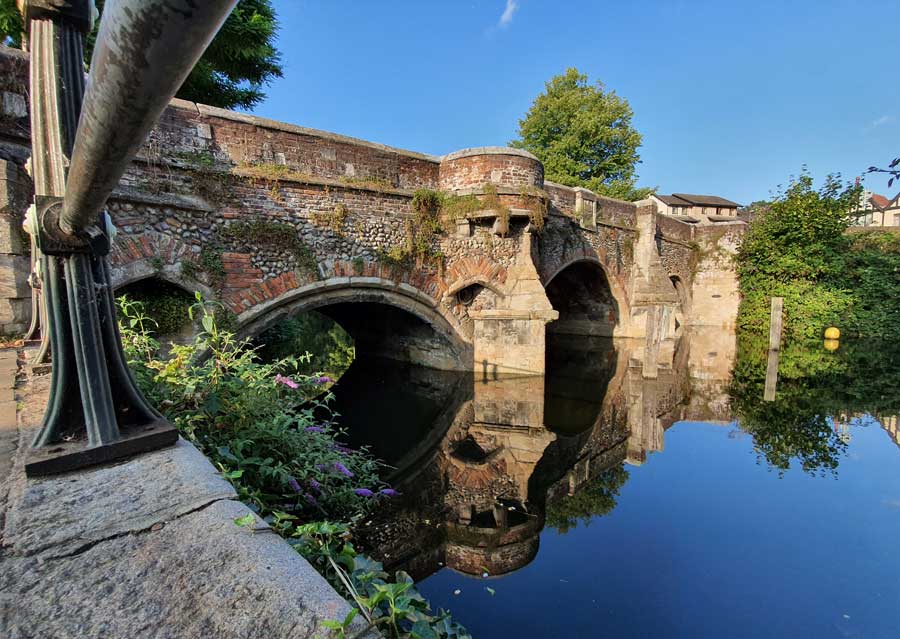
One of the oldest medieval bridges in England. Built in 1340 on the site of an even older crossing, the monks were given permisison for a gatehouse so they could extract tolls from travellers.
Robert Kett took the bridge during the ill-fated Kett’s Rebellion and Queen Elizabeth I passed across Bishop Bridge in 1578, on her way to visit the Earl of Surrey.
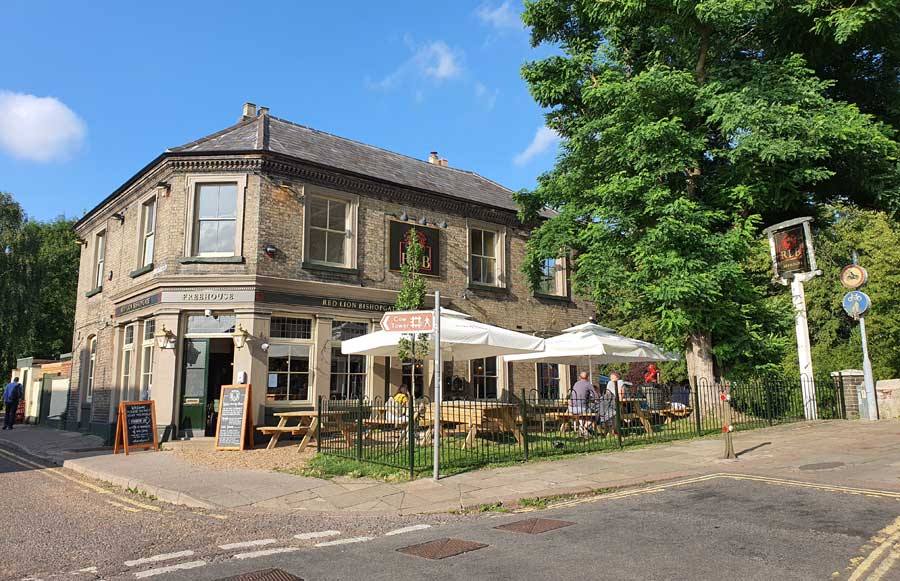
The arms of Norwich city, a lion and castle, are carved over the central arch of the bridge and the nearby Red Lion pub takes its name from the insignia.
Just a short diversion away from the riverbank is the tiny, historic oasis of Kett’s Heights.
Here’s where Kett and his thousands of rebels set up camp before storming the city in July 1549. His followers, enraged by the hardship that the enclosure of common land had caused, took up arms against their overlords.
The rebels were initially successful, crossing Bishop Bridge and taking the castle. But the Earl of Warwick fought back and Kett was captured, tried for treason and hanged from the castle walls.
We didn’t make that detour. Instead we crossed the road and carried on, heading south along the riverbank, back to Pull’s Ferry and the station.
Getting to Norwich
Greater Anglia trains run fast and regular from London’s Liverpool Street and there are good services from the popular coastal towns of Cromer and Great Yarmouth.
Road links are great via the M11, but a little slower going if you’re coming up the A12. And once you get into the countryside, expect winding lanes, slow moving traffic and the occasional farm vehicle, especially around harvest time.
Norwich is a city but its roots are true, rural Norfolk.
For the latest on what’s happening in the city see the Visit Norwich website

All photographs copyright ©rosemaryandporkbelly
Where to next?
• Beautiful places in Britain
• Things to see in Chichester for free
• Dog-friendly holiday cottages UK