
So long, Frank Lloyd Wright
I can’t believe your song is gone so soon
I barely learned the tune
So soon – Simon and Garfunkel, 1970
To be honest, before our American Road Trip, the great Frank Lloyd Wright was no more to me than that song and a fiendishly difficult jigsaw puzzle from a family holiday long ago.
Now I’ve been to Fallingwater I understand that he was, quite simply, a genius.

Fallingwater
Fallingwater is stunning, iconic, extraordinary, avant-garde – the superlatives roll off everyone’s tongues, and they are well deserved.
And yet there is something strange and a little uncomfortable about this beautiful place.

The house was commissioned by the wealthy Kaufmanns of Pittsburgh as their summer retreat in the beautiful surroundings of Bear Run River, where crystal clear water cascades in a series of small waterfalls through thickly wooded hills.
The family were impressed by Frank’s design for Mr Kaufmann’s office in the city and gave him free rein.
Most people would have placed the residence across from the stream so the occupants could enjoy views of the waterfalls.
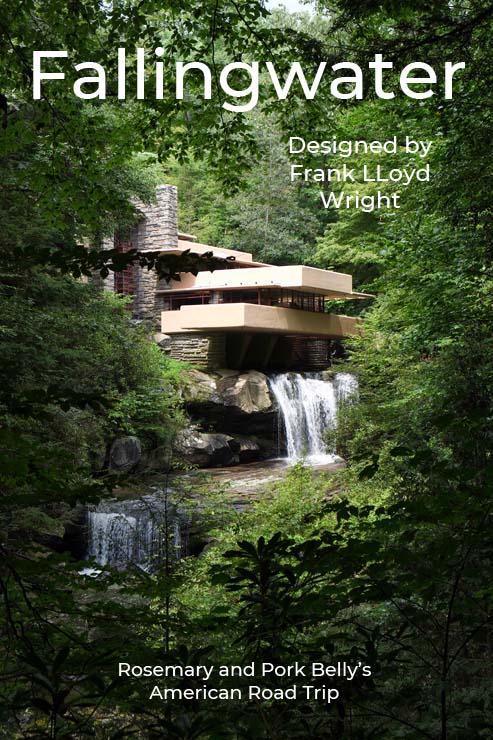
But no, Frank wouldn’t agree to anything so ordinary and designed a building set directly into the rock face and cantilevered over the stream.
Organic architecture
And for a place designed and built in the 1930s, it was way ahead of its time with uplighting, hidden central heating and perfect plumbing.
Our tour starts in the visitor centre with a guide giving us potted history of the site, the Kaufmanns, Edgar and Liliane and their son Edgar Junior, and the strict rules that govern the visit.
Funded only by ticket sales and donations, the house is constantly being repaired and nothing is allowed to threaten its preservation.
You can only view Fallingwater as part of a small group with a timed entrance.
Bags of any size are banned, and you can only wander free in the grounds. Everywhere else you are monitored, guided, shepherded.

Stone and water
Ironically, given its location on a mill race, water is its biggest enemy. Personal umbrellas have to be checked in at reception, and instead we’re issued with huge green brollies at strategic points to make sure stray drips don’t ruin the interior.
A short walk along a gravelled path lined with towering rhododendron bushes, a mass of colour in early summer but today glossily dark and a little foreboding, and we get our first glimpse of the house.
Terraces of ochre yellow draw thick lines through the greenery, while patches of the rock face behind peep through the summer leaves. Fallingwater is set in stone, water coursing above and below and the jutting, staggered terraces mimic that flow.
At the small bridge that crosses the stream we are greeted by another guide, Gaylen, who enthusiastically and almost reverentially shows us over the place.
Photographs indoors are forbidden and of course nothing can be touched. We walk under the curving covered way to the main entrance, snug against the rock face.
Leaving our umbrellas to drip, drip, drip harmlessly onto the path, we enter the house.
There are tours ahead of us, tours behind, but under Gaylen’s informative and relaxed story-telling our small group feels like honoured guests in the Kaufmann’s summer hideaway.

Frank Lloyd Wright
Frank, at 67, was considered to be at the end of his career when he accepted the commission. Instead, he went on to create this masterpiece, way beyond the Kaufmann’s original budget but a place that put him firmly back as a leading light of architecture.
The house is stunning, iconic, extraordinary, avant-garde – everything everyone says. A short flight of steps leads to the spacious open-plan living and dining area. Stone floors stretch across the whole of the ground floor, if you can call it ground, suspended as it is above the river below.
The windows fill three sides with uninterrupted views of the woods and there are no frames to mar the aspect, each pane of glass butts up directly against the other.

Low benches with temptingly soft-looking cushions run around the room, with hidden heating panels behind each section.
The colours are muted, autumnal; shades of beige, the same yellow-ochre as outside and Frank’s favourite Cherokee Red.
Over the conversation and exclamations of the tours before and behind you can still make out the hushed rushing water, a sound that intensifies as Gaylen demonstrates the room’s most innovative feature – a glass panel which, slid seamlessly back on itself, allows guests to descend a short stairway to dabble their feet in the icy-fresh water below or even sit and peacefully fish.
Nature within and without
The room opens up onto the largest of the outside terraces with a low parapet which is all that separates you from the trees and the tumbling stream several feet below.
At the opposite end of the room is the dining area, dominated by a huge fireplace and a slab of rock from the cliffside which Frank simply incorporated into the room’s design. Frank never wasted a single natural resource.

Gaylen invites us to imagine dining here, sipping mulled wine or cider prepared in a huge iron pot suspended from the ceiling and swung over the flames.
Sadly, the kitchen, the heart of any home, is now converted to offices and out of bounds for visitors.
After drinking in our fill of the room, Gaylen leads us up to the next level. The stairs are narrow and the corridors only wide enough for single file access.
Another guide stands guard at the junction between the bedrooms to ensure no two tours meet in an impasse.
Compress and release
This is all part of Frank’s design, to experience the “compress and release” of being squeezed by the roof and walls until you burst out into the open room and receive the full force of nature’s glory.
The bedrooms are compact, low ceilinged and subtly illuminated. Each room has its own outdoor terrace and the windows cleverly open out to allow in the great outdoors. Again, there are no frames to impede the view.
Frank hated clutter and wouldn’t design attics or basements in any of his houses. He seemed to have the same antipathy to corners, creating the most extraordinary way of opening out each window in sections, from floor to ceiling.
Not just for the glory of experiencing nature, but also to let in a cooling breeze in the days before air conditioning.
It’s impressive. And slightly claustrophobic.

The bathrooms are examples of modernity with mixer taps, almost unheard of when the house was completed in 1937. I envied the shower heads the size of sunflowers rearing above the baths – the ultimate power shower before the phrase was even thought of.
The Kaufmann’s adored the place and spent as much time as they could at Fallingwater.
Edgar Junior continued to use it as a weekend retreat until the late sixties before generously donating the house, most of its contents and around 1,500 acres of land to the Western Pennsylvania Conservancy.
He retained an interest in the place, often acting incognito as a guide, until his death in 1989.
Famous guests
In its heyday, the family played host to many famous guests and even had Frank design a separate guest house above the main home. Albert Einstein, Diego Rivera and Frida Kahlo were amongst their most illustrious visitors.
As I take another long look at the main room on our way out, I can imagine an elegant figure, silhouetted against the low parapet, smoking a cigarette in a long, tapering holder before returning for an evening of witty and erudite dinner conversation.
Would I like to be a guest at Fallingwater?
For a leisurely Sunday lunch and a gloriously lazy afternoon watching the light on the leaves slowly soften and dim?
Yes.
For a night in one of the dark-stained, low-ceilinged, compressed bedrooms, even with the release of those spectacular frameless windows?
No thanks.
More information about Fallingwater
The house is situated in the Laurel Highlands in western Pennsylvania, an area well worth visiting for its natural beauty and wildlife.
Do read the guidelines for visiting on their website and note that all tours have to be booked in advance. Children under the age of 6 are not permitted on the tours for safety reasons.
• Fallingwater website
While you are in the area, you can tour another Frank Lloyd Wright building, Kentuck Knob. Built on a less grand scale but still a fascinating example of architecture and nature in harmony, it’s also worth a visit and has the most amazing view of the Laurel Highlands. More details on their website.
• Kentuck Knob website
Where to next?
• Anjou delight – Plantagenets, castles and wine
• Going underground at Château de Brézé
• There’s a ghost in my house
I’ve loved Frank Lloyd Wright’s architecture ever since I studied his work at uni and visited the Guggenheim in NYC. Just a shame I haven’t had the chance to see much of it in the flesh! Would loved to visit Falling Water!
His work is quite extraordinary isn’t it. We loved Kentuck Knob too, though very different to Fallingwater, but we’ve not made it to the Guggenheim…yet!
We are so in love with Fallingwater! I had very little knowledge of FLW until our sons became obsessed with him at age 4. We thought it was weird that 4 year olds were obsessed with an architect- but they sure did pick a great one. We’ve enjoyed visiting his work all over the country! I’d sure love to see Fallingwater right now with all the autumn colors!!
Sometimes 4 year olds are wise beyond their years! Slightly envious that you’ve seen so many FLW places. Did you get to see Kentuck Knob?
I’d love to see them both in the snow and ice.
I’ve always wanted to visit this house and I only live a few hours away, but I’m annoyed that we aren’t allowed to take photos in there.
It is worth a visit, definitely. You can book for an in-depth tour, which costs more (currently $80) but allows you to take photos for your own personal use. Most people go on the ordinary guided tour (currently $30) as we did. If you do decide to go, let us know what you think.