
How many witches were killed during the Salem Witch Trials?
Of course, that’s a trick question.
The answer is none.
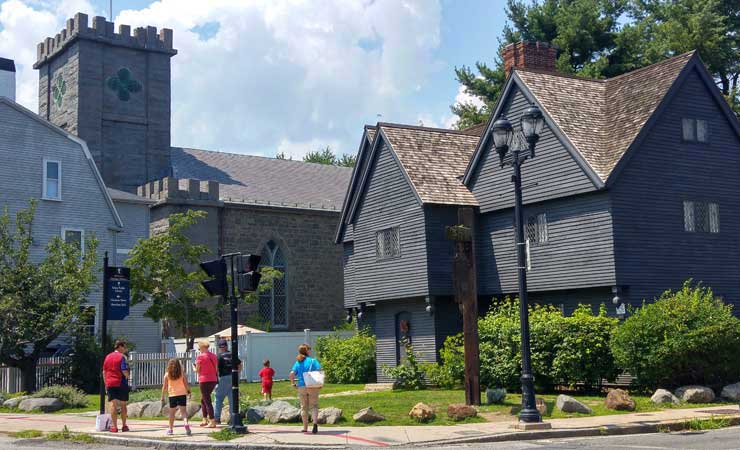
But 14 innocent women and five men were hanged, one man was pressed to death, and at least 5 people died in jail awaiting trial.
The strange story of a community which turned in on itself has fascinated people for years, spawning a raft of books, films and Halloween scare stories.
The pretty little New England town just can’t shake off its witchy past.
Not that it really tries.
The Salem Police and Fire Departments’ logo is a witch on a broomstick, and they say they serve The Witch City.
And along Essex Street every other shop has something occult to offer, from dribbly candles through crystals and tarot cards to full-blown spell books.

Myths and Misconceptions
But there’s so much more to Salem than bell, book and candle, and the real history is stranger than any fiction.
We took the Myths and Misconceptions tour run by Essex National Heritage, a walk which aims to lay to rest some of the more lurid of the Salem tales.
The tour takes you to three of the key locations from the time of the Witch Trials – the Old Burying Point Cemetery, the Witch Trials Memorial and the site of the original 17th century jail.
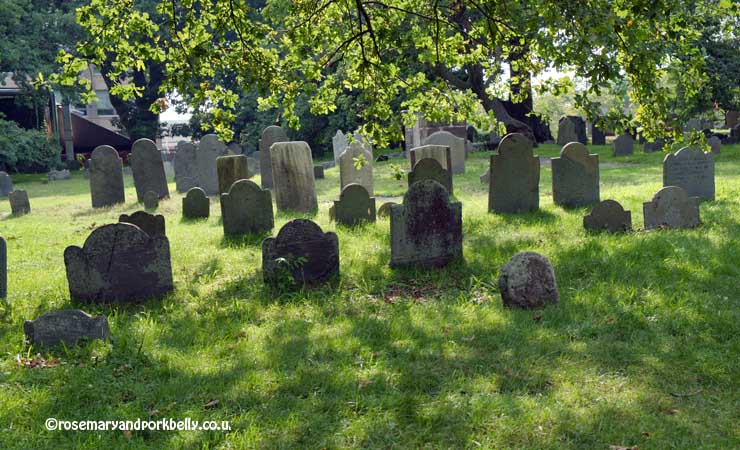
Walking tour of Salem
We gather at the Visitor Information Centre to meet our guide.
She is full of enthusiasm and knowledge, using visual aids to help us understand the geography of the time and the mindset of the early settlers.
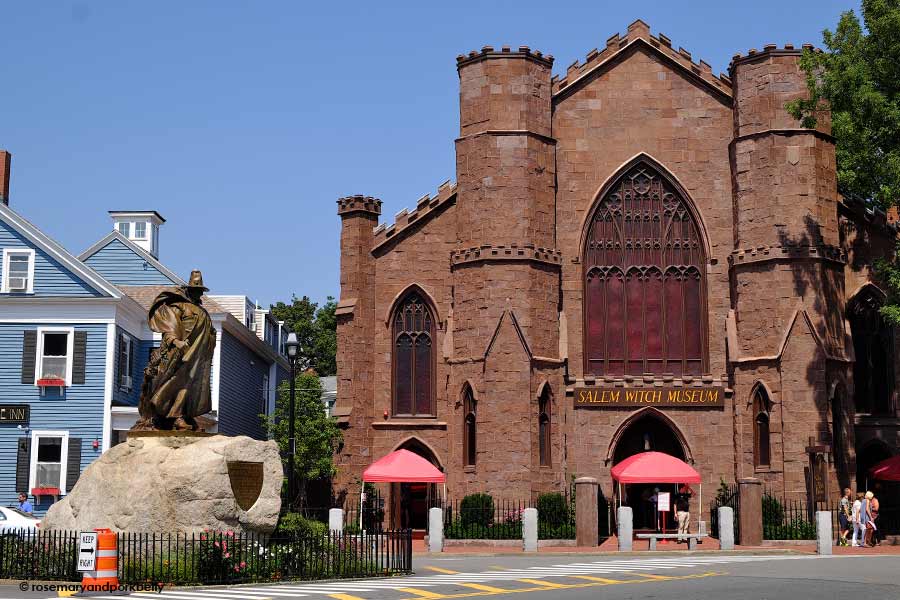
Established in 1626 by Roger Conant, a group of immigrants who’d worked their way down from the coast at Cape Ann decided to stay while their fellows moved further inland. They named the place Salem, which is Hebrew for peace, and began to carve out a new life for themselves.
A statue of Roger Conant stands outside the Salem Witch Museum, and maybe because of the statue’s hat and cloak, he is sometimes mistaken for a participant in the Salem witch trials.
It wasn’t until the spring of 1692 when something weird began to happen. A group of young girls claimed to be possessed by the devil and accused several local women of witchcraft.
Knowing the historical context helps understand what followed. Belief in the supernatural and the ability of the devil to give certain people the power to harm others in return for their loyalty was widespread.
Life was tough for the early settlers. They battled diseases, lived in fear of attacks from Native American tribes, and the usual “town versus country” divide had already sprung up with simmering tensions about who was getting rich and who wasn’t.
When tragedy struck a household – death, disease or miscarriage – it would often be seen as God’s punishment for unrighteousness.
But even given those hard-held views, what happened in Salem was extraordinary.
Witch-hunting hysteria

A wave of witch-hunting hysteria spread throughout the area, and a special court convened in Salem to hear the cases.
The first convicted witch, Bridget Bishop, was hanged that June.
Eighteen others followed Bishop to Salem’s Gallows Hill, while around 150 more men, women and children were accused over the next few months.
Strolling through the town it was clear much has changed since that turbulent time. It’s now a modern and pleasant place to visit.
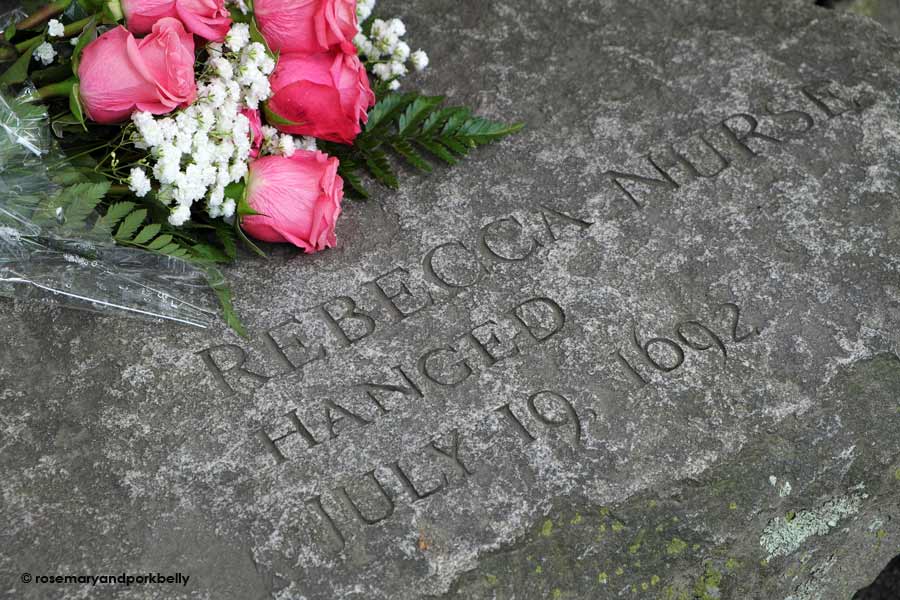
And yet it seems it cannot quite shake-off the awkwardness of municipal shame.
Our guide was knowledgeable about the customs and mindset of the time period and the oddest aspects of the trials.
We were invited to reflect on the human tragedy and not pass judgement.
The tour stretched well beyond the hour as we peppered her with questions and our own thoughts on what really went on.
What are the facts about the Salem Witch Trials?
Although known as the Salem Witch Trials, most of the hearings were conducted in a variety of locations across the whole district. But the most famous were the Court of Oyer and Terminer held in Salem Town itself.
It’s almost impossible to say exactly what went on, and theories abound.
Was it mass hysteria?
Religious extremism?
Political intrigue?
Or basic human greed?
What’s clear is that the system of due process, so beloved by the early American settlers as a pattern card for freedom and toleration, completely broke down.
It was only for a matter of months, but the harm it did cannot be underestimated. It took until the early 2000s before all the victims were completely exonerated.
The memorial is a poignant reminder of what happens when a community turns in on itself. A low wall separates it from the graveyard, with a stone bench for each of the victims.
Their last words are carved into the pavement, deliberately cut off by the wall, to reflect how their lives were cut short.
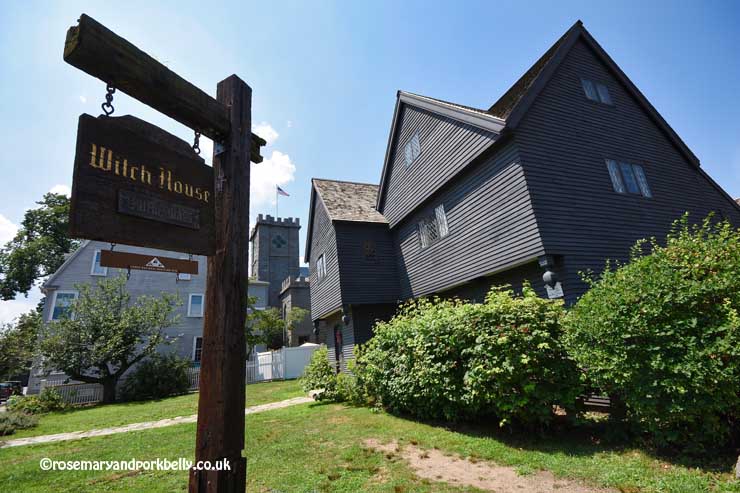
Witch trials judge
Judge Jonathan Corwin’s house still stands at the end of Essex Street. It’s not included on the tour, but you can visit it yourself.
In 1692, it was the home of a wealthy merchant who, as a member of Salem’s elite, had to serve on the town committees. He was one of the judges chosen for the soon-to-be-infamous trials.
There’s more to Salem than the Witch Trials
There’s an undercurrent of witchyness everywhere you go and if hauntings are your thing two of the hotels have a reputation for ghostly goings-on, some of them very convincing.
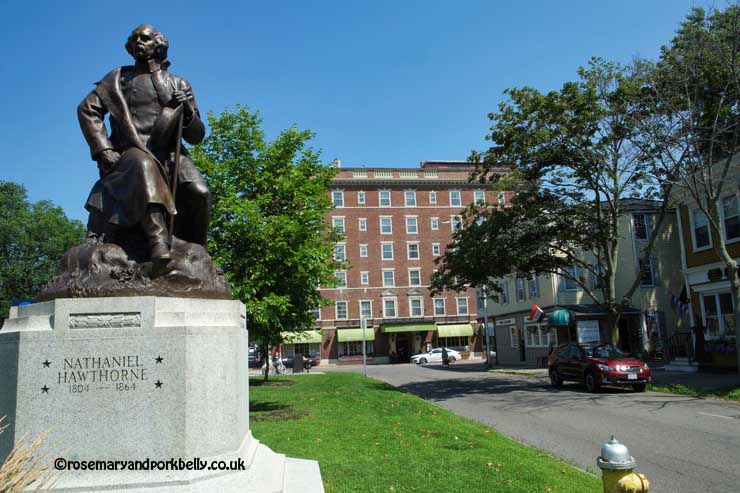
The town’s most famous resident, the writer Nathaniel Hawthorne, has a hotel named after him and a huge statue in front. He was the direct descendant of John Hathorne, the only judge at the witch trials who didn’t later say sorry for his actions.
But Nathaniel’s part-time job as surveyor and inspector of revenue for the Port of Salem is equally fascinating.
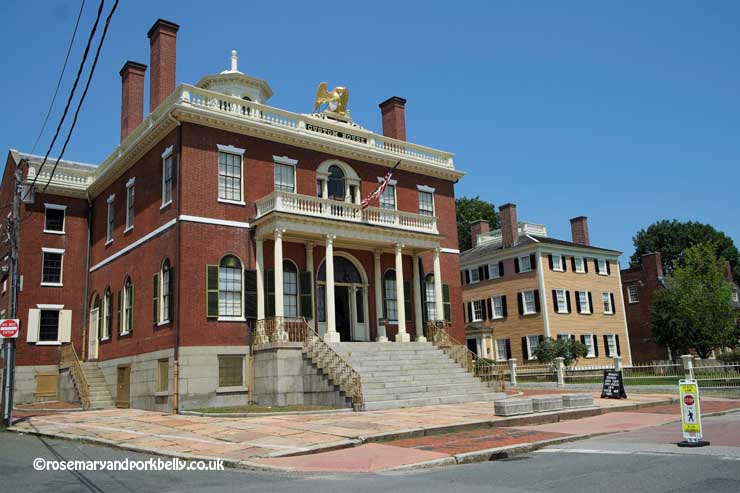
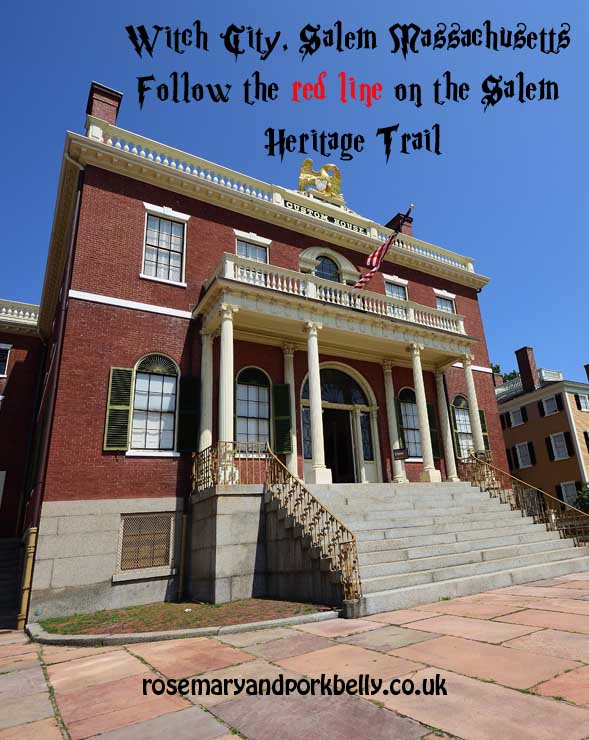
A tour of the old Custom House and a wander around the reconstructed homes on the water’s edge recall its maritime trade history.
These are self-guided tours with plenty of helpful information boards. Or you can chat to one of the National Park Rangers to get the low-down on how the once bustling port generated millions of dollars for the new US government by taxing incoming cargoes.
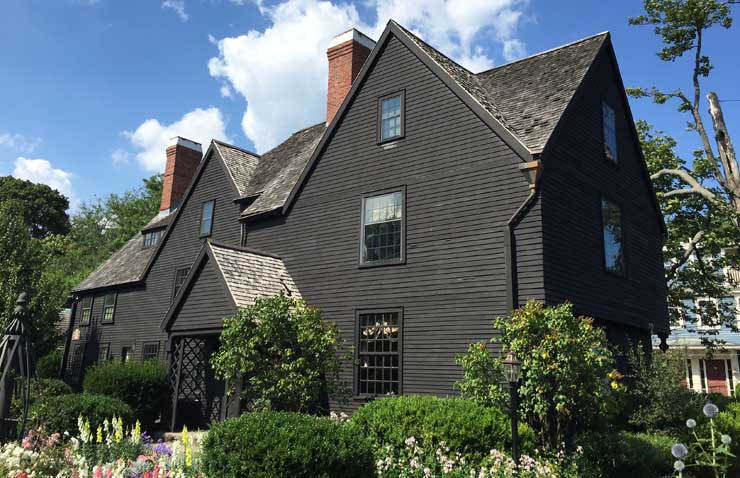
Nearby is the House of the Seven Gables, made famous in Hawthone’s gothic novel of the same name, which is open to the public for guided tours.
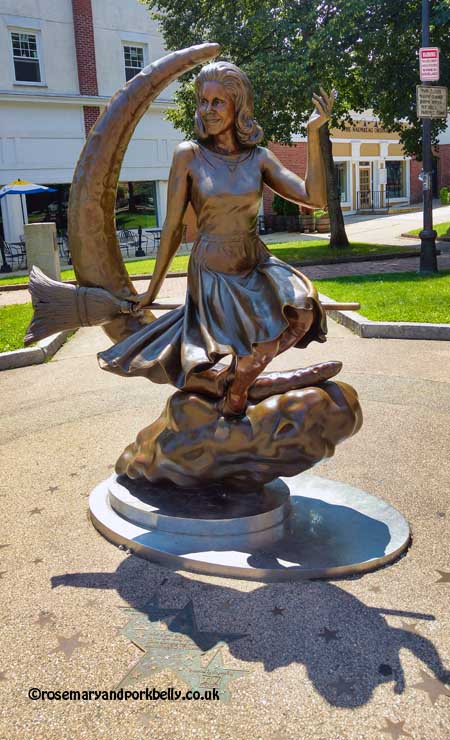
There’s also a statue marking the town’s links to the popular TV show Bewitched, which filmed episodes here in 1970.
Some townsfolk are not happy with the likeness of Elizabeth Montgomery in her role as Samantha, and it has to be said, it doesn’t do the actress justice.
Finally, if you don’t want to book a tour, simply follow the red line on the pavements, and you’ll be tracing the steps on the Salem Heritage Trail.
More information about Salem, Massachusetts
The Essex National Heritage Area website is a good source of facts and figures about the region.
And the Salem Tourist website provides an excellent overview of everything the area has to offer from beaches, boats and B&Bs to supplies for the modern witch. And of course the place goes wild at Halloween, so book early!
Seduced by Salem, but no budget? See if Pork Belly’s competitions page has a trip to win.
Where to next?
• Ghosts and Gravestones tour of Boston
• Lost Gardens of Heligan
• Rhubarb and custard cake