
Here we go again … it looks like the much publicised launch of the new Entry Exit system for Europe has been delayed once more.
Back in August, the date was set for Sunday 10 November 2024, but since then there’ve been rumours that not every European country was ready for implementation and as of today the official EES website simply states that EES is ‘not currently in operation.’
As we said when we originally wrote this article, there’s bound to be some teething problems, and there’s even talk now of a phased approach, bringing in the changes as each country is ready, rather than a Europe-wide launch.
But whatever happens in the next few months, EES is coming, and travellers from all non-EU countries, including the UK, will need to be ready for extra checks each time they cross a border into or out of the Schengen area.
And don’t forget, another change is coming. The new visa waiver system, ETIAS, which has also been in the news for ages, should go live in November 2025.
So what does it all mean?
How will the Entry Exit System work?
Travellers will need to scan their passports or other travel documents at an automated self-service kiosk prior to crossing the border.
It will apply to both short-stay visa holders and visa exempt travellers, and will happen every time they cross an EU external border.
It also applies to travellers heading for non-EU countries that are in the Schengen area – Iceland, Switzerland, Norway and Lichtenstein.
The system records the name, type of travel document, biometric data (fingerprints or a facial scan) and the date and place of entry and exit.
If you are not willing to provide fingerprints or a photo scan, you will not be allowed to enter the EU, although there are some exceptions; for example people with residency or long-stay visas.
It will also record anyone who has been refused entry previously, and make it easier to identify travellers who have no right to enter, who have stayed in European countries for too long, or are attempting to travel with fake documents.
EES replaces the current system of manual stamping of passports, and in theory should speed things up.
The only exceptions to the new system are Ireland and Cyprus where, despite being part of the EU, passports will continue to be stamped.
Why is the Entry Exit System for Europe being introduced?
The European Commission has identified four issues with the current border crossing procedure:
• Increasing numbers of travellers. Around 300 million third-country nationals are expected to cross into and out of the Schengen area in the year 2025.
• The current system of manual passport checks and stamping is slow and open to mistakes, especially around identifying non-Europeans visiting for more than 90 days in any 180 days.
• The current system cannot easily report over-stayers.
• The need for enhanced technology to reinforce the fight against international criminality, terrorism and other security threats.
When will the new Entry Exit System for Europe start?
It’s been plagued with delays, having originally been slated to begin in 2022, but it remains unclear when it will actually come in to force.
The UK travel industry is gearing up for it, and all non-EU travellers need to be prepared for delays the first time they use the system.
So what’s the problem with the Entry Exit System?
The issue with EES is with the time taken to complete all the checks on any traveller’s first entry into a European country.
The scanning and recording of biometrics and facial recognition will take longer to complete.
Travellers will also need to answer some questions about their journey and, as this has to be done in person at the point of departure, there will inevitably be bottlenecks.
The good news is that registration lasts three years, so frequent travellers will get through more quickly.
There are plans for an app, to allow the majority of travellers to pre-register before they head off, but there is no date yet confirmed for when that app will be up and running.
Some airlines have raised concerns because if they have any queries about a passenger’s right to travel, they will have to submit a verification query to the EES at least 48 hours before a scheduled departure, to find out if a traveller’s OK or not OK. They’re worried this will hit late ticket sales and cause confusion for passengers with last-minute travel plans.
What will happen when the Entry Exit System is introduced?
The travel industry is gearing up for the change, and most operators are providing additional gates and staff to help smooth the process.
Eurostar already has extra kiosks at St Pancras International and more staff on hand to help at busy times.
They’re also creating an ‘overflow room’ on the mezzanine level for when it gets really busy.
The cost of these improvements is around £8.5 million, and they estimate it will take around 7 minutes to register each new passenger, but Eurostar is confident they can keep check-in times to the current system of between 45 and 90 minutes before boarding.
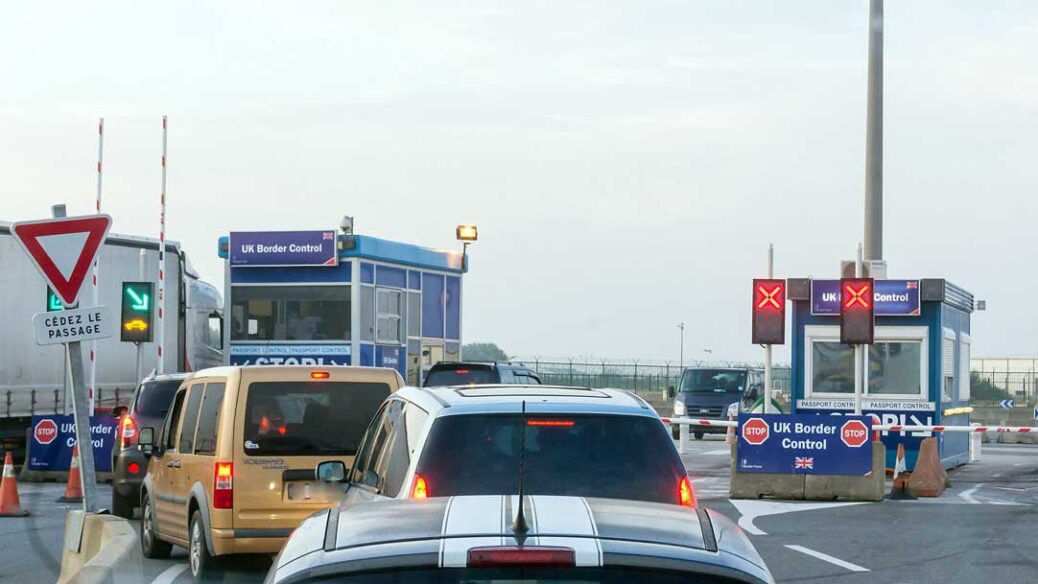
New processing areas at Folkestone and Calais
Eurotunnel is building new processing areas at Folkestone and Calais, at the cost of around £70 million.
We took Le Shuttle to France in August and found the outward trip (on a Thursday night) to be seamless, but imagine that will change under the new system.
Interestingly, the return (on a Saturday night) took a little longer at UK border control in Calais where we were quizzed on where we’d been, how long for and where we were heading. Perhaps the new system will ease that?
It’s going to be harder for the Port of Dover, as it already has space constraints and is expecting queues when EES is introduced.
There are plans to create more dock space through sea reclamation at Dover, but this will take time to complete in an area that already sees huge queues at busy times.
Coaches will be sent to a separate area for processing, away from the main check-in area, and passengers will have to disembark, use the new kiosks to register, then get back on their coach.
Cars will use the current lane system, but an agent will bring a tablet to the vehicle to complete the necessary checks. It’s expected this will take about 5 minutes per person for their first trip, doubling the current processing time.
By summer 2025 the port hopes to improve the system for cars, but additional holding space for busy times and emergencies won’t be completed until 2027.

The original hope was to introduce EES in the autumn, before the Christmas holiday rush, any teething problems would be ironed out before things get too busy. That now seems in doubt.
After launch a six month ‘grace’ period has been negotiated which means, if things get busy, some restrictions can be lifted to allow passengers to board more quickly and ease congestion.
Meanwhile, the introduction of the European Travel Information and Authorisation System (ETIAS), an electronic authorisation system for visa-exempt visitors travelling to the Schengen Area, has been delayed even further until November 2025.
With all the repeated delays, cross border conversations and technology updates, nothing is set in stone.
So we say once again, Watch This Space, and we’ll let you know what we find when we next travel to Europe.
Where can I find more info on the Entry Exit System?
For up-to-date information on the introduction of the Entry Exit System for Europe, see their website.
For updates on ETIAS see the official website.
And for all UK residents travelling abroad, we can’t stress enough how important it is to always check the official Foreign Travel Advice for the countries you are visiting.
Where to next?
• The problem with passports
• What to do when you win a holiday competition
• Flight free travel
The system is fine for Airports, but on a ferry, if everyone has to have a photo taken and fingerprints taken, that means everyone has to get out of the car to be processed, this will add at least 5 to 10 Mins for every car ! multiply that by 300 cars on a ferry!
Hi Steve, the ferry companies and Eurotunnel say they’re doing what they can to make it as painless as possible, including bringing a tablet to the car to speed things up, but yes, it could take around five minutes to register, depending on how many passengers are in the vehicle. The only good news is that the details are on file for three years, so repeat journeys should be quicker. At the moment it’s due to start in October, but who knows …