

We’re travelling in the pre-digital age and the sun is shining brightly in the clear, autumnal sky over Brisbane, Australia.
Our essentials safely stowed, and our backpacks stuffed under the hostel beds, we head briskly to the city centre. We’re on a mission – to meet the man behind the upcoming Expo exhibition and share his vision for Queensland’s future.
But first, after several long days on the road, we owe ourselves a treat.
Stopping at the central Post Office we wait in line in the vast, old colonial style building to pick up two bulging packs of letters and parcels.
Then it’s round the corner to Dunkin’ Donuts for a mega-box, coffee and time to sit and savour the news.
There’s excitement mixed with a tiny twinge of home-sickness as we lay out the envelopes in chronological order and indulge in an orgy of reading, accompanied by slurps of hot coffee and the sweet, sugary buns.

Back-packing in the pre-digital age
It’s 1988, and we are backpacking in this pre-digital age.
The internet was still in nappies learning how to crawl, mobile phones were rare (and the size of a brick) and nobody had coined the word “blog”.
Our world is still a big and beautiful place to explore but in those days “getting away from it all” was easier. The technology to shrink the miles simply didn’t exist.

Travels with family and friends
Before I met Pork Belly my travelling adventures had been short, close to home and just for fun.
My first trip abroad came when I was 16 and my parents saved up for one last family holiday before my older brother flew the nest. We spent a week in a tiny whitewashed villa on the island of Menorca. We hired bikes, drank cheap wine and ate paella.
I felt so sophisticated.
Fast-forward five years, and I’m camping in Greece with Uni friends, escaping the long wait for degree results and living on stale bread and Primula cheese.
A few organised trips to European cities followed while I found my travelling feet and learned about passport control, customs, travellers cheques and currency conversion – a struggling radio journalist didn’t earn enough to own a credit card.
Pork Belly meanwhile was thinking big, already hoofing it around Britain picking up jobs in the catering trade, encouraging his mates to take off and drive through France in a tiny Triumph Herald and plotting to sell up and head to America.
We met and the rest as they say is history. He went to the USA for six months but decided to return (it must have been love) and spent the next 18 months persuading me that we should sell all our worldly possessions, buy a round the world ticket and just go.
Backpacking round the world
So on a sunny September morning in 1987 we stepped out with all the usual travellers’ stuff plus one Sony professional cassette recorder, 6 kilos of camera gear and a tripod.
The master plan was that I would provide radio features for media organisations in the English-speaking world while Pork Belly left behind his catering roots and became a full-time photographer, selling his work as we travelled.

My wonderfully understanding parents (once they’d got over the shock) agreed to act as our financial experts, managing our accounts, banking any stray cheques and ensuring bills were paid from our very small savings.
We’d stay in touch with them via slow-moving letters and tapes, sent from far-flung places. They’d reply using the Poste Restante services in pre-arranged Post Offices in towns and cities as we passed through.
Remember this is the 1980s; no laptops, no internet cafés, no digital cameras, no mobile phones.
The Dark Ages.
How did we do it?
With a lot of forward planning and a great dollop of luck!
Pre-digital nomads
Recording for radio was easy, editing impossible.
I had no portable facilities to transfer from cassette to reel-to-reel (this was in the days when editing required razor blades, splicing tape and steady fingers).
Fortunately the camaraderie amongst radio people meant that wherever there was a station I’d find someone willing to lend me a news booth for half an hour in return for some copy writing, editing or feature work.

Our stay in Hong Kong was almost entirely funded by casual work for The British Forces network.
Keeping costs down by staying at a youth hostel on top of Mount Davis on Hong Kong island (except weekends when we had to move out to make room for the locals) we weren’t exactly contactable (no mobile phones remember?).

So every few days we’d walk down the 1,349 steps, grab three cha siu bao for breakfast and eat them on the tram ride into Central.
There I’d pop into HMS Tamar to see what work was available over the next few days.

Last-minute jobs
One day I dispatched Pork Belly on his own, but there was a booking for me that morning in the Mandarin Hotel.
So back he raced on the tram and ran up those 1,347 steps to let me know. A swift shake-out from the backpack of my one presentable dress (thank goodness crush-free material was around then) and off we swanned, arriving just as the presentations began.

Staying as we did for three months helped us get to know the locals and led to a commission for Pork Belly, an advertising shoot for the then innovative “dim sum” tram tours.
I mooched around on the top deck nibbling tasty treats while Pork Belly wielded the power only a photographer can – that of bringing the busy streets of Central Hong Kong to a complete standstill outside the Hong Kong and Shanghai Bank.

Travel writing in the pre-digital age
Through Thailand, Malaysia, Singapore and Bali there were few radio opportunities. Even the opening of the falconry display at Jurong Bird Park couldn’t get me a nibble.
No regrets though, the thrill of having a bird of prey land on my gloved fist will stay with me forever.

Timing our arrival in Australia for the bicentennial year opened a few doors and saved our bacon. The eyes of the world were turned on Brisbane for Expo 88 which meant I could sell my interviews with organisers and exhibitors and file reports for agencies back in the UK.
Eventually that well ran dry and the occasional radio feature simply wasn’t enough to keep body and soul together, even for a pair of frugal back-packers.
That’s when I began cultivating long-distance relationships with magazine editors, typing on a tiny, portable typewriter I’d picked up in a second-hand shop.

Pitches had to be typed, carbon copies kept, and letters sent telling the editor which Post Office we expected to be at within the next few weeks.
If we got a positive response I’d hole up in hostel, corner of a café or on an upturned packing case in a tent and bash out the story, sending it off the same way, and giving my details for payment via international money transfer.
Looking back I am amazed that editors even bothered with such a flaky way of working and no-one ever stiffed us. They all paid up.
Pre-digital photography
For Pork Belly the process was even more agonising.
He had to photograph everything, just in case an editor wanted the story, covering every possible angle. The rolls of transparency film had to be annotated, dated and kept completely dry whilst we trekked through forests, slept in huts on chilly mountainsides or steamed in the heat of a tropical city.
If the publication said yes we’d have to find somewhere to get them developed, carefully pack up the selected transparencies and send them off to the picture editor.
We had no idea how they would look on the page, no digital technology was available to crop, edit or filter.

Writing for magazines
Praise be for the Australasian Post, a now defunct weekly colour magazine which, in between the scandals and sensational news of the day, liked to feature tales of “ocker Aussies” and “true New Zealanders” doing incredible things in their home countries.
That magazine, and the willingness of everyone we met to be interviewed and photographed by two “bloody Poms”, kept us afloat and moving on.

And we met some extraordinary people: The Wizard of New Zealand, sharing his loopy logic every day in the city of Christchurch. ‘Half-foot’ Simpson, a real possum trapper with half a foot, half a finger and only one eye.

There was Rangi, the Maori guide taking trekkers on the Franz Josef Glacier and Doug and Norma who lived in a shack on the beach of Australia’s most northerly point, Cape York.

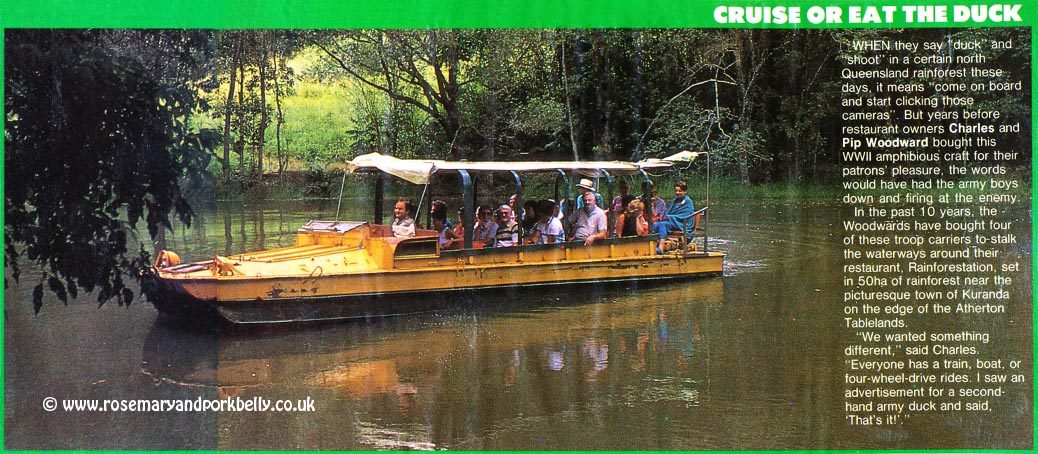
We even sold a story about a duck – not the feathered kind but the ex-WW2 amphibious craft taking tourists through the Queensland rainforest in Kuranda. Delighted to say Charles and Pip’s tours are still going strong.
Home thoughts from abroad
On a personal level, keeping in touch with home was sooo hard. News was weeks out of date by the time we got it.
It was also strange what cultural phenomena we missed. With no internet and only occasional access to TV we caught snippets of news, major events on the international scale, and local incidents wherever we were.
We learned of the UK hurricane while waiting for typhoon warnings in Hong Kong. Black Monday and the stock market crash in October 1987 was viewed from an Asian perspective.
UK pop songs from ’88 ring no bells with us and the whole comedy phenomenon that was Harry Enfield completely passed us by.
So to all you digital nomads whose adventures we love to read with your regularly updated blogs, Twitter feeds, Facebook profiles, WhatsApp, and FaceTime with family and friends, images of your feet flashed around the world in an instant, we salute you.
We do it too, now.
But we ‘did it different’ back then.
Travelling soon? Things to do and attractions not to miss with Get Your Guide …
If you’ve enjoyed browsing our website, learned something new, or just had a smile because of what we do – we’d love your support to keep the good stuff brewing!
Where to next?
• Holiday and travel competitions
• Top tips for travellers
• 9 tips for taking great travel photos