
Bee keepers must be the calmest people in the universe.
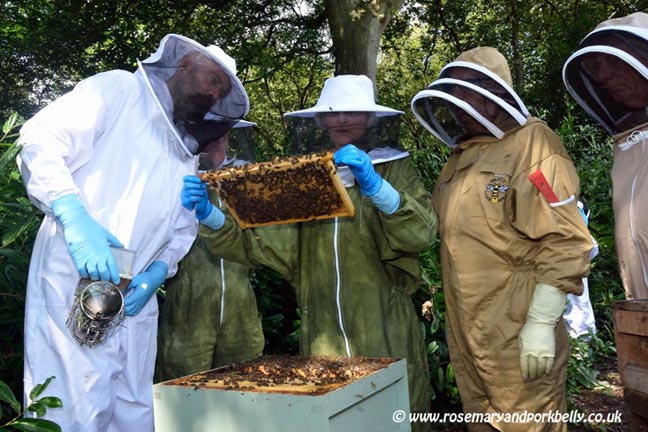
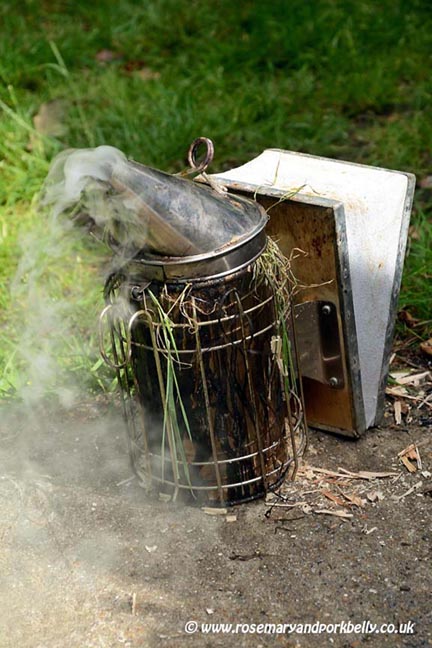
Suited, booted and veiled they slowly, almost reverently approach the beehives, gently swinging a hand-held smoker.
Delicately, yet with impressive strength they prise apart the hive’s layers, taking a long, meditative look at the occupants, talking to them in low tones.
Studying the bee behaviour and checking their health they move on to the upper layers where the precious honey is stored.

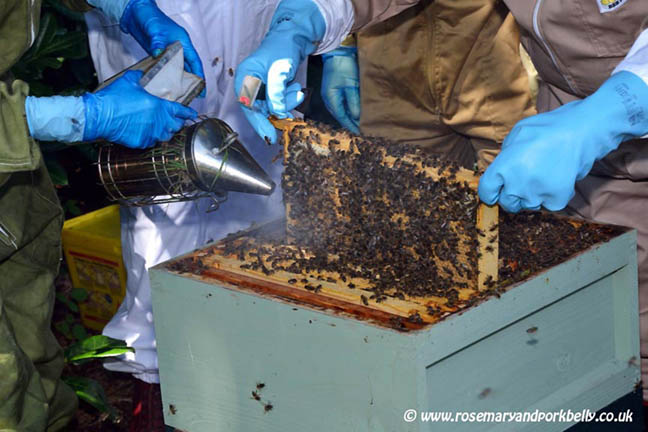
With a combination of precision, strength and delicacy they slowly remove frame after frame, heavy with honeycomb, soothing the workers with puffs of smoke, taking stock of the harvest which will serve both bee and human for the coming winter.
The bees, disturbed but not angry, perform a vigorous dance, swooping and diving around the keepers’ heads until the day’s business is done, the hives re-stacked and peace and tranquillity restored.
This was our first experience of bee-keeping and it was absolutely fascinating.
We’d met members of the Central Sussex Beekeepers’ Association at a foodies event and spent some time looking at their observation hive (glass both sides so you can see the swarm in action) chatting about how important bees are to humans and tasting the locally made, pure and sweet honey.
• Central Sussex Beekeepers’ Association
Reach for the honey
Honey is a staple in our household – not only as an ingredient for sweet and savoury dishes or a toast-topping treat but whenever anyone has the slightest sign of a cold or sore throat up goes the cry for honey and hot lemon.
The health-giving properties of honey are well documented and it’s known to be powerful stuff, although it should never be given to infants under the age of 1.
Even if you are sceptical, there’s no denying it is a delicious, naturally occurring treat and it’s no wonder than humans have been making sure they benefit from the bees’ hard work for millennia.
How bees make honey
Left alone in the wild bees will swarm and build their own nest in trees and bushes. The structure is the same – a vast network of identical hexagonal shapes made by the bees themselves, which are used in the lower half of the nest for the queen to lay her eggs and the larvae to be tended.
Higher up, there’s the honeycomb where the bees store pollen and nectar to feed the colony.
It’s how they store the nectar, reducing the water content from around 80% to 20% and capping it with a seal of wax That’s what gives us honey.
All we humans have done throughout the centuries, in different ways across the world, is devise methods of encouraging bees to build their colonies where it suits us, by offering them a sort of starter home kit with ready-made boxes and frames lined with waxy, hexagonal patterned paper.
But there’s much more to it that just putting up a hive, letting nature takes its course and sitting back to reap that golden harvest. There are bee-keepers’ associations across the world whose members are on hand to guide both beginners and experts alike into the fascinating world of the honey-bee.
Bees in decline
When Pork Belly and I were young, honey bees were a familiar sight. Pork Belly grew up in the country, so that’s no surprise. I was a “townie” but even so bees (and avoiding getting stung by them) was part of my childhood.
That’s not the case any more, unless you are lucky enough to live near someone who owns a hive or two, and the passing visit of a bee to our flowerpots today is cause for excitement and celebration
‘A bee, on the fuchsia. Quick, grab the camera!’
But of course they never stay long enough to pose for a picture.
Why do we need bees?
Bees are vital for the health and ultimate survival of our planet. They perform an essential job in pollinating a wide range of farm crops, vegetables, fruit and many wild plants.
Without bees crop yields would be lower, birds wouldn’t have enough food to last the winter and from there on a whole catalogue of disasters would befall us,
So let’s thank the army of amateurs who devote their spare time to keeping bees – not a job for the faint-hearted.
Each hive in the height of summer can be home to up to 60,000 bees, all busily working away gathering enough nectar and pollen to make sure they survive the winter – although their numbers dramatically reduce to around 5,000 during the colder months.
Bee-keepers need to be calm, steady, dedicated to keeping a regular eye on the health of their bees and ready to take swift action at the first sign of disease, infestations, wasp attacks and even (in extreme cases) culling the queen.
It’s not a job for the squeamish, or anyone with no patience, but looking around at the faces of those taking part in an induction session it clearly has its devotees.
Talking to beekeepers
“Enthralling, fascinating, engrossing, enjoyable” are just a few of the words the members use to describe their hobby.
When it comes to tasting the fruits of their (and the bees’) labours there are even more superlatives. And their admiration for the bees themselves shines through.
Lyn Thornton explains, “We know that one bee makes less than a teaspoonful of honey in their very short lifetime and for every pound of honey bees have flown the equivalent of twice round the world gathering nectar to make it – so I can’t bear to see a single drop wasted!”
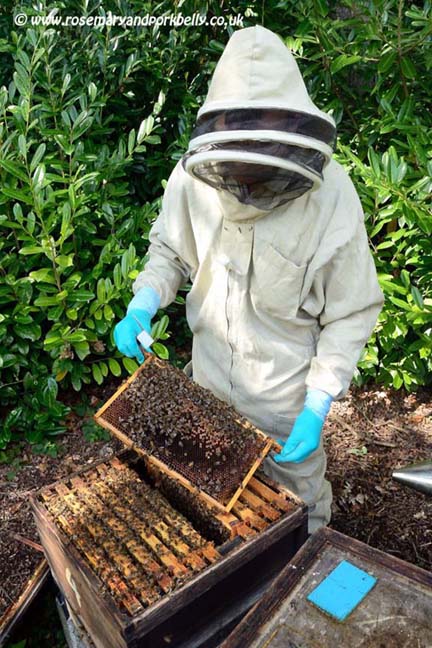
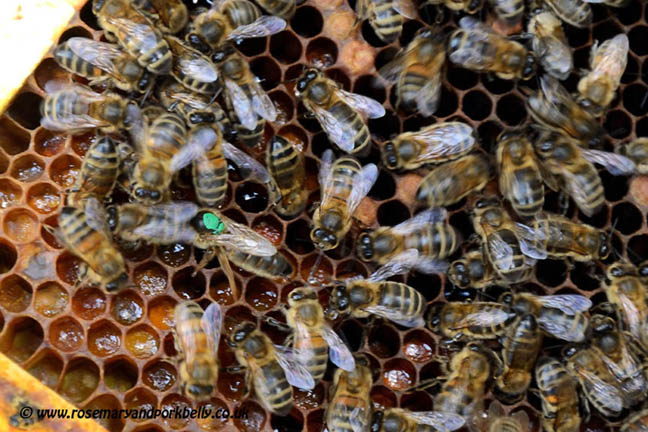
Melvyn Essen, the group’s chairman, guides Pork Belly and I through our first tour of a hive. Fully clothed in protective gear he slowly and carefully takes one apart to show us the teeming life within. He gently removes the frames in the lowest box to expose the brood cells where the queen (tagged so we can easily find her) lays her eggs and the cells are sealed over until they hatch.
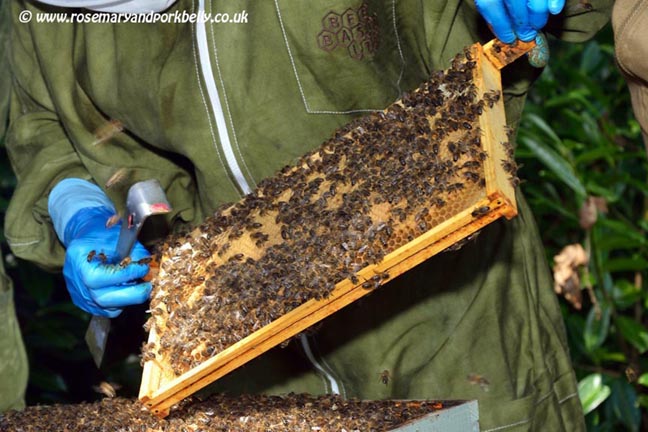
The larvae are tended by nursemaid bees, fed on a mixture of pollen and re-hydrated nectar until they are fully grown and can replace their “nurses”. The older bees then graduate to become foraging bees – a dangerous and short-lived time, running missions to bring back the precious nectar, reducing its water content from 80% to 20% so it can be stored indefinitely in the honeycomb cells sealed with beeswax.
In the short summer months the bees need to bring back enough nectar to convert into honey to sustain the colony throughout summer and into the winter. Fortunately these manic little workers make so much honey that there’s plenty for us as well.
Smoking the bees
As Melvyn goes through the talk, moving slowly and carefully so as not to damage any of the bees who barely pause in their labours, he asks me to regularly dispense puffs of smoke.
“In the wild smoke would be an early warning system for the bees that a forest fire was on its way and they should leave the nest and find another, safer place. Before they swarm they will fill up on honey, taking as much as they can carry to start the new colony. So puffing smoke at them sends them down to the honey store, which keeps them out of our way and saves them from getting accidentally squashed.”
I am amazed at how calm the bees are, and how quickly they settle once we have put the hive back together. “On the whole a bee won’t attack unless provoked so if you move slowly and carefully you, and they, will be okay. Sometimes though we do get a bad-tempered brood – and that seems to be down the mood of the queen. In the wild this isn’t a problem but for us, as we are training new bee-keepers here, we can’t afford to have a bad-tempered hive so we will, regretfully, have to squish that queen and put in a new one. That usually sorts things out.”
So no sentimentality then? Well, no but there is a great deal of respect for the bees and the keepers do all they can to help them live, thrive and survive.
Bees are under threat
Bees are facing a tough time. Firstly there’s been a huge loss of the bees’ natural foraging habitat as we have covered over countryside with bricks and mortar.
Then there’s disease. Honey and the ‘bee glue’ (propolis) that they collect from trees and shrubs are mildly antiseptic, which helps keep the bees fairly free from disease. In the past bee-keepers didn’t need to do much more than check the hives in spring, give them some fresh combs then harvest the honey in the summer.
With the arrival in the 1990s of a parasitic mite (varroa) in the UK, things changed and now bee-keepers have to work hard to keep their colonies disease-free. Despite that, many people still choose to keep bees and 2014 has been a good year – a mild winter and warm summer has meant they’ve had an easier time of it and are reaping the rewards.
Harvesting honey is hard work
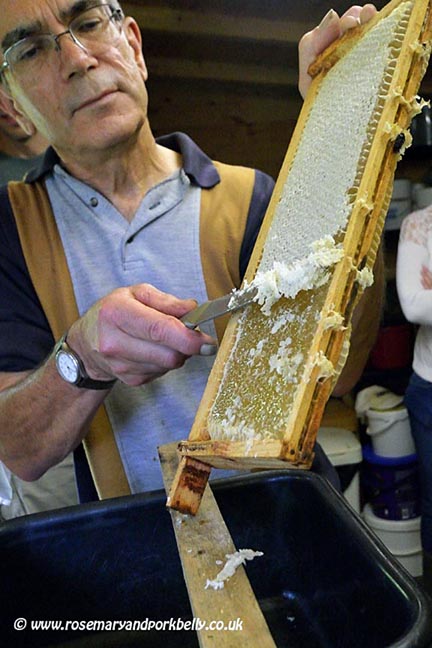
Melvyn brings in a box – called a “super” – which is full and ready to be processed. It weighs so much I can’t even hold it. Taking out a frame he gently removes the wax capping with a sharp knife to reveal the pale golden honey beneath. The wax is not wasted – it’s drained of any residual honey then used to make candles or other beeswax products.
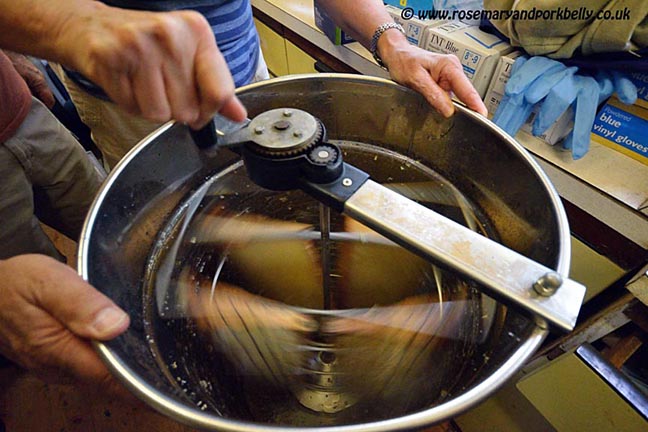
The frame is then secured inside a stainless steel container and gently spun – by turning a handle at the top. There are electric versions that make the job a little easier, but this is the traditional way.
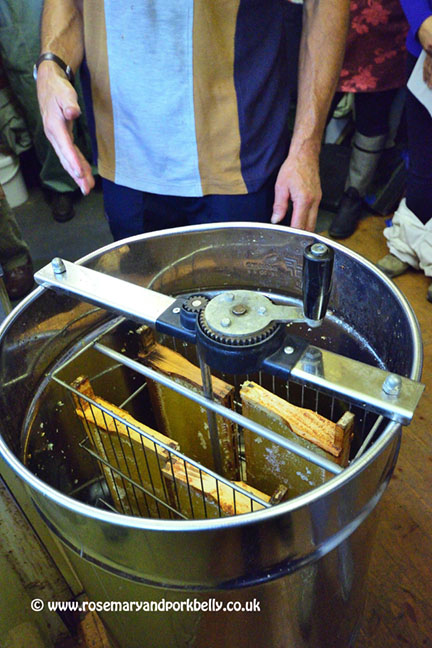
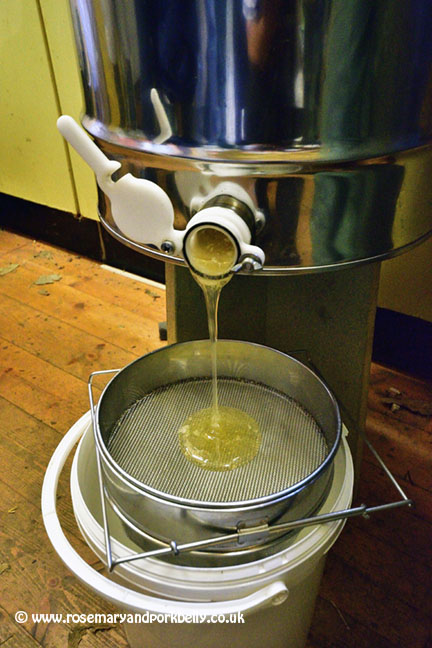
The honey is then released and poured through a sieve to catch any remaining wax. The end result is pure, soothing, sweet honey.
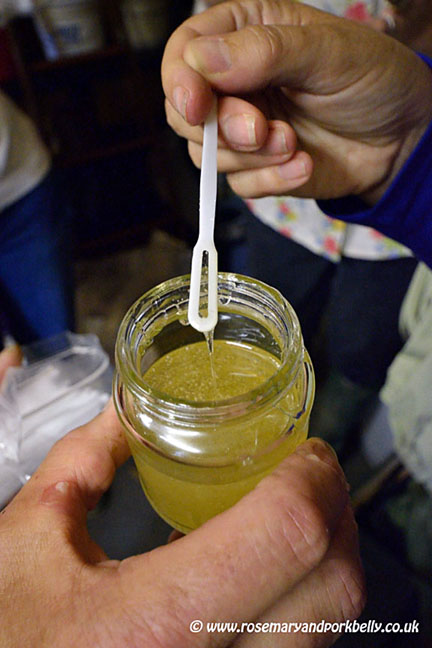
“We have a lot of lime trees around here so it’s mainly lime blossom honey with a bit of clover,” explains Melvyn. “My hives at home are near fields of rapeseed so the honey is paler and creamier.” He produces some which he made his year, chopping in tiny bits of root ginger. The resulting flavour is delicate and delightful.
As with most bee-keepers Melvyn supplies a local shop with as much honey as he can spare. Others simply keep friends, family and work mates supplied.
Who keeps bees?
If you imagine all bee-keepers to be country-born, middle-aged or elderly, with lots of land, think again. The group’s members include Philip – an environmental scientist who keeps bees at the bottom of the family garden, Rachel – who wants to “do her bit for the bees” and get involved while she is still young. Debbie (whose name actually means “bee”!) is hoping to have two hives very soon. She says young people have become more aware of the threat to bees and want to help and Paul Miller – an urban bee-keeper who took up the hobby just 13 months ago and now has 10 hives on an allotment in Crawley.
Melvyn chuckles, “When Paul first came on the course I thought there was no way he would go on to keep bees. He seemed to me like the type who would come for a few weeks and then stop. But he’s proved me wrong!”
Paul is a bit experimental too, using polystyrene hives rather than the traditional wooden boxes. “I’ve always been interested in bees and thought about taking a course, but was put off by the price. When I found the Central Sussex course was just £50 I thought ‘Bargain – a sort of ‘try before you buy’ offer’.
Before I knew it I was helping out regularly at the sessions, got more involved and joined the committee. Being part of the group lays good foundations so you can become a better bee-keeper. It gives you a chance to compare how your hives are doing with others and learn from them too.
Beekeeping is addictive
“I didn’t mean to end up with quite so many hives, but I joined the “swarm register” which means I am able to go and collect bees when people find them swarming, and I just kept on getting more and more bees. I’m now in discussion with the council about taking on another allotment – they let me have the land for a reduced rate as I don’t cultivate it and my bees have a lovely time foraging in everyone else’s vegetable patches!
“I find keeping bees is quite calming – you have to do things in slow-time and think about everything you do from the bees’ perspective. I can spend hours just bee-watching; seeing them groom their queen, trying to interpret their little dances and watching them take off on their foraging missions.”
And everyone seems to think that old country tradition of talking to the bees is important. They admit to going to ‘tell the bees” of any significant news in the family and Melvyn says it’s essential to tell them if they are to be moved or given to a new owner.
And somehow, as you are standing under the trees in a peaceful glade in the middle of the countryside, talking to the bees seems perfectly natural.
More about bees:
• UK – British Beekeepers Association
• USA – American Beekeeping Federation
• Australia – Australian Beekeeper Network
Where to next?
• Milla’s Mead
• Hidden Spring Vineyard
• Beautiful places in Britain