
Years ago I was standing in the May sunshine in the centre of Brighton gently adjusting my daughter’s elaborate costume. I was sporting streamers, an ear-piercing whistle and a backpack stuffed with drinks and snacks.
I heaved a sigh as all around me excited little people shrieked and yelled. I knew that by the time the noisy and colourful procession marking the start of the annual arts festival had wound its way through the busy streets to the seafront we’d all be tired, hungry and hot.
But then it dawned on me.
If Pork Belly and I were on our travels and came across somewhere hosting such a wild and wacky affair we’d be thrilled and rate it a highlight of our journey.

Treasures on your doorstep
It’s true that familiarity breeds if not contempt then certainly indifference. It’s so easy to ignore the treasures on your own doorstep.

Living near a popular seaside resort we have no shortage of beach, bars and bouncy castles throughout the summer, although we prefer to take an out of season stroll.
But whenever we have visitors or there’s a free day for residents, we head to one of our local treasures, The Royal Pavilion.
And every time we’re reminded just how extraordinary it is.
The Prince Regent’s palace by the sea
It began as a humble farmhouse near the seafront in the unfashionable fishing village known as Brighthelmstone.
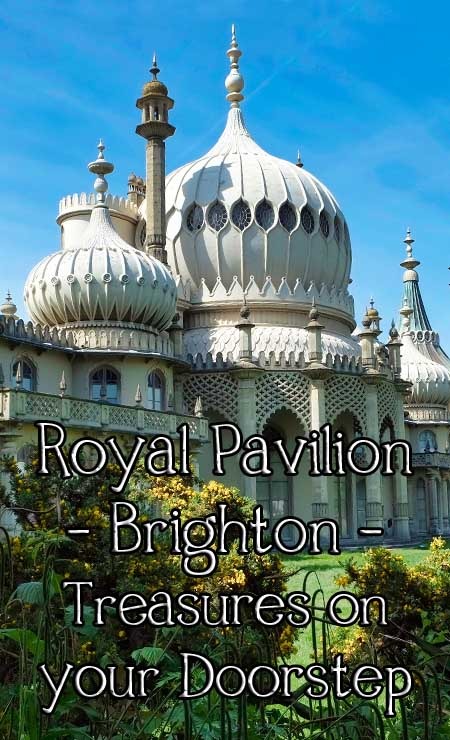
Then the Prince Regent, later George the Fourth, commissioned architect John Nash to turn it into the most extravagant of holiday homes – a mish-mash of Chinese and Indian influences with a generous touch of extremely bad taste.

There are dragons, huge pillars topped with palm trees, bamboo stairways, plaster parasols and weird and wonderful animals wherever you look.
You almost expect the Prince Regent himself to appear in a puff of smoke at the top of the bamboo staircase.
That’s how he liked to greet his guests as they arrived for his famous pleasure evenings.
Dedicated to pleasure
And how George entertained. He was a larger-than-life character and history remembers him rather cruelly but he loved life and was a great host.
Today the banqueting room glitters and gleams, laid out as it would have been for a royal feast with sparkling cutlery, plates and glasses beneath the 1 tonne dragon chandelier.

In the vast kitchens nearby there are copper pans, open fires and gigantic scrubbed wooden tables. Children can play “spot the rat” with the replica rodents scattered in sneaky places.
Shelves are stacked with beautiful copper pans and jelly moulds and it’s here that George’s personality really comes to life.
The Pavilion was where he could break with all the conventions of court and invite the people of his own choice – literary, artistic and artisan.

The regent’s own inventions
George took a hands-on approach to entertaining.
He invented a steam heated copper warming table to make sure guests got their meals piping hot.
He always supervised the menu and arranged more than just culinary delights, even serving the jellies with a little mechanism that ensured they wobbled as they arrived at the table.
He appreciated the work of his servants too, going so far as to picnic with them in the kitchen.
Well-fed and probably over-wined everyone would repair to the ornate Music Room, all red and gold with yet another dragon looming overhead, to hear the most famous performers of the time.

It was an invitation not to be refused, even when his popularity waned in later life and he became a bit of a joke.
The contemporary cartoons displayed on the upstairs walls show the abuse poor Georgy-Porgy got for his far from conventional lifestyle.
Even those of us used to Twitter today go “ouch” at some of the comments.

The saloon, restored
Once he became George IV it seems he steadied down a bit, although he never lost his love of the rich and ornate.
After a three year painstaking and detailed restoration the saloon reopened to the public in 2018, returned to all the crimson-gold-and-silver glory of its 1823 design.
After he succeeded his father, George commissioned Robert Jones to recreate the room, once all muted greys and greens, to something more fitting his kingly state.
Using original watercolour paintings, the tiniest snippet of tasselled curtain and a patch of faded carpet from the archive, a team of talented conservators, restorers and craftspeople have created a room awash with colour.

Red and gold festooned curtains allow pale sunlight to gently illuminate the sun-inspired carpet with its motif of dragons and lotus leaves.
The walls are covered in hand-applied platinum leaves, each with its painstakingly painted shadow.
The room is furnished with its original cabinets and chairs and in the centre is a crimson ottoman which the public are allowed to sit on to admire the room’s glory.

The Pavilion after George
Eventually the Pavilion became a holiday home for George’s more restrained younger brother William the Fourth and later Queen Victoria, who also turned against the extravagance of its previous owner.
But it still retained a little elegance and got an update with a few mod-cons including an indoor toilet for the regal rump.
Most moving of all are the photographs dating from 1914 to 1916 showing how the ornate rooms became a shelter for Indian soldiers wounded on the battlefields of the Western Front.
The beautiful India gate at the southern entrance to the Pavilion was installed in 1921 to commemorate the 12,000 Indian troops treated there.

Pork Belly and I have toured the Pavilion many times yet there’s always something we’ve forgotten or another piece of history that’s just been uncovered.

Christmas at the Royal Pavilion
Christmas is a great time to visit to see fireplaces adorned with wreaths and swags of colour reflecting the glory and palette of the individual rooms.
Christmas trees spring up in almost every room decorated with Pavilion-inspired baubles and paper hangings and tables are set for breakfast with delicate china and a stack of colourful presents waiting to be opened.

Whatever time of year you go it’s worth dropping in to the café on the first floor.
From the terrace you get a bird’s eye view of the Pavilion Gardens which have been restored as far as possible to the winding paths and dense shrubbery originally conceived by Nash.

It also affords you a close up view of the extraordinary minarets and cupolas that grace the roof-line and the nearby Dome complex, built originally to house the Prince’s horses and now a theatre, art gallery and museum.

More information about Brighton’s Royal Pavilion
Admission to the Royal Pavilion in 2018 costs £13.50 for an adult, children £8.00. There are concession tickets and a saving if you buy online in advance. If you plan on making several visits in a year, membership’s a good deal.
See Brighton Museums website for up-to-date info on exhibitions and special events.
Where to next?
• Prince Regent’s Treasures
• Treasurehunting in Brighton
• Agnes B Marshall
I love going to the Pavilion on the free visit days; there’s always something new to see 🙂 You took some really stunning photos 🙂 x
Yes, aren’t we lucky to have places like this on our doorstep. Love the free days too.
Stunning photos! I’ll never tire of visiting this gorgeous place! My mum has a season ticket and takes my daughter a lot as she gets in free I think!
Thanks Lauren, just one of the many perks of living in Brighton.