
Mughlai Shahi Hiran Ka Qorma (Mughlai Royal Venison Qorma) is a rich and meaty dish from the royal households of Northern India.

Mughlai Royal Venison Qorma can be traced back to the 16th century and was often prepared in the Mughal court kitchens.
Recipe courtesy of Priya Deshingkar of Deccan Tiffin.
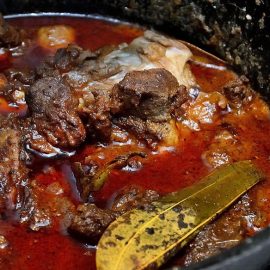
Mughlai Royal Venison Qorma
A dish from the royal households of Northern India
Ingredients
- 500 g venison cut into medium sized cubes
- Ask the butcher to throw in some marrow bones too so the total weight should be about 700g
- 2 large red onions
- 100 g clarified butter/ghee
- 4 large cloves of garlic and roughly the same volume of fresh ginger root
- 3/4 cup yoghurt
- 1 teaspoon hot chilli powder
- 1 teaspoon Kashmiri chilli powder use paprika if you dont have this
- 1/4 teaspoon nutmeg
- 1/4 teaspoon mace
- 8-10 peppercorns
- 4-5 cloves
- 3 black large cardamom pods
- 8 green large cardamom pods
- 3 Indian bay leaves
- 1 tablespoon coriander powder
- 2 teaspoon garam masala best to have freshly prepared
- pinch of saffron
- unrefined sea salt
- 2 tsp Screwpine Pandan leaf extract
- 100 g freshly kneaded wheat dough
Instructions
- Peel and slice the onions as finely as you can.
- Heat the ghee on high heat in a wok. Add the onions and stir. Keep the heat on high and stir occasionally. We are aiming to have browned and crisped onions.
- While the onions are cooking, start preparing the other ingredients. First peel the garlic and scrape the ginger root and cut both into centimetre wide pieces. Grind both in an electric grinder together with half a cup of water and a teaspoon of salt.
- Continue frying the onions until they become crisp and move them to the sides of the wok so that the ghee drains into the middle – we will be using this to fry the meat. If more time is needed on the onions, start grinding some of the spices.
- In a pestle and mortar roughly smash the two types of cardamom to remove the outer skins. Take the seeds out and grind these to a fine powder together with the peppercorns and cloves. Reserve this powder for adding into the dish later.
- After the onions have been browned and the ghee has collected in the middle of the wok, spoon as much as you can get out into another casserole dish (choose a heavy based dish with a tight fitting lid). I like using my old cast iron casserole for this dish but a le creuset casserole or something similar will work well.
- Heat the ghee on a high flame, when hot add the meat and stir. Keep stirring until the liquid evaporates and ghee reappears at the bottom of the casserole. This is called the bhuna method.
- Once this happens drizzle a couple of teaspoons of the garlic-ginger paste on to the meat and repeat the bhuna process until you see the fat separating; add more of the mix and repeat until it is all finished.
- Do the same with the yoghurt (drizzle a small amount, stir until the fat separates) until all the yoghurt is used up.
- Blitz the fried onions and add them to the meat with enough water to cover the meat pieces. Now add the chilli powders, coriander, mace, nutmeg, ground spice mix of cardamoms, cloves and pepper and the bay leaves.
- Simmer for a minute and then add the garam masala, saffron and screwpine extract.
- Put the lid on and seal all round the edges with the dough to prevent any steam from escaping. Cook on a very low heat for a further hour. This is the “dum” method of cooking developed in the royal kitchens of north India.
- Serve with freshly made roti or naan – it is traditionally eaten with tandoori roti or naan.
Other recipes you may like:
• Mung Daal Halwa
• Bacon jam
• Nellore Chapala Pulusu