
English scones are delicious. They’ve been enjoyed for centuries around the world. These small, round cakes made from flour, sugar, butter, eggs and milk make for a perfect afternoon tea.
But did you know that the quintessential English scone originated in Scotland?
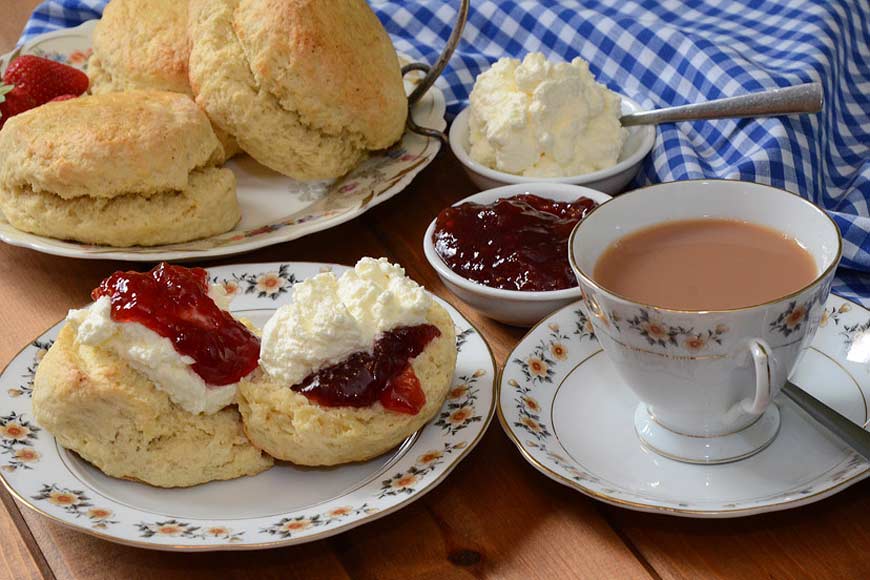
The story goes that in the early 1500s, and originally made using oats, they were named after the Stone of Destiny, upon which Scottish kings and several English ones (after they had nicked it!) were once crowned. They were a popular food among the lower classes in Scotland, who often served them with butter, cheese, or honey.
It’s said that in the 16th century, the scone recipe was brought to England by Queen Elizabeth I and certainly in the 19th Century, Anna Duchess of Bedford declared they were perfect to be served at 4pm for an afternoon tea.
Today, scones can be found in bakeries and tearooms throughout England, and they come in a variety of shapes and flavours.
Whether you prefer them with jam and clotted cream or topped with savoury ingredients, scones are a versatile and delicious snack.
Devon and Cornwall both serve them with clotted cream and jam. The debate over cream or jam first has been a source of contention for centuries, with both sides adamant that their way is the right way.
Scottish scones are slightly denser than their English counterparts, with a firmer texture that makes them perfect for soaking up soups and stews.
In Northern Ireland, scones are known as griddle cakes and are made with buttermilk. These scones are fluffier and softer than their Scottish and English counterparts.
In the United States, scones have become a popular breakfast pastry, and are often flavoured with chocolate chips or blueberries.
BUT how to pronounce the name …
I asked the maid in dulcet tone
To order me a buttered scone;
The silly girl has been and gone
And ordered me a buttered scone.
Punch 1913
Recipes for scones vary. Do you use self-raising flour or plain all-purpose, add eggs, or baking powder, cream or milk? Just look around the internet and you’ll find hundreds of variations.
Pork Belly likes eggs in his and is not adverse to the addition of cream. So here’s his version with added sparkle!
These can easily be made dairy free by using plant butter and a non-dairy cream, like we did.
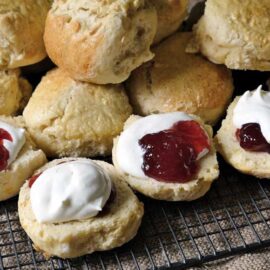
Sparkling scones
Ingredients
- 700 g self-raising flour
- 1/2 tsp salt
- 115 g butter
- 3 medium eggs
- 100 ml cream
- 150 ml sparkling wine (such as Prosecco or Champagne)
Instructions
- Preheat your oven to 220C/200C fan/gas 7 and lightly grease two baking trays or line with parchment paper.
- In a large mixing bowl, sieve together the self-raising flour and salt.
- Add the chilled butter to the dry mixture, and using your fingertips, work the butter into the flour mixture until it resembles breadcrumbs.
- In a separate bowl, whisk together the eggs, cream, and sparkling wine until smooth.
- Make a well in the centre of the dry mixture, and pour in the wet ingredients. Use a fork to stir everything together until just combined.
- On a lightly floured surface, bring the dough together. Be careful not to overwork the dough. It will be a little sticky.
- Gently roll out the dough to about 2.5 cm (1 inch) thickness and cut out rounds using a straight edge biscuit cutter or drinking glass and place them onto the prepared baking sheet, leaving a few centimetres between each scone.
- Brush the tops of the scones with a little beaten egg.
- Bake the scones for 12–15 minutes, or until they are lightly golden brown and cooked through.
- Remove the scones from the oven and allow them to cool on the baking sheet for a few minutes before transferring them to a wire rack to cool completely.
Other recipes you may like
• Irish whiskey coffee cake
• Langues de Chat biscuits
• Chocolate pie – dairy free