
Why the Train is Having Its Moment
There is a certain irony in the fact that it took a war, a global energy crisis, and the collective realisation that flying to Malaga for a long weekend might not actually be saving anyone any money, to make us rediscover what our great grandparents always knew: the train is rather wonderful.
Night trains are making a comeback and slow travel, once the preserve of gap-year students and retired geography teachers, has quietly gone mainstream.
And the budget airline industry, which spent two decades convincing us that £20 flights were both normal and sustainable, is now staring down the barrel of an 84% rise in jet fuel prices and asking some fairly awkward questions about its business model.
The crisis has already led to the collapse of Spirit Airlines, which shut down all operations on 2 May 2026. easyJet expects to report a headline loss before tax of between £540 million and £560 million for the six-month period ending 31 March and other major airline groups including Ryanair and IAG, which owns British Airways, Iberia, and Aer Lingus, have issued similar warnings about the financial impact of the current jet fuel crisis.
Welcome to 2026. It turns out the journey really does matter.
The Fuel Crisis Nobody Saw Coming (But Several People Did Warn About)
To understand why rail travel is suddenly dominating the travel conversation, you need to understand what has happened to the global energy market since February 2026. It is not a comfortable story.
When the United States and Israel launched coordinated airstrikes on Iran on 28 February 2026, Iran responded by doing the one thing analysts had long dreaded: closing the Strait of Hormuz. This narrow chokepoint between the Persian Gulf and the Gulf of Oman carries roughly a quarter of the world’s seaborne oil trade. The world’s energy markets scrambled to react.
Brent crude immediately jumped 8% in the first two trading days, and kept climbing. The International Energy Agency has called it “the largest supply disruption in the history of the global oil market.” Brent crude broke $100 per barrel on 8 March for the first time in four years, eventually peaking at $126.
The International Air Transport Association’s head, Willie Walsh, told Reuters there is “a risk that we’ll see rationing of fuel supply, particularly in Asia and Europe,” though he added that supply remained robust for now. Not exactly the pre-holiday reassurance travellers were hoping for.
The consequences for aviation were swift and brutal. Jet fuel prices have risen nearly 84% since the conflict began. The Lufthansa Group alone plans to cancel around 20,000 flights over the next six months. Airfares, according to Oxford Economics, are expected to rise by 5% to 10%, with fuel surcharges beginning to appear. As the Associated Press reported in late April 2026: “Consumers are paying for the Iran war’s disruption of global energy production.”
And while this crisis is geopolitical in origin, it has a way of making every previous argument for train travel suddenly look less like idealism and more like sound financial planning.
The Rigged Game
Before getting too carried away with the romance of rail, it is worth acknowledging something that has been quietly infuriating sustainable travel advocates for years: the playing field between trains and planes was never level to begin with.
A landmark Greenpeace study published in August 2025 examined 142 routes across 31 European countries and found that flying was cheaper than the train on 54% of cross-border routes. In France, Spain and the UK, trains were more expensive than flights on up to 95% of international routes. On the Barcelona to London corridor, the train could cost 26 times more than a budget flight.
Herwig Schuster, transport campaigner for Greenpeace Central and Eastern Europe, put it with admirable bluntness: “It is absurd that a flight from Barcelona to London can cost just €15 [around £13] while the train on the same route is up to 26 times more expensive. Aviation enjoys unfair tax privileges while train passengers are left to pay the price. These prices don’t reflect a functioning market, they reflect a rigged system.”
The distortion is structural. Aviation fuel is entirely untaxed across the EU. International flight tickets are exempt from VAT. Rail operators pay full VAT, face high track access charges, and bear rising energy costs. There is, however, some good news buried in the Greenpeace data: the share of routes where trains are now cheaper than flights rose by 14 percentage points between 2023 and 2025, a reflection of fewer ultra-cheap flights and the revival of night trains. It is not a revolution yet. But the direction of travel, if you will forgive the pun, is shifting.
Slow Down, You Move Too Fast
Long before anyone was worrying about the Strait of Hormuz, something else was already changing in how we think about holidays. Call it post-pandemic reflection, climate anxiety, or simple exhaustion from being wedged into a middle seat at Stansted at 5am with nothing but a £4 bottle of water and a bag of crisps.
Travel specialist Byway, whose business is built entirely around overland holidays, reported that 2025 was the year travellers fell in love with overland travel, and that 2026 is shaping up to be the year they fully commit to it. “The slow travel movement has moved from fringe to familiar,” they noted, “with families, friends and solo travellers choosing journeys by land and sea as their first thought, not their fallback.”
Byway reports particular growth in family and off-season overland travel, with parents increasingly ditching security queues and overpriced airport lounges for smoother journeys by land and sea.
The Simon-Kucher 2026 Travel Trends Study, which surveyed more than 10,000 travellers across ten global markets, found that roughly 60% of Gen Z travellers and 57% of Millennials took two or more holidays in 2025, with a strong focus on wellness and meaningful experiences rather than rapid sightseeing. The pattern has been neatly summarised as “fewer cities, longer stays”, a deliberate rejection of the multi-stop Instagram dash in favour of actually getting to know a place.
The same study confirmed the broader sustainability shift: 70% of travellers now seek companies offering sustainable travel options, and 35% are willing to pay a 27% premium for greener flights. When even the people boarding planes are prepared to pay more to feel less guilty about it, you know the conversation has genuinely changed.
Euronews Travel confirmed the trend in its 2026 outlook, noting that travellers increasingly wanted “slow travel to niche destinations, to be able to fully immerse themselves in a place, instead of just ticking things off a list.” The rise of the “quietcation”, a holiday designed specifically for digital detox and burnout recovery, fits neatly into this picture. Watching the Alps slide past your train window turns out to do the job rather well.
The Environmental Case
On environmental impact, the comparison between train and plane is not a contest.
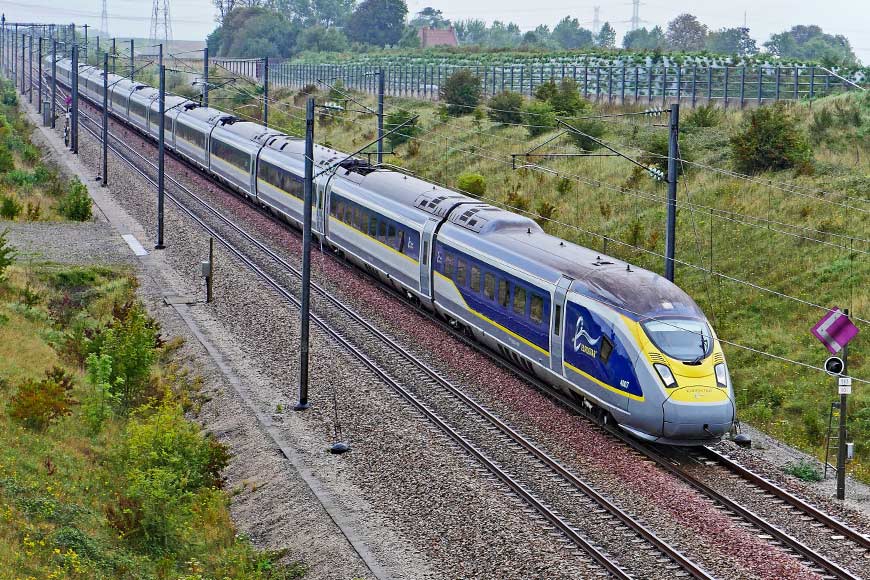
Trains emit up to 90% less CO2 per passenger kilometre than flights. London to Paris by train generates just one-tenth of the carbon emissions of the equivalent flight, and Eurostar’s own analysis puts the carbon saving on that route at 97%. For longer routes like London to Rome, switching from plane to rail cuts your carbon footprint by up to 80%. High-speed electric trains also recover energy during braking and feed it back into the rail network, a trick no Airbus has yet managed. If powered entirely by renewables, trains could be over 80 times less polluting than planes.
The EU’s rail network already spans over 220,000 km. The European Commission has committed to doubling high-speed rail capacity by 2030 and increasing rail’s share of passenger transport to 50% by 2050. That is a serious long-term bet on an alternative to short-haul flying, and it is already delivering new routes.
The Night Train Renaissance
The most exciting development in European rail is the spectacular return of the night train, which most directly addresses the time objection frequent flyers always raise.
European Sleeper, whose co-founder Chris Engelsman describes the venture as driven by “passion for night trains and the way they connect people, cities and cultures across Europe,” is one of the players in this revival. Its new Brussels to Milan service, calling at Cologne, Zurich, Lugano and Como, is scheduled to launch on 9 September 2026, after a delay from the original June start date caused by summer track works in Germany and the certification process for Switzerland. The Amsterdam connection has been pushed back to 2027. A Barcelona extension remains the longer-term ambition.
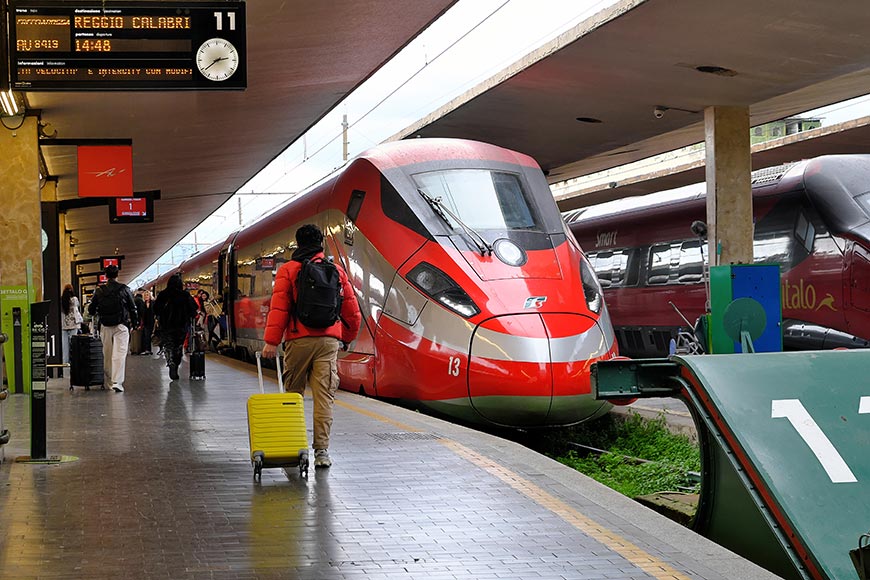
Elsewhere, a new multi-country night train launched in December 2025 now connects cities across Poland, Czechia, Slovakia, Hungary, Austria and Germany overnight, the kind of cross-border connectivity that once required a connecting flight and two hours at a gate. Direct high-speed Frecciarossa services between Munich and both Milan and Rome are targeted for December 2026, following an agreement between Trenitalia, Deutsche Bahn and ÖBB, subject to final certification across all three countries.
The logic of the night train is beautifully simple: board in the evening, sleep, arrive in a new country with the whole day ahead and a hotel night saved. As one travel writer captured it: “Hop on in the evening in Vienna, wake up in Rome.”
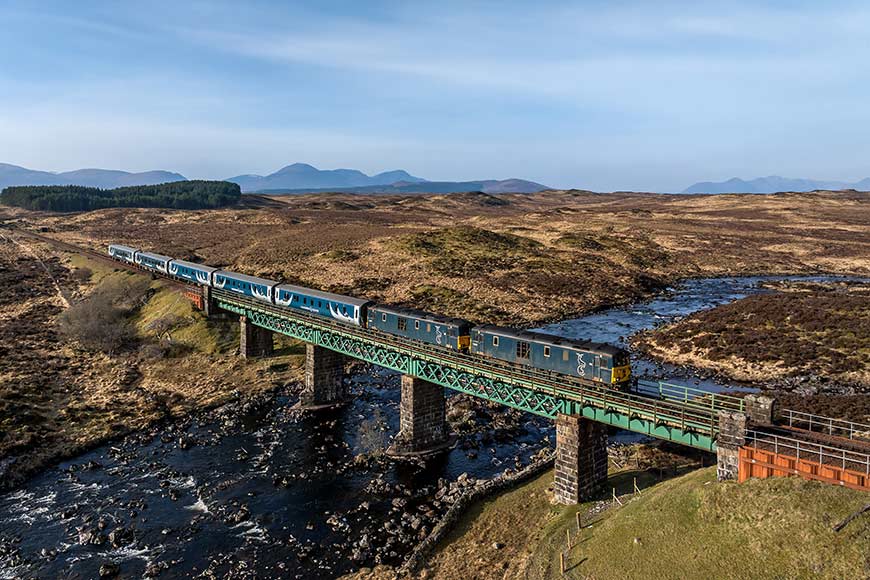
Closer to home, the UK has its own overnight options. The Caledonian Sleeper connects London to Scotland, and the Night Riviera links London to Cornwall, both popular with travellers who want to make the most of every waking hour at their destination.
Where Can You Actually Get To?
For those worried that rail suits Paris weekenders but nobody else, the 2026 network is more encouraging than many expect. Direct connections from London via Eurostar reach Barcelona, Milan, Amsterdam, Brussels, Zurich, Vienna, Prague and Budapest with onward services. Spain’s AVE high-speed network reaches the southern coast. Italy’s Frecce services link Milan to Naples in under three hours.
And then there are the destinations trains serve better than planes ever could. Slovenia’s Lake Bled is reached by a two-hour journey through forests and glacial scenery. The Portuguese Douro Valley offers a three-and-a-half-hour riverside journey from Porto through terraced vineyards.
The Swiss Bernina Express, a UNESCO World Heritage railway, climbs over 2,200 metres through glacial lakes and alpine villages across 196 bridges and 55 tunnels. You cannot recreate that from a window seat in row 32.
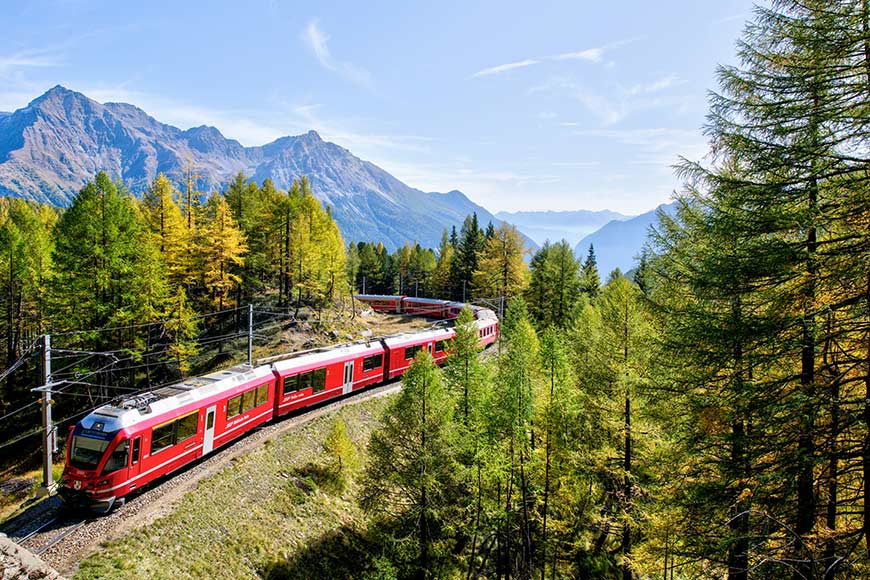
Byway has flagged alpine destinations in Austria, Slovenia and Switzerland as booming alternatives to overcrowded Mediterranean resorts, noting that “trains wind through mountain passes only accessible by rail or on foot, linking remote mountain inns, hiking trails through wildflower meadows, and wild swimming spots in glacial lakes.”
Rail also quietly addresses the overtourism problem, distributing visitors across wider regions rather than concentrating them in the handful of famous cities already struggling under the weight of too many selfie sticks.
The Hidden Costs of “Cheap” Flying
The headline price of a budget flight is frequently a fiction. A ticket that starts at £20 has a habit of arriving at checkout at £100 once baggage fees, seat selection and the airline’s creative approach to optional extras are applied. Budget carriers routinely operate from secondary airports far from where you actually want to be, adding time and cost at both ends of the journey.
Trains depart from city-centre stations. Luggage travels with you at no extra cost. You can eat your own food, visit the dining car, read, sleep, or stare contentedly at the Loire Valley rolling past.
The Honest Drawbacks
The case for trains is not without complications, and the UK is a particular problem.
British rail fares are, by European standards, genuinely expensive unless you master the dark arts of split ticketing and advance booking. London to Edinburgh by train costs around £100 against a budget flight fare of around £50 that takes half the time.
The trains are often crowded, the seats uncomfortable, plus the infrastructure improvements being made across Europe are constrained here by Victorian-era bridges, weight limits and a rail network with a complicated relationship with investment.
Cross-border booking across multiple countries remains fiddly, and Eastern European carriers often require booking directly through national websites. Islands, by definition, cannot be reached by rail. If your heart is set on Majorca, the Canaries or a Greek island, you can get to the coast by train, but the final leg still needs a boat or a plane.
A Perfect Storm
Three forces that have been building separately have now collided. A cultural shift has made slow travel a mainstream aspiration. A decade of European infrastructure investment is paying off with new night trains and high-speed corridors. And a geopolitical shock has done more in three months to close the price gap between flying and the train than a decade of policy advocacy managed to achieve.
Greenpeace’s Herwig Schuster said in 2025 that “every route where a plane is cheaper than a train is a political failure.” He was talking about tax policy. As it turns out, geopolitics can achieve what tax reform did not, at least in the short term.
The train is not a perfect solution and will not suit every traveller or every destination. But in 2026, with flights being cancelled, fuel prices surging and a network of night trains spreading quietly across the continent, rail has never looked more viable, more appealing or more timely.
Sources: Greenpeace European Unit, “Flying Cheap, Paying Dear” (August 2025); Simon-Kucher 2026 Travel Trends Study; Oxford Economics; Iran International; Associated Press; Byway Travel Trends 2026; Euronews Travel; Congressional Research Service; International Energy Agency; European Sleeper; Eurostar Sustainability Report; Wikipedia: 2026 Iran War Fuel Crisis / Strait of Hormuz Crisis; Aviation24.be; Travel Trade Journal.
If you’ve enjoyed browsing our website, learned something new, or just had a smile because of what we do – we’d love your support to keep the good stuff brewing!
Travelling soon? Things to do and attractions not to miss with Get Your Guide …
Where to next?
• The problem with passports
• 7 Reasons Travel Insurance Is a Must for UK Travellers in 2026
• SS Great Britain, Bristol’s most famous ship