
What is a tourist tax, where you’ll be charged, and what’s coming in 2027.
Back in May 2024, we wrote about tourist taxes as something that mostly happened to other people, in other countries. Britain grumbled about them from a safe distance. Two years on, the grumbling has turned into legislation, the legislation has turned into dates in the diary, and one Scottish city has already started taking your money.
The plot has thickened.
For what it’s worth, we haven’t personally paid one in the UK, which either means we’re careful planners or just haven’t been anywhere interesting enough.
Here’s where things actually stand, and where they’re heading next.
Why does anyone want a tourist tax anyway?
The reasoning hasn’t changed since 2024, and it’s still fairly simple.
A higher price might put a few people off, which takes some pressure off the most crowded spots. The money raised gets ploughed back into fixing the damage all those visitors cause in the first place.
Which raises the same old question nobody quite wants to answer honestly. Who’s actually to blame for turning a quiet fishing village into a queue for a photo spot? The influencers posting the same sunset shot? The councils quietly enjoying the extra income? The travel industry, which built its whole business model on making far-flung places reachable by anyone with a fortnight off and a credit card?
Or is it just us, turning up in numbers that no medieval street layout was ever built to handle?
Tourist taxes don’t answer that question. They just tax it.

What actually counts as a tourist tax?
Most tourist taxes are small charges, usually collected through the hotel, the Airbnb host, or the tour operator, so you rarely hand over cash directly. They’re generally aimed at overnight visitors, though a few places have started charging people who only come for the day.
Venice is still the best example of that. After a trial run in 2024, the city’s day-tripper fee continued in 2026, running on 60 dates between 3 April and 26 July, mostly weekends and holiday clusters. Book at least four days ahead and it’s €5. Turn up on a whim and it doubles to €10. The charge only applies between 8.30am and 4pm, so an evening arrival sidesteps it entirely, and anyone staying overnight, along with residents, students and workers, is exempt.
Japan has gone further than simply charging more, it’s widened who pays. The old ¥2,000 climbing fee for Mount Fuji’s Yoshida Trail is gone. As of 2026, all four routes up the mountain charge a flat ¥4,000 (roughly £21), and the daily cap of 4,000 climbers on Yoshida stays in place.
None of this is happening in a vacuum. Residents in Barcelona, Amsterdam and Athens have been saying for years that overtourism means noisier streets, pricier rents, and bin collections that can’t keep up. Tourist taxes are the compromise everyone’s landed on, not because it’s a great fix, but because it’s easier to legislate than “please stop coming.”
How do these taxes actually get collected?
Nothing complicated. Accommodation providers add the charge at booking or check-in, tech makes it easy to flex the rate by season, and plenty of city breaks now include it in the headline price without telling you. Always check the small print, especially on cruises, where port fees and local levies have a habit of turning up as a surprise item right at the end.
Where will you actually be charged in 2026?
Europe generally. Most European countries charge something. Portugal’s cities tend to sit at the low end, around £1.75 a night in places like Lisbon and Porto. Switzerland is towards the top, closer to £7. It varies wildly by city and season, so it’s worth checking before you book rather than being surprised at checkout.
Greece replaced its old flat hotel tax with a “Climate Crisis Resilience Fee” in 2024, and the rates went up again from January 2025. It now runs from €0.50 a night for a budget room in low season, up to €15 a night for a five-star room in peak season, charged per room rather than per person. It applies to hotels, villas and Airbnb-style lets alike.
Bali charges a one-off entry fee of 150,000 rupiah, just under £8, aimed at funding environmental and cultural protection rather than a nightly accommodation charge.

Bhutan is the extreme end of the scale, but not quite as extreme as it used to be. The country’s Sustainable Development Fee was $200 a night at its peak. It’s been cut to $100 a night (about £79) since 2023, and that reduced rate is locked in until at least August 2027, which makes Bhutan considerably more approachable than it was even a couple of years ago, if “approachable” is a word you can use about a country that still charges £79 just to be there.
The UK has finally stopped just talking about tourist taxes
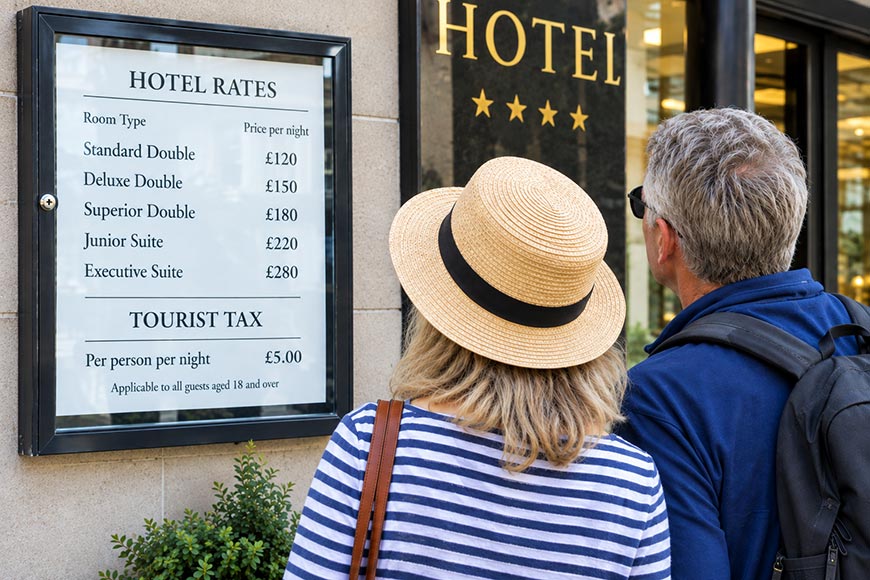
Scotland is first out of the gate. Edinburgh’s Transient Visitor Levy went live on 24 July, a mandatory 5% charge on the pre-VAT cost of hotels, short-term lets and campsites, capped at the first five nights of any stay. Reaction so far is mixed. Some welcome the investment, but Scottish Ballet has already cut performances in the city, pointing to what it called the unsustainable economics of touring Edinburgh, an early sign that the costs of a visitor levy don’t land only on visitors.
Edinburgh won’t be alone for long.
Wales passed the law allowing councils to introduce a visitor levy back in July 2025, and the rate itself is already fixed in legislation nationwide, £1.30 per person per night for most accommodation, 75p for hostels and campsites. Cardiff has become the first council to actually confirm it’ll switch the charge on, from 1 April 2027. Nobody’s paying it yet, but the wait for “which council goes first” is now over.
England is where it gets interesting.
Manchester and Liverpool have run their own voluntary schemes for a few years already, a £1 per room per night City Visitor Charge in Manchester and a £2 nightly charge in Liverpool, both business-led, with hotels choosing to pool the money for local tourism.

Bournemouth, Christchurch and Poole tried something similar, a £2-a-night levy voted through by a single vote in 2024, but a group of 42 hoteliers appealed, and the government upheld that appeal and declared the whole ballot void in January 2025. So despite what you might have read, there is currently no coastal tourist tax in Dorset; that scheme is dead, not paused.
What replaces it is the new statutory framework: on 10 September 2026, the government confirmed that mayors across England will get the power to introduce their own overnight visitor levy, charged as a percentage of the room rate rather than a flat fee. There’s no legal cap on the rate, but a group of Labour metro mayors have written to ministers proposing 5% as a voluntary ceiling.
Not every region’s on board; a few mayors have already said they won’t introduce it at all, so plenty of England will likely charge nothing even once the power exists.
UKHospitality reckons a 5% levy could add somewhere around £100 to £120 to the average family holiday in England, and there’s a sting in the tail on top of that: UK hotels already carry 20% VAT, and the tourism levy itself would be taxed at that same rate, so the real bump on your bill runs a bit higher than the headline percentage.
Nobody in England is actually paying this yet. It isn’t expected to arrive before 2028, and each mayor will have to publish their own plans and consult locally before switching it on.
Bournemouth, Christchurch and Poole doesn’t currently have a mayor, and the government’s framework was originally pitched as a mayoral power only, which is why the council has been publicly lobbying to be included. The latest wording does extend the option to some non-mayoral “Foundation Strategic Authorities” too, so it’s genuinely unclear right now whether BCP ends up covered or not. Worth watching if you holiday on the south-west coast, but either way, there’s nothing to pay there currently.
What’s already booked in for 2027
A few of these aren’t guesses, they’re already law or already announced, just waiting for the calendar to catch up.
Glasgow switches its 5% overnight levy on from 25 January 2027, with Aberdeen following at 7% from that April.
Cardiff becomes the first Welsh council to actually charge its visitor levy, from 1 April 2027, at the rate set nationally, £1.30 per person per night for most accommodation.
Vienna is partway through a staged increase already. Its Ortstaxe rose to 5% in July 2026 and climbs again to 8% from 1 July 2027.
Barcelona and the rest of Catalonia aren’t finished either. The region’s tourist tax rose sharply in April 2026, and it rises again in 2027, with five-star hotels outside Barcelona itself moving from €4.50 to €6 a night, and the cruise passenger charge ticking up from €3 to €4.
Amsterdam has a coalition plan, not yet formally signed off by the city council, to raise its tourist tax from the current 12.5% to 16% in 2027, then up by a percentage point a year until it hits 20% around 2030. It’s already the highest rate in Europe, so this would stretch that lead further, assuming the council actually adopts it.
Norway passed a national law in 2025 letting individual municipalities apply for permission to charge up to 3% on overnight stays, but as of now nobody has actually been cleared to collect it. Tromsø is furthest along, having submitted its plan to central government on 1 July 2026 and targeting 1 January 2027, but even that still needs sign-off from the relevant ministry before it’s official.
Notably absent from that list: England. The mayoral levy confirmed in September 2026 isn’t expected to actually charge anyone before 2028, so if you’re holidaying in England next year, 2027 should still be the same price it always was, for this particular reason at least.
Here’s where we get a bit earnest.
Tourism generates real money from real places, but that money doesn’t always find its way back to the people living there. The theory behind a tourist tax is that it closes that gap a little, funding the clean beaches, the maintained footpaths, the nightlife that pulled you there in the first place.
Travel is a privilege, not a right, and a fortnight’s holiday shouldn’t outweigh someone else’s right to live in their own city without it buckling under the weight of visitors. That’s still true in 2026, and honestly, it’ll still be true whenever we next update this piece.
So, do tourist taxes actually work?
They nudge things. They raise money for the places that need it. What they don’t do, on their own, is fix the actual problem, which is that popular places are popular because everyone wants to see them at once, and a 5% surcharge isn’t going to talk anyone out of finally seeing Venice … before they die!
A tourist tax is a sticking plaster, not a cure. Whether that’s good enough depends on how deep the wound is, and in most of the places charging one, it’s fairly deep.
Disclaimer: Travel regulations, taxes, and border requirements are changing rapidly. While we strive to keep this guide as up-to-date as possible, rules can be amended with very little notice. This article is for informational purposes and does not constitute official legal or travel advice. Always check official government or municipal tourism websites before booking your trip.
If you’ve enjoyed browsing our website, learned something new, or just had a smile because of what we do – we’d love your support to keep the good stuff brewing!
Travelling soon? Things to do and attractions not to miss with Get Your Guide …
Where to next?
• The Great Border Shift: What the New ETA Rules Mean for Dual Nationals
• 48 hours in Ramsgate and Broadstairs
• Holiday competitions