
‘Ah, it’s the perfect example of an English garden.’
The accent was trans-Atlantic, the stance oratorical and the tone absolutely certain.
I stood, lurking quietly in the shrubbery, inhaling the sweet perfume of summer roses, and pondered.
I love gardens and will happily wander through them for hours on end, unable to name more than a handful of plants, avidly reading any gardeners’ notes I find.
It’s one of my favourite pastimes, but I admit a depth of ignorance on things horticultural that almost matches my passion for plants.
So what exactly is an English garden? And why is it so beguiling?
What is a typical English garden?
Technically it’s a type of garden that developed in England, as a sort of genteel revolt against the formality of the architectural gardens of Europe prevalent at that time.
You know, the ones where everything is grown for show in straight lines with patterns, sculpted hedges and trees clipped into unnatural shapes.

Beautiful to visit, a nightmare to maintain, and just a little rigid. The gardens of the Loire châteaux are probably the best examples of this style, with neat borders and even the kitchen garden designed more for show than food.
But the English garden was soon to challenge these French and Italian inspired creations, and the battle of the flower beds began.
English landscape garden
In the 17th and 18th centuries, this became the most fashionable style of garden across most of Europe. Inspired by the great landscape artists of the time, it presents an idealised version of nature.

The traditional English landscape garden usually includes a sweep of rolling lawns, a lake, groves of trees and the occasional Gothic ruin, classic temple, folly or rustic bridge.
It was originally invented by designers William Kent and Charles Bridgeman who worked for a number of wealthy patrons.
Chiswick House in London was probably the first, with Stowe House in Buckinghamshire and Rousham House in Oxfordshire being the most famous.
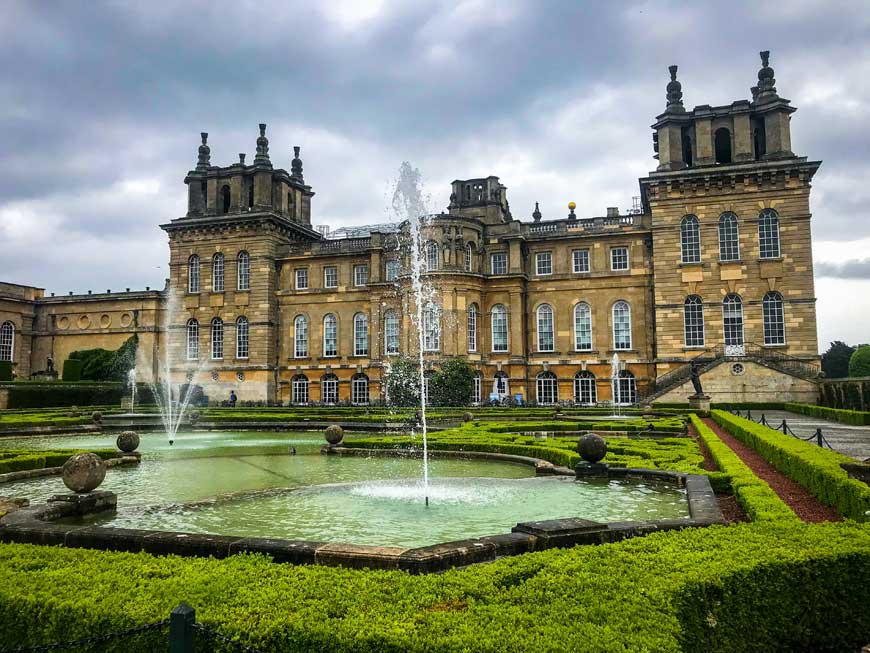
But the landscape creator everyone remembers is Lancelot ‘Capability’ Brown, whose contribution was to get rid of all small garden designs near the stately homes and replace them with extensive views of trees, making the landscape seem even larger.
Brown designed 170 gardens including Petworth in West Sussex, Chatsworth in Derbyshire and Blenheim Palace in Oxfordshire.


Capability Brown – so famous he’s a parody.
Author Terry Pratchett portrays him in his Discworld books as Bergholt Stuttley ‘Bloody Stupid’ Johnson, responsible for the creation of a fifty-foot deep ha-ha, named a ho-ho, a gargantuan beehive that is used for pigeons and an ornamental trout lake, very long but only one inch wide!
Most public parks in England contain more than a nod to this style of gardening. When strolling around them, I often think how delighted the late Sir Terry would be.
The classic English garden

By the 19th century, the grandeur of these big showpieces was being replaced by something on a smaller scale. Grottoes, temples, fake ruins and statues can still be found, but there are more shrubberies, woodland walks and flowers.
This is what most people think of as a typical English garden although, somewhat ironically, the best examples are found in Europe, like the Englischer Garten in Munich.

One of our favourite gardens in France, Château du Rivau, is based on this style and the Lost Gardens of Heligan in Cornwall is a beautiful restored English garden.


The English country or ‘cottage’ garden
How many kinds of sweet flowers grow
In an English country garden?
We’ll tell you now of some that we know
Those we miss you’ll surely pardon.
Informality is the guiding principle of an English country garden, with a style that uses naturalistic design, traditional materials and a mixture of ornamental and edible plants. Without formal structure, it relies heavily on the skill of the designer to create something with grace and charm.
It’s loosely based on the gardens of working class cottages where food not flowers was the main reason for their existence. You can see great examples of such cottage gardens at the Weald and Downland Museum.
But in the 1870s designers began working on the gardens of wealthier home-owners as an alternative to the more formal estate gardens with their rigid structures and mass plantings.
The earliest cottage gardens were very practical with vegetables, herbs, fruit trees, probably a beehive and some livestock. Flowers were first used to fill in spaces but gradually became more prominent.
Our very favourite cottage garden is the eclectic collection of plants at Five Oaks Cottage in West Sussex.

Love English gardens?
Do have a favourite English-style garden?
Or are you a fan of the formal?
Here are a few of our favourites which you may have missed.
RHS Wisley, Surrey, East Ruston, Norfolk, Leonardslee Gardens, Sussex
Discover all types of English garden with the NGS.
Founded in 1927 The National Garden Scheme gives visitors access to over 3,500 exceptional private gardens in England and Wales for charity.
Where to next?
• Postcard from Cornwall
• Island Life – Tresco
• Fuller’s Follies

The most beautiful gardens I have been to are at Crook Hall in Durham. @crookhall
Thanks for the heads-up. Next time we’re that way we’ll seek them out. Love the maze and they have accommodation too, even better.