
Early in the morning of June 15th 1215 a king rode out from a castle.
Pennants flying, escorted by his not-so-loyal barons, King John was leaving his favourite hunting lodge. He was on his way to nearby Runnymede, to put his signature to a document which would echo down through the centuries.

Magna Carta.
This was an historic document setting out an uneasy truce between Bad King John and his nobles. It protected them from illegal imprisonment, promised access to swift justice, and set a limit on how much they had to pay their feudal overlord.
It didn’t last, of course.
But Magna Carta is still an important symbol of liberty, justice and honesty.

Odiham and Magna Carta
Historians are now unsure if John, Richard the Lionheart’s unpopular younger brother, really rode out from Odiham to sign the charter.
It’s more than likely he was actually there on 10 June, meeting with his knights to draw up the Articles of Barons which preceded the charter itself. From there he rode on to Windsor.
But Odiham was undoubtedly one of his favourite castles and it’s possible that he did use it as a stopping point.
Oh, and Magna Carta itself wasn’t actually signed at Runnymede – it wasn’t fully ratified for another month.
But that’s history for you. Full of holes, anomalies and misinterpretations!
Odiham Castle
Today the remains of Odiham Castle still stand just outside the village.
A short walk away across the Royal Deer Park and along the peaceful towpath of the Basingstoke Canal brings you to the ruins.
It’s hard to believe the busy M3 is just a trebuchet shot away.

Odiham village

Odiham is a typical old English village.
A long High Street with houses from a dozen different eras spread out, all higgeldy-piggeldy, from the centre on tiny, winding streets.


Soft summer breezes and winter gales rustle through the creeper-covered stones, set ancient clay tiles rattling and branches of historic oak, ash and beech trees swaying.
In the churchyard moss-encrusted stones tell the tales of long lost village folk and a sundial keeps track of time.
But Odiham stands out from the rest because it has one of only five remaining Pest Houses in the country.
Odiham Pest House

A Pest House – that’s what drew us to Odiham on a sunny Sunday in September.
It just seemed appropriate in this brave new Covid world.

Odiham’s Pest House (or Plague House as they’re also called) is unusual being situated in the corner of the churchyard at the centre of the village.
Most Pest Houses were built outside the centre, for obvious reasons and Odiham did have a second Pest House built later on nearby Colt Hill.
The one in the churchyard was built around 1622. A one roomed brick house with a huge fireplace and a tiny sleeping loft above.
It probably started life as a poor house – somewhere for an individual or family who’d fallen on hard times to live.
By the late 18th century it was being used to house travellers who showed any signs of infectious disease like smallpox or plague. They were only allowed on their way once they had recovered.
Life in a pest house


In the early 19th century it was back in use as a poor house and the last inhabitant, Charlotte Cole, died there in February 1916.
The volunteers of the Odiham Society launched a campaign to save this slice of history. It’s now open and free to enter every weekend from 10 until 4 and outside of these times you can request a key from Odiham Cards in the High Street.
The village has many other old buildings spanning the centuries, most still in use today. The Bridewell, or old prison house, now houses the library, MP’s offices and the police when they need a local base.
Odiham stocks

From 1376 every town or village had to have stocks ‘to encourage virtue and discourage evil doers’.
They were used up to the early 19th century to punish misdeeds such as blasphemy, drunkenness and breaking the sabbath.
Nowadays you’re more likely to see carol singers than miscreants.

The local council still meets in the tiny Parish Rooms in The Bury, which was once the centre of the village.
Bel and The Dragon on the High Street dates from the 15th century and is the village’s largest timber-framed building.
The Cross Barn, now a community venue, was originally built in 1532 during the reign of Henry VIII.

And, like so many ancient places, it’s always worth looking up as you stroll around Odiham – so many oddities on roofs, windows and doors.

There’s even a little mystery high up on the outside wall of All Saints Church – a double sundial.

The upper dial has hour lines from 1 to 4pm but the midday point isn’t visible. The lower dial has similar hour lines 1pm to 4pm, but has another line between the vertical and the 1 o’clock line, which is odd.
And no-one’s yet come up with an explanation of why this double dial is so different.
Following the Odiham history trail
We spent a whole day exploring the village, taking one of the many self-guided trails the Odiham Society recommends.
The walk to King John’s Castle wasn’t strenuous but comfy shoes are a must and the paths could get muddy on damp days.
The round trip from the centre of the village will take a good hour and a half though you can park much nearer to the canal and take a shorter stroll.

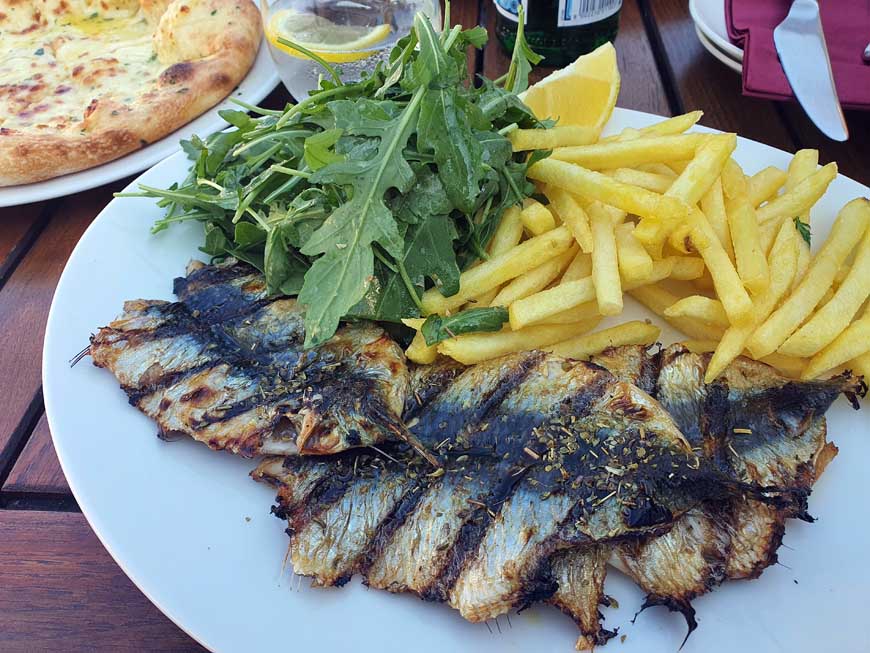
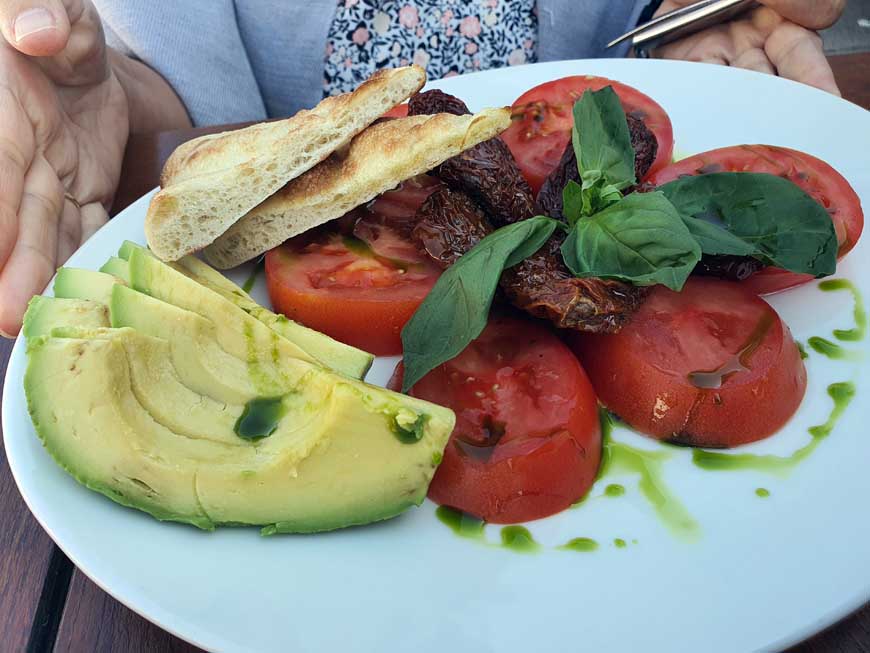
But we’d been fortified by a delicious light lunch at the Italian restuarant El Castello – grilled sardines and fries for Pork Belly, a fresh tomato and avocado salad for me – so we went for the full round trip.
Medieval deer park
As we crossed the deer park, following the grassy path down beyond the ancient dewpond, we didn’t encounter any wildlife except a herd of cows, chewing the cud and watching impassively until we passed out of view.

Although the park is much smaller than it was in medieval times, deer can still be seen here and much is being done to protect and preserve this slice of local history.
The long, circular walk loops back through the River Whitewater meadows, a site of Special Scientific Interest but also perfect for families pond-dipping and paddling in crystal clear streams.

The old ford can now be crossed by a narrow footbridge so you don’t have to get your feet wet and even the last stretch of busy roadway is dotted with historic interest.

Coming back towards the village centre there’s the Old Mill House pub and a row of 16th century cottages.
Millhouse and Castlebridge, with their bowed timber floors signifying years of use as reading room, malthouse, tannery, and even a slaughterhouse.
Now they’ve been restored as family homes.

By the time we were back in the High Street my FitBit told me we’d walked over 7 miles.
Not a bad day out in the soft September air.

More information about Odiham
• Things to see and do in Odiham
• Exploring Odiham
• The Odiham Society
How to get to Odiham
If you’re coming by car, the village is easily accessible from the M3, just off junction 5.
From London there are trains to Basingstoke and a bus route from there to the village.
Where to next?
• The very best of Exmoor
• Walk like a Venetian
• Fallingwater
Hello there. Could you tell me please WHERE i would find the old stocks?
Thank you in advance,
Nick H
Hi Nick, when we were there the stocks were outside All Saints Church in The Bury opposite the Bell pub. According to Odiham Parish Council webpage they are still there! Good luck in your search.