
It was the sound that struck me first, or rather the lack of it.
The moment the other members of the tour passed by, I felt it pressing on my eardrums. A soft, velvety silence that spread as the guide’s torchlight dwindled in the passageway ahead.
A few more seconds, and I’d be alone, in total darkness, enveloped in absolute stillness.
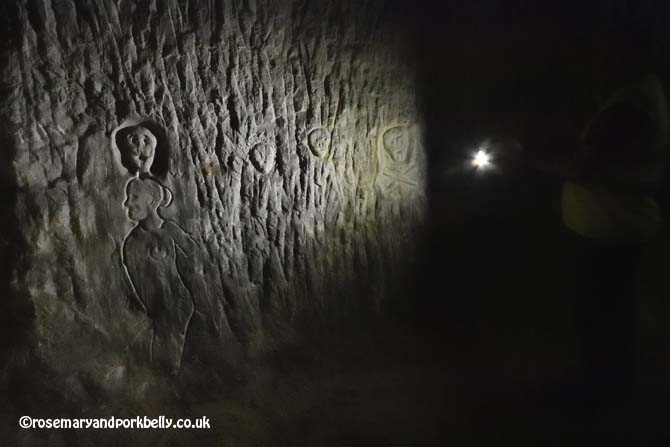
And the most extraordinary thing?
This is no dramatic cave on a faraway, exotic island. This is right beneath one of southern England’s busiest towns, Reigate in Surrey.
Of course, I’m not alone for more than a few moments.
I may have dropped behind my group to absorb the atmosphere, but there’s another party coming up behind. I see the lamplight creeping round the corner long before I hear their voices.
Because the tunnels under Reigate owe their unusual sound-absorbing properties to one thing.
Sand.
Mining usually brings to mind the search for precious metals and gems or manufacturing staples like coal, tin, clay and slate. But sand has played a vital part in human history for centuries.
Guided tours of the tunnels
Reigate Caves are open once a month from May to September for guided tours of the tunnels and nearby Baron’s Cave.
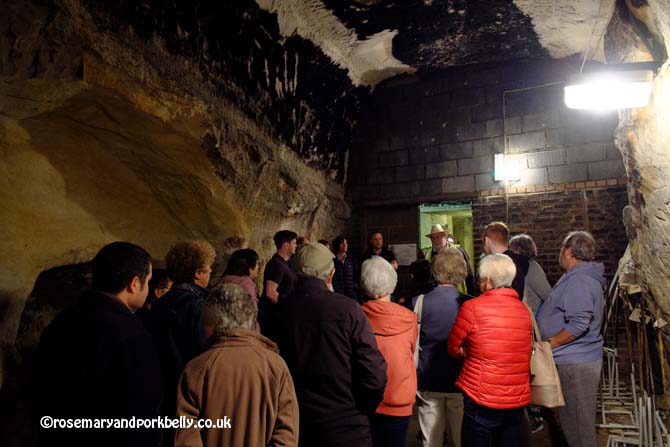
Experts from the Wealden Cave and Mining Society are on hand to lead you through the winding passageways and explain their long and busy history.
Our guides Frank and Paul are knowledgeable and entertaining, pointing out things the uninitiated would miss.
Sandstone is soft and easily rubbed away, so we’re warned to be careful not to touch anything.
Photography is allowed, the signs that ban it date from when the caves were used as ammunition stores, but everything explosive has now been removed.
The caves, or more accurately tunnels, are extensive, spreading out in a honeycomb under the whole of the town centre.
Experts are still exploring, excavating and preserving its history. Its passageways and caverns have been here for centuries and are robust enough to survive most things, even the regular target practice by the local gun club. Ironically, they have to bring their own sand for absorbing the bullets, because the stuff here is too fine.
The history of Reigate sand
You have to learn a little background to really appreciate the importance of Reigate caves.
The sand here is very special, part of the Folkestone beds, which stretch all the way from the Kent coast to Alum Bay on the Isle of Wight.
It was too soft for building work, so only became truly valuable when glassmaking and industrial abrasives were developed.
Quarrying started in earnest here in 1820. Folklore says it was ordered by the Prince Regent, but there’s no real evidence of that.
However, the opening up of the route from London to Brighton in 1824 with a tunnel under the North Downs meant Prinny’s friends on their way back from a riotous time in his Pavilion could buy a bag at the site for sixpence and sell it for a shilling when they got back to London. A neat way to combine pleasure and profit.
As with everything that’s been around for centuries, the caves have had a multitude of uses and the tour takes in most of its history.
Much of that centres on its role in the two World Wars as both ammunition store and safe haven.
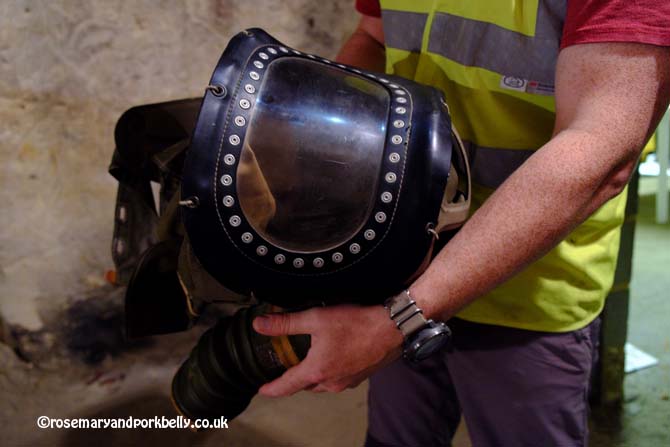
Wartime use
In World War 2 it served as a secure place to avoid the bombing raids and was equipped with bunk beds, chemical toilets and an entertainment section for concerts, films and magic lantern shows to take people’s minds off what might be happening above ground.
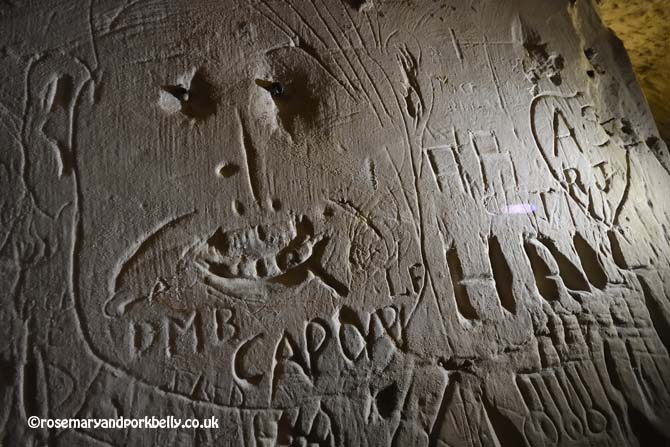
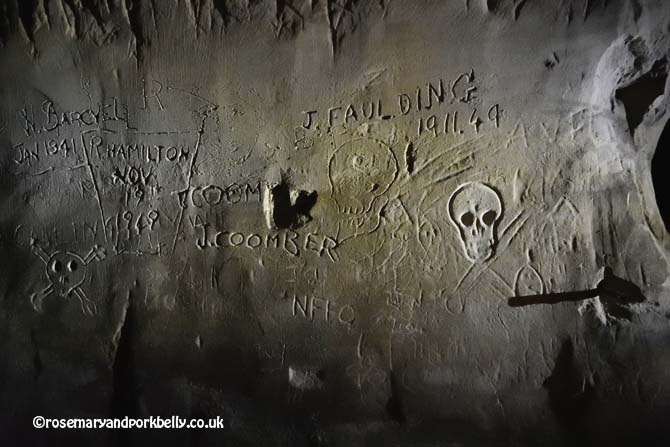
During the day, the caves were the base for Canadian tank troops. The walls are covered in graffiti, some very explicit, along with several cartoons of Hitler.
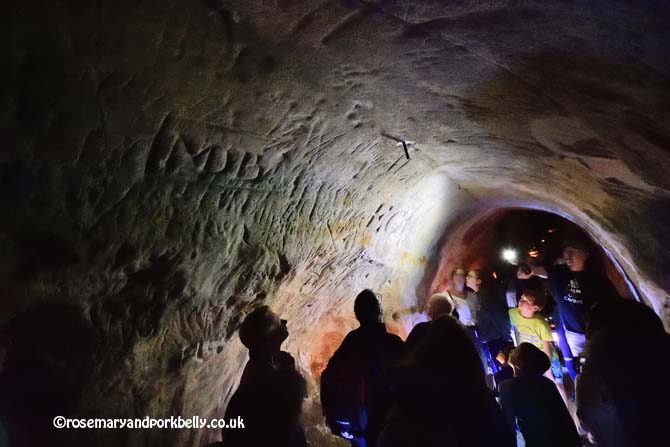
Even more fascinating are the older parts of the caves, where you can still make out the pick marks on the roof from the first miners quarrying the sand.
The lines go across the roof from side to side which is unexpected, but this method meant that two young lads could work with each miner, one on each side, gathering up the sand as it fell. These youngsters were paid a wage which included a mug or two of “small beer”, which is probably the origin of the phrase “as happy as a sandboy”.
The early miners worked by tallow candlelight, illuminating little more than the part they were working on. Later gas was piped in to create more light and the remains of that piping can still be seen in the cave roof.
But not all times below the surface were grim.
One cavern was so large it was once a dance hall and hosted musical concerts. Other parts were brought into use as store rooms because the constant temperature below ground kept food fresh in the days before fridges. Meat, cheese, beer and wine have all been stored over time in Reigate Caves.
Even today, local brewers Pilgrim use it to store six 40 gallon oak barrels of stout, aged for 6 months before bottling. You can taste the results at their shop in West Street.
Spooky faces
The caves are still being explored, and new areas opened up for surveying.
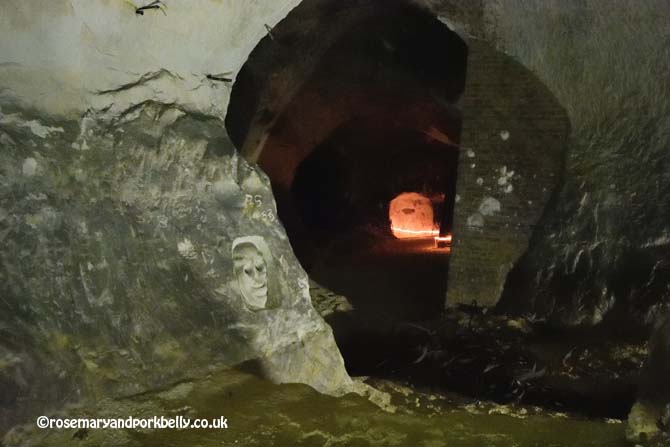
The faces that can be found dotted along the walls probably date from the 1850s and are rather startling.
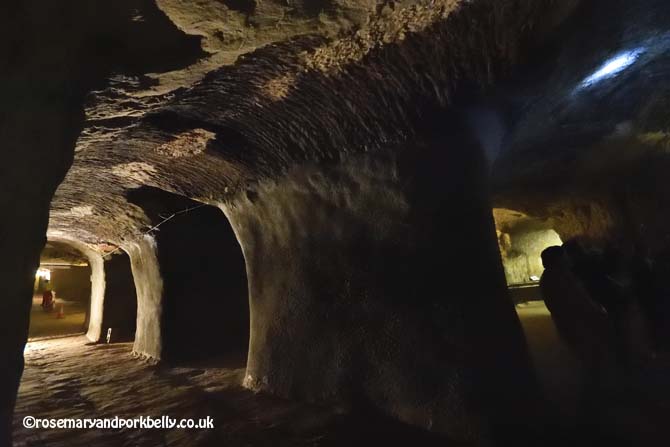
Having underground quarries inevitably causes problems up above. The two lower levels have been filled in to support the surface after several collapses caused by the weight of houses and traffic vibration.
Originally the wattle and daub houses of the town posed no problem, but when bricks and mortar came along, not surprisingly there were a few incidents. In 1886 there was a huge collapse, sinking several cottages, and the falling rubble forced the air out and blew the steel doors off the tunnel entrance.
Amazingly, no-one was killed.
The guides tell us a story of the local cricket team sheltering under an oak tree during a thunderstorm when they saw the entire cricket pitch sink downwards. No-one’s found any documentary evidence to confirm this event, but it’s a great tale.
Reigate Tunnel Museum
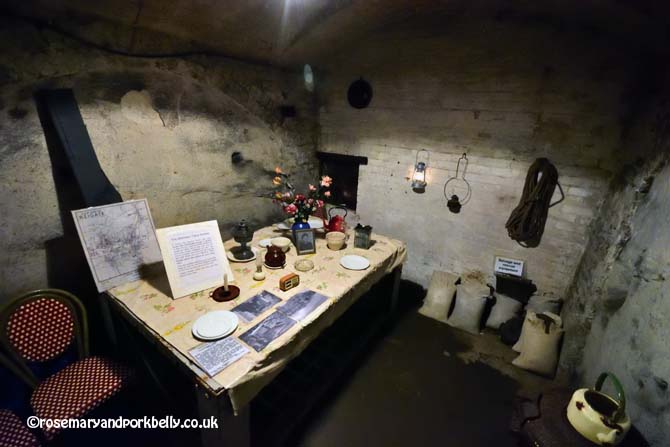
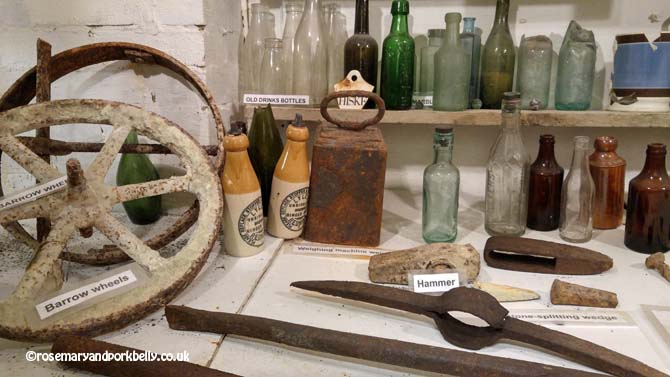
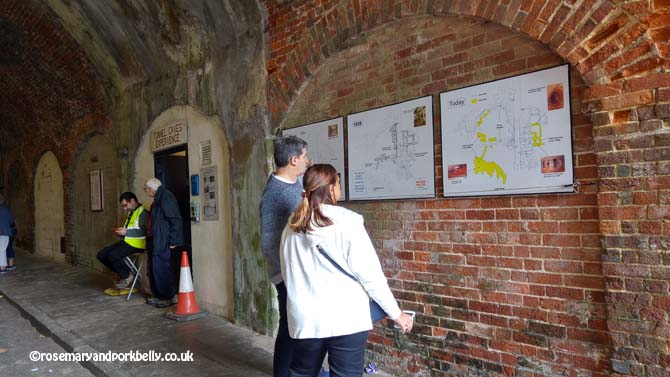
Once the tour is over you can take your time to explore further on the other side of the road where there’s a museum gathering together artefacts and recreations of the tunnels’ varied uses.
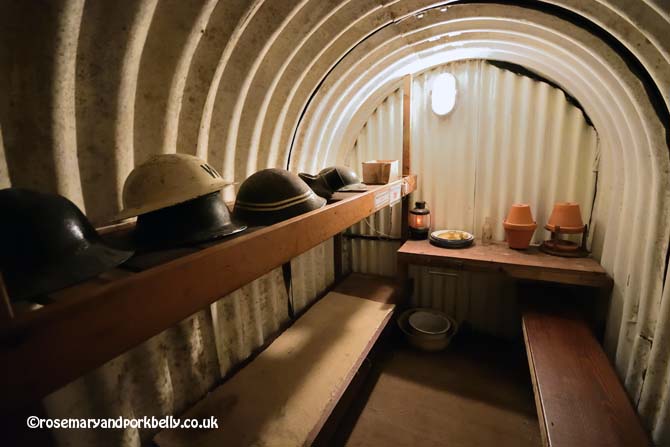
Work is underway to reconstruct an old Roman kiln discovered nearby, and there’s an audio experience of what it was like to be in an Andersen shelter during a WW2 air raid.
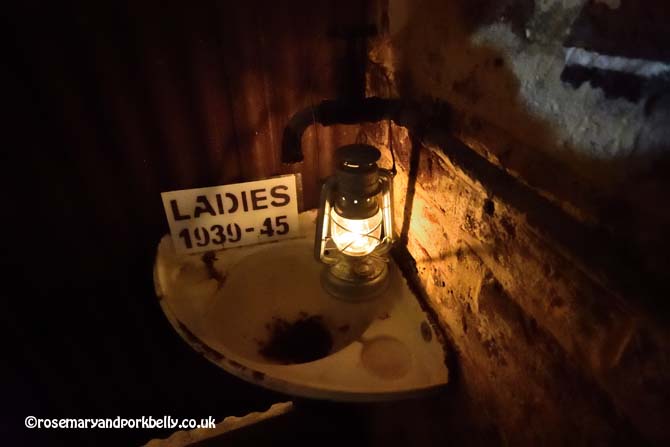
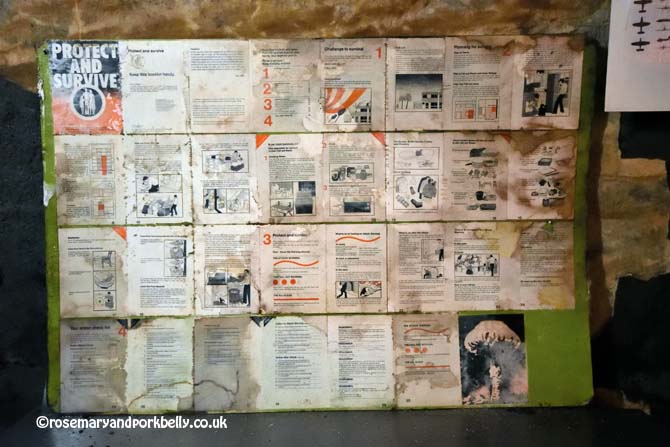
Even more chilling is the Cold War Room from the 1970s.
There you’ll find an original Protect and Survive pamphlet that Pork Belly and I remember dropping through our letterboxes. Packed with impractical and mainly useless suggestions for surviving a nuclear attack.
As Frankie Goes to Hollywood sang “when two tribes go to war”…
Reigate Castle and Baron’s Cave
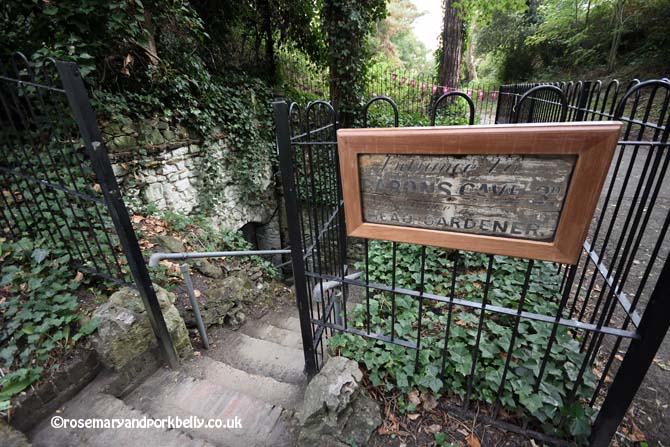
Coming up again into the sunshine, it’s a relief to feel the bustle of Reigate in the 21st century around us.
A stroll in the gardens on the mound where Reigate Castle used to stand helps my mood and leads us to Baron’s Cave, the oldest part of the workings.
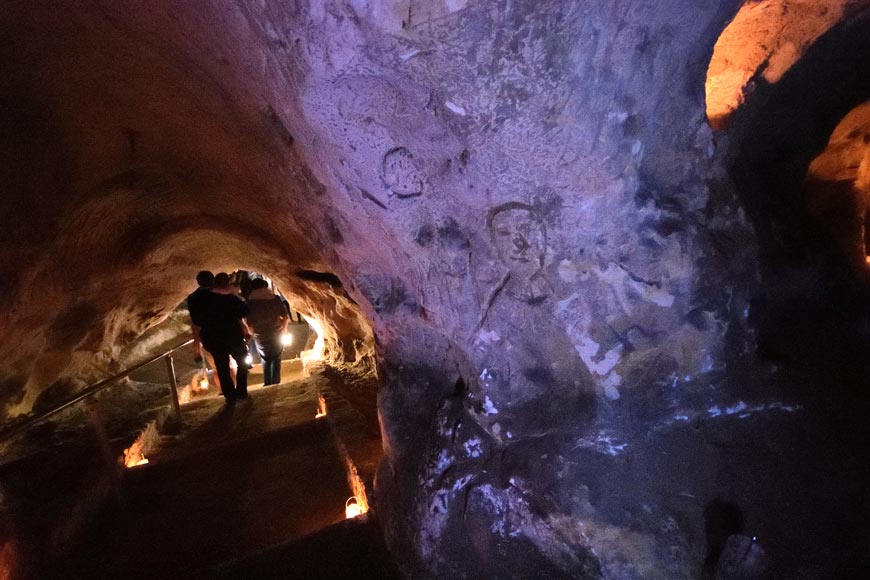
William de Warenne came over as part of the Norman Conquest and began to build a wooden castle on the site in the early 1100s.
All that remains of the structure today is the stone tunnel he excavated as a “sally port” so his troops could ride out undetected and surprise any enemy with the temerity to try besieging his castle.
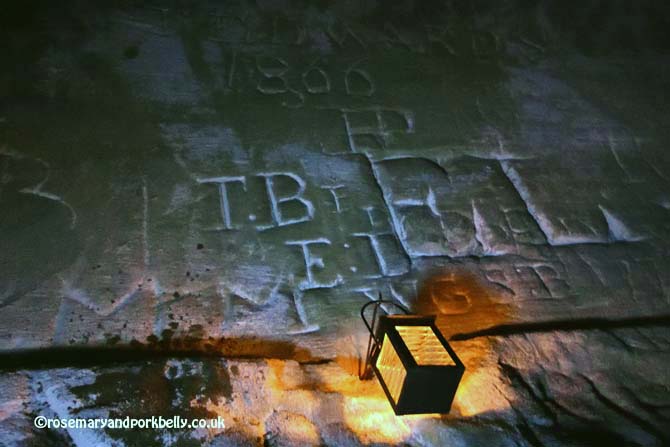
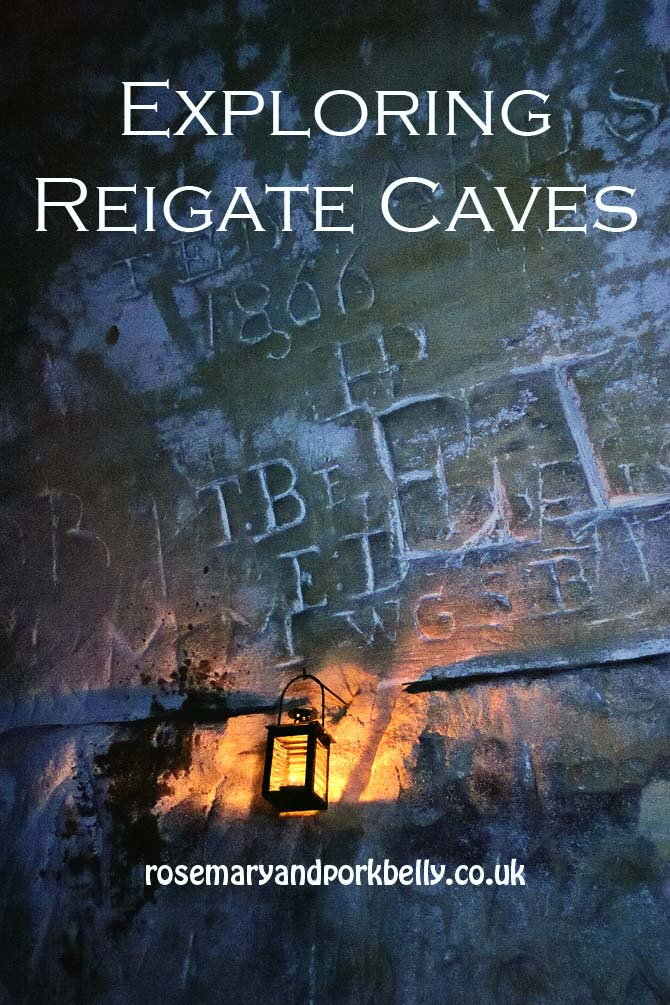
Here too the walls are covered in graffiti, but it’s clear these are no casual scratchings by bored soldiers or miners.
It turns out they were done professionally in Victorian times as a form of advertising. The Victorians loved a bit of tourism, and the caves were a real attraction. They kinda spoilt things from a historic perspective, but they certainly left their mark.
Other historic vandalism soon followed; Mods burned their slogans into the walls with zippo lighters and hippies camping out in the caves added their signs and symbols, including the CND ‘ban the bomb’.
There are some squares with initials in that look like stonemason marks, but experts think most are recreations, although there is one that could be an original. On all the walls there are strange animal and human faces, but it’s hard to make them all out.
What to expect of a tour of Reigate Caves
You will need to wear sensible shoes and put on hard hats. The stairs are steep in places and the floor uneven. The guides are full of stories about the caves and many of them have personal memories to share, so every tour is slightly different.
The guided tour of Tunnel West takes 45 to 60 minutes to complete, and after that you’re free to spend as long as you like in the museum displays across the road. The tour of Baron’s Cave takes from 30 to 45 minutes, and it’s recommended to leave 90 minutes between bookings to see them both.
Costs in 2024
Baron’s Cave
£4 for adult, 5-16 year olds and Over 60s £2
Tunnel Road caves (tour and museum)
£4 for adult, 5-16 year olds and Over 60s £2
see here for dates and booking information
For the best time to visit Reigate Caves, you can find more details on their website.
Where to next?
• A Derbyshire Tale
• Fabulous worldwide film locations you can actually visit
• History walks
Wow! Just trying to catch up on some research for the last Reigate Caves open day for the year, tomorrow 14th September 2019. Hoping to add some new stories. My search, ‘ The Prince Regent and Reigate Caves’ brought your article up as, a very comprehensive, 4th place.
Hi Helen, Glad the great and mighty Google thinks we are worth serving up to you!
Reigate has so many fab hidden gems, you’ve really captured this amazing location.
Thank you, the town took us by surprise. We live pretty close but had never visited til we heard about the caves.