
The Call of the Wild – and Why It’s Closer Than You Think
Are you an islomaniac – someone who dreams of being surrounded by sea spray, seabirds and a healthy dose of isolation?
One of the most haunting songs from my childhood was Bali Ha’i from the musical South Pacific. It promised a mysterious island “calling across the sea”. Well, here in the UK, you don’t have to travel halfway round the world to find your very own Bali Ha’i.
If you try, you will find me
Rodgers and Hammerstein
Where the sky meets the sea
Here am I your special island
Come to me, come to me
You just have to be willing to push the boat out – sometimes literally – and explore the abandoned, the untamed and the wildly beautiful corners of our island nation where nature reigns supreme and mobile signal is a distant dream.
How many islands?
Between England, Scotland and Wales there are around 6,289 islands, though only about 189 are permanently inhabited.
That leaves thousands more which are remote, tidal, occasionally unreachable, and almost always fascinating and mysterious.
So, if you fancy swapping traffic noise for crashing waves, here are eight wild and wonderful UK islands you can (with a bit of effort) actually visit.
Oronsay, Inner Hebrides – A Tidal Island and RSPB Nature Reserve

This tiny tidal island lies just south of Colonsay and is reached only at low tide across The Strand. It’s privately owned but farmed and managed as a nature reserve by the RSPB, under agreement with Oronsay Estate.
Oronsay is a paradise for corncrakes, choughs and grey seals, and a reminder that on some Scottish islands, the wildlife really does have right of way. The ruined Oronsay Priory, founded in the 1300s, still stands among the fields – a weathered echo of medieval devotion.
You’re welcome to visit Oransay but bear in mind there are no visitor facilities, and timing your crossing with the tides is essential, but that’s all part of the adventure.
If you’re planning a trip, your base camp will be Colonsay, its slightly larger and much more sociable neighbour. The island has a population of around 120, a hotel, self-catering cottages, and a café.
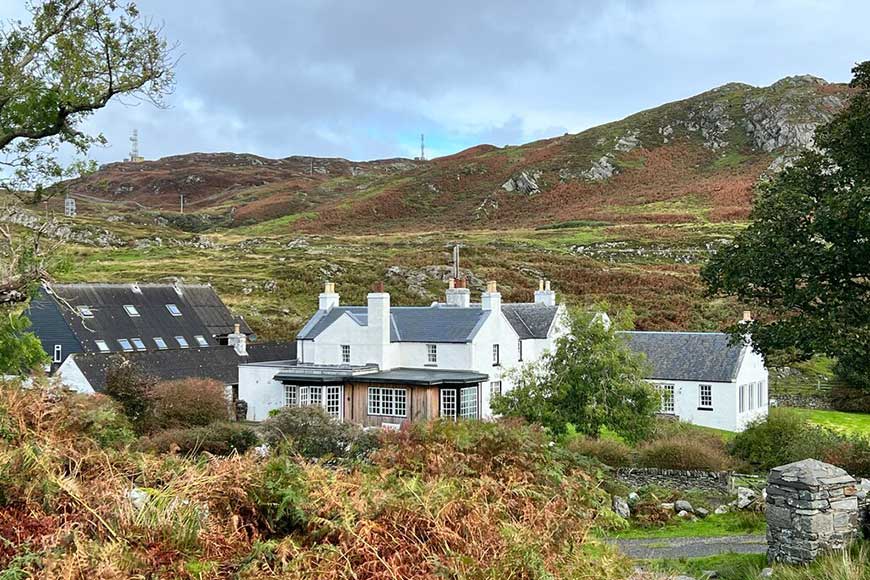
You can reach Colonsay by ferry from Oban or by air from Islay, and once there, it’s a short walk or cycle to The Strand, the tidal causeway linking the two islands. Just make sure you consult local advice before crossing; the tides wait for no one, no matter how enthusiastic the adventurer.
Mousa, Shetland Islands – Home of the Ancient Broch and Storm-Petrels
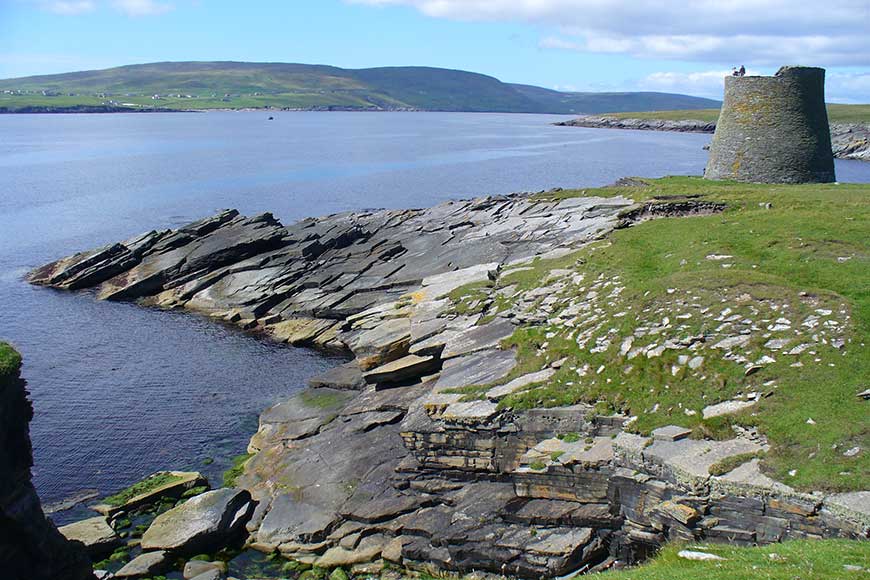
If you think you’ve reached the end of Britain, keep going, Mousa lies even further north, a wild, wind-whipped island that’s been uninhabited since the 19th century.
It’s home to the Broch of Mousa, the best-preserved Iron Age tower in the world, built around 300 BC and still standing a proud 13 metres tall. The island is now an RSPB nature reserve and Special Protection Area for the thousands of storm-petrels that nest inside its ancient stone walls.
Add to that the grey seals, black guillemots, and Arctic terns, and you’ve got a naturalists’ nirvana. A small summer-only ferry sails from Sandwick (April to mid-September) – weather permitting. Bring a windproof jacket, a camera and a sense of awe.
Catch the Mousa Boat from late May to mid-July for guided nighttime trips to see the European storm petrels.
Holm of Papay, Orkney – Step Inside a 5,000-Year-Old Cairn

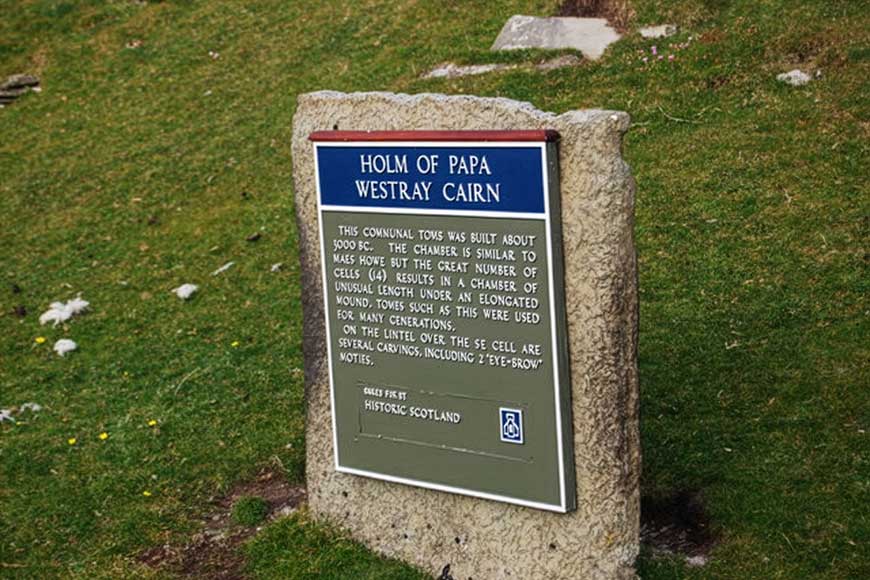
Just off Papa Westray lies a speck of land known locally as Papay Holm. Uninhabited and mysterious, it hides a 5,000-year-old Neolithic chambered cairn, complete with carvings that look like eyebrows. Perhaps the earliest example of expressive art in Britain.
During summer, local rangers offer guided boat trips from Papa Westray. Expect seabirds, seals and a touch of time travel as you descend into the ancient stone chambers.
• Find out about the guided boat trips here.
• If Orkney’s your dream destination, read more here
Farne Islands, Northumberland – Puffins, Seals and Saintly Legends

Everyone’s heard of Lindisfarne, but a few miles down the coast lie the Farne Islands, a scatter of 15-20 rocky outcrops that disappear and reappear with the tides.
In the 7th century, St Aidan and St Cuthbert sought solitude here, and Cuthbert even introduced what’s thought to be the world’s first bird protection law, safeguarding the eider ducks that still nest on the islands today.
Fast-forward to now, and the islands are managed by the National Trust as a vital seabird reserve. Puffins, seals and terns rule the roost; the terns, incidentally, have no qualms about dive-bombing your hat if you stray too close to their nests.
Boat trips depart from Seahouses, with landings (on Inner Farne and Staple Island) available seasonally, but always check ahead, as restrictions and closures can occur for wildlife protection or bad weather.

The islands are also known as the home of Grace Darling, the daughter of Longstone lighthouse-keeper, who helped her father rescue nine people from the wreck of the Forfarshire after it ran aground on Harcar Rock in September 1838.
Today the islands have no permanent residents, just National Trust rangers who stay in the old tower on the Inner Farne and the lighthouse cottage on the Brownsman in the outer group.
Puffins can be seen at certain times of the year and share their burrows with wild rabbits – they simply evict them when it’s nesting time! And beware of the arctic terns who nest close to the path on Inner Farne, they’ll attack if you get too close!
Cei Ballast, North Wales – The Man-Made Island with a Maritime Past

Proof that not all islands are born of volcanoes or shifting tectonic plates – some are made of leftovers.
Cei Ballast was formed when Victorian ships, empty of slate, dumped their ballast rocks in Porthmadog Harbour. Today it’s a tiny tidal island that you can walk to at low tide from The Cob, rewarded with views of Snowdonia and a shoreline rich in shells, pottery shards and curiosity.
There are no facilities, no signs and no ticket booths – just tide tables to check and common sense to pack. A lovely reminder that wildness sometimes lurks just beyond the high street.
Ramsey Island (Ynys Dewi), Pembrokeshire – RSPB Seabird Sanctuary of the South West

Much further south, off the Welsh coast, you’ll find another RSPB nature reserve on Ramsey Island.
Named Ynys Dewi in Welsh, “St David’s Island”, this wild outpost sits just off the coast from St David’s Head. But the English name, Ramsey, comes from the Old Norse Hrafns ey, meaning “Raven’s Island”. A fitting name, really, for a place still ruled by birds.
Towering cliffs (up to 120 m) are home to peregrine falcons, choughs, and thousands of nesting seabirds, while the surrounding waters host one of the largest colonies of grey seals in southern Britain.
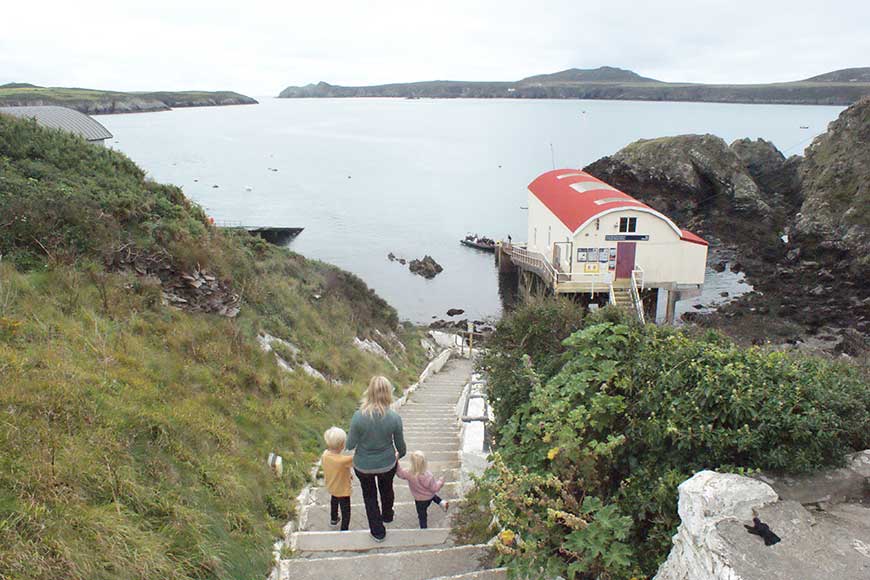
Owned and managed by the RSPB since the early 1990s, Ramsey is tended by wardens and volunteers during the visitor season (spring to autumn). Boat trips run across the swirling Ramsey Sound from St Justinian’s – a short but thrilling crossing where strong tides and swirling currents add to the sense of adventure.
It’s wild, windswept and wonderfully Welsh. Just remember, the tides here set the timetable, not you.
• Boat trips to Ramsey Island
• Ramsey Nature Reserve
Samson, Isles of Scilly – The Deserted Island of Myths and Wildflowers

We’ve shared the delights of Tresco in the Isles of Scilly, but Samson, just a tiny strip of water away, is a wildflower island paradise.
A ghost island – deserted since 1855 when its last residents left after years of hardship. The ruins of their cottages still stand amid dunes and wildflower meadows, alongside prehistoric burial mounds and the remains of a failed Victorian deer park (the deer famously swam away).
There’s no quay, so visitors arriving by boat (usually between May and September) disembark via a plank or ladder – proper island-hopping style.
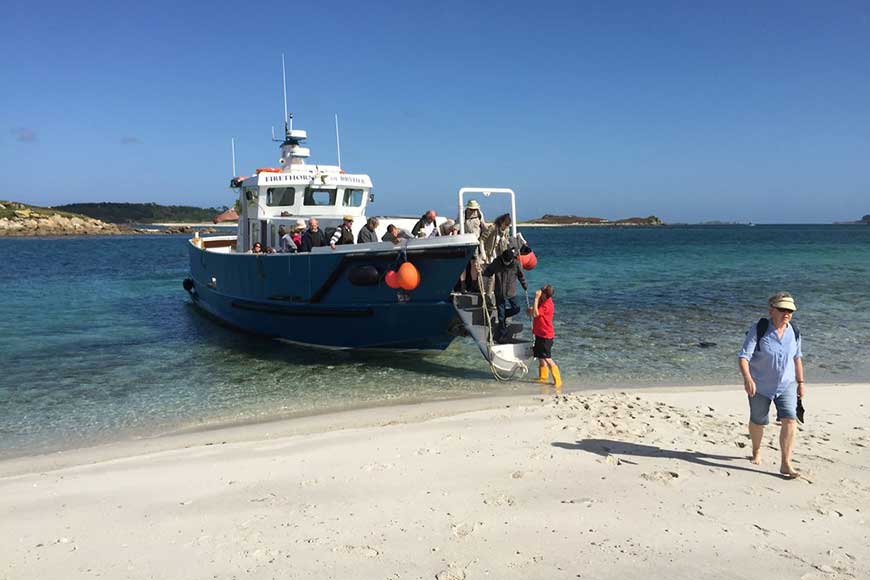
Children may know Samson as the setting for Michael Morpurgo’s Why the Whales Came, and fans of Arthurian legend will recognise it as the place where Tristan defeated Morholt. Either way, it’s rich in stories, solitude and seabirds.
Scolt Head Island, Norfolk – Sand, Seabirds and Shifting Tides

If you prefer your wilderness with a bit more sand, Scolt Head Island is the place for you. Set in calmer seas but still remote and wild, it’s a shifting blend of dunes, mudflats and salt marshes. Owned by the National Trust, it’s a National Nature Reserve renowned for its birdlife.
Terns, oystercatchers, waders and wildfowl make it a twitcher’s paradise – though you may also spot rabbits, shrews and stoats if you keep still long enough.
A ferry runs from Burnham Overy Staithe, but always check the tide times on the Boathouse door before setting off; the North Sea has no sympathy for dawdlers.
It is theoretically possible to walk to Scolt Head at low tide, but not recommended as the local waters can be treacherous and currents strong.
There’s also plenty of sand so bring a bucket-and-spade, as well as binoculars, a flask and plenty of layers, but remember it is a nature reserve, there are no tourist facilities plus the weather can be unpredictable, so come prepared for four seasons in one day – it’s Norfolk, after all!

Oh, and if you’ve come by car to the Burnhams, please don’t park near the water’s edge. The tide comes in fast and high – every year tourists have to be rescued!
So – is your favourite UK wild island here?
These are places where the elements still call the shots. You won’t find fancy cafés or phone signal, but you will find cliffs echoing with birdsong, ancient ruins, and the delicious feeling of standing somewhere most people never reach.
Grab your boots, your tide timetable and your sense of adventure – and go answer the call of the wild.
Feature image: Innner Farne Isle at Dawn © Neil Howard, Flickr (cc by-nc 2.0)
Images reproduced under Creative Commons licence
If you’ve enjoyed browsing our website, learned something new, or just had a smile because of what we do – we’d love your support to keep the good stuff brewing!
Looking for somewhere to stay? Browse our Travel Shop
Where to next?
• 7 weird and wonderful things to see in England
• Nelson’s Norfolk
• 7 best summer beaches UK