
A big plus of holidaying in your home country is, with a bit of training, forward planning and the right accommodation, it’s easy for dogs to come too.
But what about taking your dog abroad on holiday? Since we last updated this post in 2025, the world of pet travel has shifted again.
This is your essential update for taking your dog abroad on holiday in 2026.

Should I take my pet on holiday abroad?
Cats, rabbits and small animals who aren’t used to travel shouldn’t be taken on holiday, as the experience is likely to be too stressful for them.
We’re told that ferrets make easy travel companions, but we’ve never tried it!
First things first, whatever the destination, there will be a number of health-related actions you need to take before you can travel out of the UK with your pet.
Travelling with a dog to Europe and Northern Ireland
Great Britain is a “Part 2 listed country” under the EU Pet Travel Scheme. As of 22 April 2026, the rules for EU Pet Passports have changed significantly for UK residents. A good place to find up to date information about travelling with a pet is the GOV.UK website.
The “Loophole” is Closed
As of this week, 22 April 2026, new EU regulations have officially “closed the loophole” for UK residents. Previously, some UK travellers used pet passports issued in EU countries (like Spain or France) to skip the AHC fee. This is no longer allowed. If you live in Great Britain, you must now have a UK-issued Animal Health Certificate (AHC) for every trip to the EU. An EU Pet Passport can only be held by a person whose primary residence is within the European Union.
You will need the following:
• Microchip: Confirmation that they are chipped
• Up to date rabies vaccination/booster: Get this done by your vet at least 21 days before you travel.
• An Animal Health Certificate (AHC): This must be issued by an “Official Veterinarian” (OV) no more than 10 days before you travel. Expect to pay around £150 – £250, though specialist travel clinics near ferry ports sometimes offer better rates.
Important AHC facts
• The AHC can only be issued from 21 days after your dog’s rabies vaccination (unless it was an in date rabies booster).
• Entry Window: You must pass through EU border control within 10 days of the AHC being issued.
• Once you enter the EU, the AHC is valid for 6 months travel throughout the EU as well as Switzerland, Norway, Gibraltar and Andorra.
• The AHC is a single use document valid to enter the EU and return to the UK once only within the 6 month timeframe.
• Up to 5 pets belonging to the same owner can go on the same AHC, and a mixture of dogs, cats, and even ferrets can all be on the AHC if needed.
Good News for Northern Ireland
The Northern Ireland Pet Travel Scheme is now fully live! If you are a resident of Great Britain travelling directly to NI (and not onwards to the Republic of Ireland), you can now apply for a Pet Travel Document (PTD).
Cost: Free.
Validity: It lasts for the lifetime of your pet.
To get a PTD for Northern Ireland your pet must be microchipped but will not need a rabies vaccination or tapeworm treatment. You can apply online.
Tapeworm treatment
Five countries still require dogs to be treated for tapeworm (Echinococcus multilocularis) before entry from Great Britain: Finland, Ireland, Malta, Norway, and Northern Ireland (unless you have the new PTD).
• Timing: Treatment must be given between 24 and 120 hours before arrival.
• The Vet’s Role: A vet must administer the treatment (containing Praziquantel) and sign the relevant section of your AHC.
When you leave Great Britain for a short trip to visit countries other than Finland, Ireland, Malta, Northern Ireland or Norway, you can have your dog treated and recorded in the Animal Health Certificate (AHC) by a vet before you go.
If your trip is longer than 5 days your pet you will need to visit a vet in Europe at least 24 hours before you head to the ferry or tunnel to get a fresh dose and a signature on your AHC.

Travelling with a dog to non EU countries
For trips to non-European destinations (like the USA, UAE, or Australia), you will need an Export Health Certificate (EHC) and, if you are in England, Scotland, or Wales, an Export Application Form (EXA).
An EHC is a bespoke document ensuring your pet meets the specific health requirements of your destination. Because these rules are strict, start your research at least 3 to 4 months before you fly. Some countries require blood tests and waiting periods that can’t be rushed.
The Process:
You must apply for the EHC via the GOV.UK portal.
You will be asked to nominate an Official Vet (OV). APHA (the Animal and Plant Health Agency) will then send the digital certificate directly to your vet for them to sign after they have examined your pet.
Pro-Tip: If you are flying to a non-EU country but stopping over in Europe (e.g., a layover in Frankfurt), check if you need a “Transit Certificate” to get through the airport.
As always, check the Pet Travel Section of the government website for the specific country you are visiting to ensure you have the most recent version of their forms.
Border control for dogs
When travelling with pets you must make sure you have gone through the correct point of entry where you may need to show the AHC and any other proof of health status.
To Muzzle or Not to Muzzle
Many companies require a dog to be muzzled throughout the journey and on a leash or restrained in some way. Check and comply.
Now down to the practicalities of travel itself.
Leaving the UK with your dog
There are only three ways to leave the UK – ferry, plane or tunnel. And each has its own strengths and weaknesses.
Dog friendly ferry companies
All the main UK ferry companies have provision for carrying pets, but their facilities vary and to get the best, dog friendly transport you will have to pay extra, unless you are travelling with a registered assistance dog.
And, a word of warning for dog families travelling on popular routes to and from Europe. You will need to book well in advance, maybe as much as a year, unless you’re lucky enough to get a cancellation.
Dogs on Stena Line
Stena Line has standardised their pet-friendly cabin offering across these key Irish Sea and Continental routes. There is a strict limit of two pets per cabin. If you have more than two, any additional animals must be booked into a kennel or left in your vehicle (where permitted).
Stena Line Pet-Friendly Cabin Routes:
Cherbourg – Rosslare: Stena Vision and Stena Horizon
Liverpool – Belfast: Stena Edda and Stena Embla
Holyhead – Dublin: Stena Adventurer and Stena Estrid
Fishguard – Rosslare: Stena Nordica
Got questions? A good place to start is with their FAQ section.
And if you are travelling to Sweden with a dog, you must notify Swedish customs in advance. For more information see the official website.
Dogs on DFDS Seaways
For the short Dover–Calais and Dover–Dunkirk crossings, pets must stay in your vehicle. You can arrange a supervised visit to check on them during the voyage by speaking to the crew at the Guest Service Centre.
However, for 2026, the Newhaven–Dieppe route offers more flexibility: you can now book pet-friendly cabins or onboard kennels. This is also the primary route for foot passengers travelling to France with a dog.
On the Newcastle–Amsterdam route, dogs must be booked into a pet-friendly cabin or a kennel at the onboard “Pet Hotel.” There is even a dedicated dog exercise area on the outer deck so Fido can get some fresh North Sea air!
For the Dunkirk–Rosslare, Oslo–Frederikshavn–Copenhagen, and Baltic Sea routes, pet-friendly cabins are the only option. Because these are limited, if no cabin is available, you won’t be able to board with your pet. So book early!
For more details see their website.
Dogs on P&O Ferries
The Pet Lounge (Dover-Calais) remains the most popular choice for social dogs, offering a dedicated space where you can stay with your pet throughout the crossing. There’s also an exercise area on the outside deck.
Extra information can be found here.
Dogs on Brittany Ferries
These are longer crossings than the Dover-Calais route and the company warns that pet travel is very popular and space is limited and subject to availability.
Pet friendly cabins are available on 7 of their ships; Armorique, Galicia, Salamanca, Pont-Aven, Santoña and Normandie, and there are kennels on 5 ships; Bretagne, Galicia, Salamanca, Santoña, Pont-Aven and the brand-new Saint-Malo.
If you are leaving your pet in your car, you can only make visits to your dog with a crew member (if sailing conditions allow) and there are no permitted visits at all on overnight sailings.
You can find a useful checklist here.
Dogs on Condor Ferries
Now part of Brittany Ferries, the routes between UK, The Channel Islands and France now have the option of pet-friendly cabins on two major ships:
Condor Islander: This ship features dedicated pet-friendly cabins with laminate flooring and easy access to an outside exercise deck. These are limited to two pets per cabin.
Commodore Clipper: Following the success on the Islander, the Clipper has also been refitted with pet-friendly cabins for the UK–Guernsey–Jersey routes.
Find useful information on their Travel with Pets section.
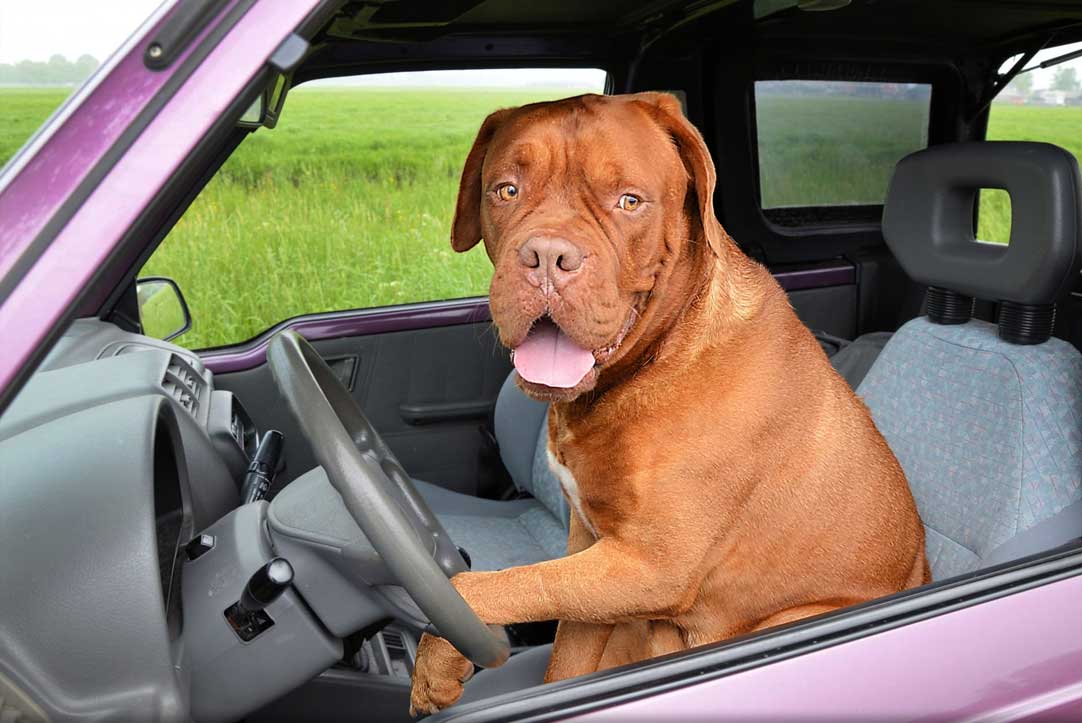
Dog friendly airlines
This remains a wide-open field, and as always, you must check with the airline before booking. Flying can be a stressful experience for dogs, and for 2026, many airlines have tightened their rules to prioritize animal welfare.
Travel with registered assistance dogs remains well-supported. However, for 2026, most airlines now require you to submit your “Assistance Dog” documentation at least 48 to 72 hours in advance for digital pre-approval.
The Guide Dogs for the Blind charity in the UK does a lot of work in this area. We visited their training centre back in 2018 and learned how they prepare puppies for any travel eventuality.
For guidance about travelling by boat, car, coach, or rail with an assistance dog they have a very informative page. They also have a comprehensive guide to flying with an assistance dog.
But what about the family pet?
The first thing to check is your destination – each country has its own rules about who can fly there with a pet and under what conditions.
You’ll also need to do your homework on individual airlines, because there are no generally applicable regulations for the transport of animals in planes.
Most airlines operate under the following criteria:
• Small dogs up to 8kg are usually transported directly in the cabin. They need to be in a small, soft carrier that can fit under a seat and not block the aisles.
Important for UK Travelers: Most airlines are still not permitted to fly pets into the UK in the cabin (except for assistance dogs). If you are flying into a UK airport, your pet will almost certainly have to travel in the hold or as cargo, even if they flew out in the cabin.
While many European airlines (like KLM, Lufthansa, or Air France) will let you fly from the UK to Europe with a small dog in the cabin, the UK government’s biosecurity and customs laws require that all pets entering the country by air must arrive as manifested cargo.
Most owners seem to avoid this by flying out and taking the ferry or LeShuttle back!
• Bigger dogs must go in the hold in a safe and comfortable carrier. For larger dogs, the IATA Live Animals Regulations (52nd Edition, 2026) have introduced stricter oversight. Your dog must be able to stand, turn around, and lie down naturally. If the crate is deemed too small at the airport, the airline will refuse boarding.
The “Snub-Nosed” (Brachycephalic) Ban: Many major airlines (including KLM, Lufthansa, and British Airways) have now implemented a total ban on certain breeds traveling in the hold due to respiratory risks. This includes Pugs, Bulldogs, Boxers, and certain Spaniels. If you have one of these breeds, you may now only be able to fly them via specialized “Pet Cargo” services or stick to the ferry/tunnel.

Is Eurostar dog friendly?
Up to a point.
Pets are welcome on all train routes between Belgium, France, Germany, and the Netherlands, but cannot be taken on trains to and from London, between Brussels and Lille, or on the Eurostar Sun and Snow routes, unless they are registered assistance animals.
Domestic animals weighing less than 6kg travel free of charge on the permitted routes, provided they travel in a carrier no bigger than 45 x 30 x 25 cm.
Larger dogs that don’t fit in a small carrier will need a ticket with the special dog fare and the dog must sit on your lap (oof! if you have a Newfie!) or on the floor and be leashed and muzzled for the duration of the journey.
They also suggest talking to the onboard Train Manager when you arrive, so they can make sure everyone around you is comfortable with you having a dog with you, and can arrange alternative seating if there’s any problem.
See Eurostar’s guidance on travelling with your pet.
Is Eurotunnel Le Shuttle dog friendly?
Eurotunnel prides itself on being dog friendly with lots of advice and support and have carried over 4 million happy pets since 2000.
It’s probably the most relaxing way to travel with a dog, as you all stay together in your vehicle for the duration of the trip – around 35 minutes.
They have a dedicated 24 hour pet check in process – just follow the pawprints – and you should register between 1 and 2 hours before your scheduled crossing.
Then you’ll be shown to Pet Reception for the final checks of all the necessary paperwork and you can make use of their special exercise area to make sure your pooch has pooped and is comfy for the journey ahead.
They have a page for ‘Bringing your pet on LeShuttle‘.
A final check on destination rules
Each country has its own 2026 entry requirements. For example, some non-EU countries now require a Rabies Titre Test (a blood test) which can take up to 3 months to process. Always check the rules for your specific destination at least 12 weeks before you travel.
Happy pet friendly travels!
With the AHC now lasting 6 months once you’re in the EU, are you tempted to take a longer road trip this year?

More information and advice on taking your pet abroad
Most of the reputable animal charities have very helpful advice on their websites but for the most up to date information we recommend you check the official UK Government page first.
Taking your pet abroad is a logistical minefield and if we have missed anything we apologise in advance!
If you’ve enjoyed browsing our website, learned something new, or just had a smile because of what we do – we’d love your support to keep the good stuff brewing!
Travelling soon? Things to do and attractions not to miss with Get Your Guide …
Where to next?
• Don’t Forget Your Fingerprints: A Brit’s Guide to 2025 Travel
• Ultimate Travel Checklist
• The Problem with Passports