
Boston – the birthplace of freedom and a city of American firsts.
• First newspaper and printing press
• First public school for free African Americans
• First public school
• First public park
• First post office
• First subway system
• First organ transplant
• First free library….
The list of Boston firsts is long and supposedly includes first brothel, first UFO sighting and, Pork Belly’s fave, first chocolate factory.


History and green spaces
Boston is a fascinating mix of old and new and has a real outdoor feel, with plenty of open spaces to enjoy even in the heart of the city.
This ‘Emerald Necklace’ of green includes Boston Common, the city’s largest and oldest public space, established in 1684. It’s popular with joggers, dog walkers, open air theatre-goers, families and tourists.

But there are areas of greenery tucked away in all parts of the city.
Down towards the riverside you’ll find even the traffic-filled Rose Kennedy Greenway has gardens with welcome seating, ever-changing artwork, fountains and restored neon signs.
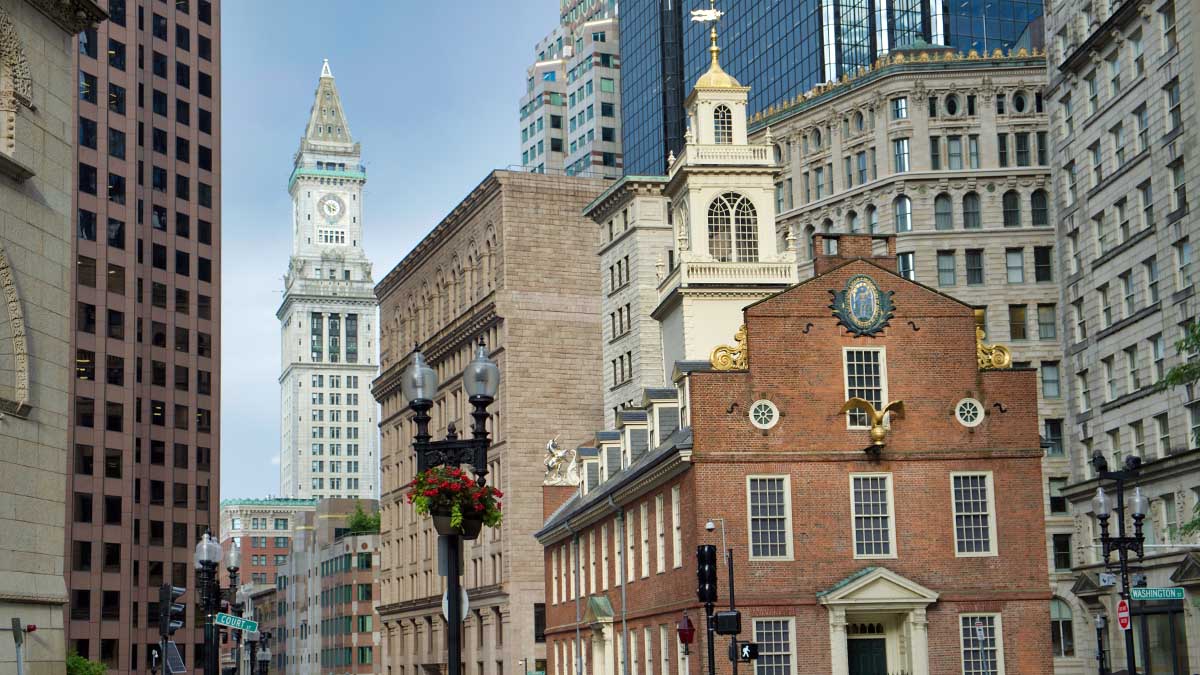
Boston’s central skyline is not the most iconic or inspiring, lacking a real focal point. But at ground level, on the city streets, Boston really comes alive.

Walking the Freedom Trail

Look down and follow the red brick path that marks the Freedom Trail.
If you have the time to walk its entire length, you will see every major spot in Boston where history has been made.
Discover Paul Revere’s house and the Old North Church where the warning light was hung, the old burying grounds, the harbour and ‘Old Ironsides’ the USS Constitution herself.


Every site is a small piece in the story of the struggle for independence from Britain’s King and the birth of a nation.

Follow the red brick road
The red brick trail also serves as what must be the longest ever sobriety test. I couldn’t help but mutter, “The Leith Police dismisseth us” as I stuck doggedly to its path.
If you don’t watch your feet, you might also miss the memorials and markers set in the pavement.
Not just the giant circle marking the site of the Boston Massacre outside the Old State House or the regular Freedom Trail markers themselves, but also random symbols of Boston life.
There are shells, seafood and compass points showing street names old and new. Come the revolution, the Founding Fathers worked hard to erase any trace of colonial Britain and its royal family.

Head for North End where all the Italian restaurants cluster together, and the markers become stranger still with knives, forks and meat cleavers set into the concrete.
You can pay for guided walks along the Freedom Trail, but armed with a map and helpful advice from the friendly orange T-shirted city guides, who station themselves strategically at every memorable location, you can easily do it yourself.

Ranger tours and talks
Or make your way to the so-called Cradle of Liberty, Faneuil Hall, to hear Park Rangers explain its long history of debate, protest and democracy.
You can also book a free Ranger-led walking tour of parts of the Freedom Trail.
We’re big fans of the American Park Rangers who are founts of knowledge, enthusiasm and superb story-telling whether they’re on a city street, historic battlefield or nature reserve.

Quincy Market is a popular place, drawing crowds of locals and tourists alike.
Pork Belly was last in the city in the early eighties, and he remembers it as a quaint and quirky meeting place.
Today it’s bigger but not necessarily better – a heaving hot and sticky mass of humanity seeking fast food.
But in the courtyards surrounding the building you can breathe, sit a while and watch the street entertainment which is clever, funny and very professional.
Quirky Boston

Like any city, Boston has its fair share of oddities.
Down by the river you’ll find a memorial plaque to the Great Molasses Disaster.
It sounds funny, but tragically, 21 people were killed and 150 injured when a molasses storage tank burst in January 1919. The resulting sticky tide flooded through the streets at about 35 miles an hour, destroying buildings and drowning animals and humans alike.
On nearby Hull Street you’ll find The Skinny House, 4 floors high but only 10.4 feet at its widest point.
Rumoured to be a ‘spite house’ it was built shortly after the American Civil War to block light and air from a grumpy neighbour.

Cheers!
On Beacon Street, to the north of Boston Common, fans flock to the Cheers bar.
Not having seen the series myself (I know, what the heck was I doing in the 1980s? Oh yes, working late nights in radio and travelling abroad!) it didn’t excite me as much as others in the queue to see the basement bar where ‘everybody knows your name’.
And if you want a drink where Kirstie, Kelsey and Ted hung out, well you’ll have to go to LA because that’s where the show was filmed. It’s just the exterior shots that were filmed in Boston at the Bull & Finch pub.
On the ground floor there is a recreation of the film set, but if you want a drink or a bite to eat instead of just a quick gawp, you’d better be prepared to wait.

Tours of Boston
If you choose to splash your cash, there are dozens of entertaining guided tours of the city. Costumed characters will walk you to the most famous locations, adding background colour and a few tall tales to the history.
The Old Trolley Bus hop-on-hop-off service runs throughout the day to all the major sites and at night you can take a special Ghosts and Gravestones trip which gets you into the cemeteries after dark.

The amphibious Duck tours are also very popular, taking you from Common to City Hall, harbour to Holocaust memorial and ending with splashdown in the Charles River.
Or you can let a Segway experience take the weight off your feet, although dodging the city traffic could be a challenge.
Boston’s Beacon Hill

Our favourite part of Boston lies just north of the impressive Massachusetts State House with its huge copper dome.

Away from the crowds, you can stroll the narrow streets of historic Beacon Hill. The first European settlers chose the area with its 3 hills sloping down to the river as the perfect vantage point.
After a brief period of undesirability, when sailors and soldiers frequented the area to pursue their off-duty activities, it morphed into an area of elegant city homes.
By the end of the 18th century, the row houses with their decorative doors began to be constructed. Its narrow streets were made beautiful with fancy ironwork, trees set in the brick sidewalks and state-of-the-art gas lamps.
Much of this remains today, and the area has the same air of faded gentility and unobtrusive wealth that pervaded Boston in the years between revolution and civil war.
More information on Boston
It’s a compact city, and you can see most of the main historic sites in one day, if you’re just passing through on your way to explore deeper into beautiful New England. But that would do the place a disservice.
We spent four nights there, staying at a pretty Airbnb in the suburbs, which allowed us plenty of time to seek out restaurants (highly recommend the Parish Café in Boylston Street), hear the Ranger talks or just linger in parks and on sidewalks, feeling the buzz of city life.
• More information on Boston’s Ranger talks and tours can be found here
Where to next?
• Cyprus in Spring
• 5 things we love about Philadelphia
• Going underground at Château de Brézé
