
The ‘Oh *@!# I’ve forgotten to make a Christmas cake’ cake.
Of course, we’re all organised enough to have made our festive cakes and puds on Stir Up Sunday, aren’t we?
No?
Oh well, for those of you leaving it to the last minute, here’s a recipe that will save you.
You can play with the ingredients, with a few nuts, more cherries or a different-tasting alcohol.

A Brief History of the Mincemeat Fruitcake
The history of the mincemeat fruitcake is, at heart, a story of culinary identity theft. It begins with two entirely separate food traditions, one Roman, one medieval English, that had no intention of meeting, let alone marrying. One was essentially an ancient protein bar; the other was a spiced meat preserve masquerading as a pie. Over centuries, sugar got cheaper, tastes got sweeter, meat quietly slipped out the back door, and what emerged was a dense, boozy cake that has confused and divided Christmas tables ever since.
To understand how we got here, we need to rewind about two thousand years, and recalibrate our expectations of what “cake” meant.
Fruitcake Before Cake Was Cake
The earliest ancestor of fruitcake wasn’t a dessert at all. It was a Roman survival ration called satura, a compact slab of barley mash mixed with nuts, dried fruits, seeds, and honeyed wine. Think less “holiday indulgence” and more “something you gnaw on while marching across Gaul.”
Roman soldiers and travellers prized it because it didn’t spoil easily and delivered calories efficiently. Flavour was a bonus, not a requirement. Still, the core idea, combining grains, fruit, and sweetness into a dense, durable food, laid the foundation for what would eventually become fruitcake.
No frosting. No candles.
Enter the Crusaders, Bearing Meat (Middle Ages)
Fast-forward to 13th-century England, where mincemeat pie made its dramatic entrance. Crusaders returning from the Middle East brought with them new spices, cinnamon, cloves, nutmeg, mace, along with a taste for combining sweet and savoury flavours in ways that would make modern diners suspicious.
Early mincemeat was exactly what it sounds like:
Finely chopped beef or mutton
Suet (hard kidney fat)
Dried fruits
Vinegar or wine
Sugar or honey
A frankly alarming amount of spice
The Long, Sugary Slide Into Dessert
The transformation from “spiced meat storage system” to “Christmas dessert” happened slowly, like a centuries-long identity crisis.
This sweet mincemeat became inseparable from Christmas in the United Kingdom, and it also found a new life when baked into cakes.
It’s a light fruit cake that can be iced the traditional way, simply topped with glazed dried fruit and nuts or just a sprinkling of icing sugar.


Quick and easy, you could use homemade mincemeat, like this traditional Eliza Acton recipe, or shop-bought in a jar, which is what PB did.
We’ve made it lots of times now and even come up with a vegan alternative which works just as well.
Enjoy!
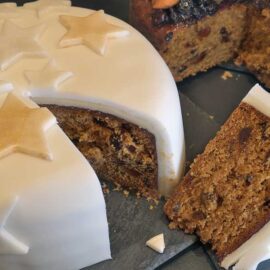
Mincemeat fruitcake
Ingredients
- 250g 8oz self-raising flour, sifted
- 150g 5oz softened butter
- 150g 5oz muscovado or dark brown sugar
- 150g 5oz glacé cherries (chopped)
- 11/2 teaspoons mixed spice
- 2 eggs beaten
- 450g 1lb mincemeat
- 1 generous tablespoon dark alcohol – Rum Brandy, Toffee Vodka or Ginger wine
Instructions
- Preheat oven to gas mark 3, 325F or 160C.
- Grease and line a 20cm wide round tin.
- Cream together the butter and sugar, then put all the other ingredients into the bowl and mix thoroughly.
- Pour into the tin and bake for 1 hour 30 to 1 hour 45 minutes, depending on your oven.
- Check after 90 minutes to see if cake is cooked by inserting a skewer, it should come out clean.
- Take the cake out of the oven and leave in the tin for 15 minutes, then remove and place on a wire rack to cool.
- When cold, glaze with fruit, cover with fondant or just dust with icing sugar.
Other recipes you may like:
• Lemon curd
• Cinnamon Cappuccino Fudge
• Carrot and ginger cake
If you’ve enjoyed browsing our website, learned something new, or just had a smile because of what we do – we’d love your support to keep the good stuff brewing!