
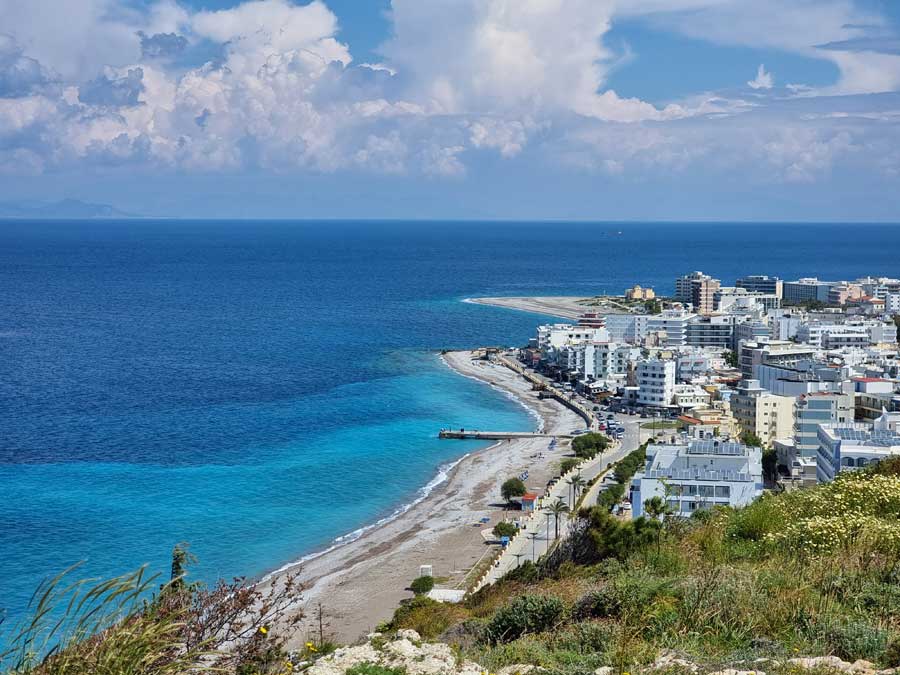
I love Greek islands.
And I’ve always wanted to see Rhodes, for its history and natural beauty.
It did not disappoint.
It was one of those rare occasions when I travelled without Pork Belly. Our daughter had enticed me away for a short break, with promises of relaxation, sunshine and cocktails. She organised flights, a great hotel deal and talked Pork Belly into cat sitting!
With only 4 full days on the island, I can’t possibly write one of those ‘114 amazing, incredible and life-changing things to do in Rhodes’ posts. To be honest, most of my time was spent lounging poolside, eating delicious local food and sipping those cocktails.
But …
The lure of all that history, just a short walk away, was irresistible.
And because we were there before the summer crowds, it was perfect. Bright, sunny days, cool, calm nights and quiet streets to wander.
So here are some of the best things to see in Rhodes, when you’re really just chilling! And many of them are free.
Mandraki Harbour
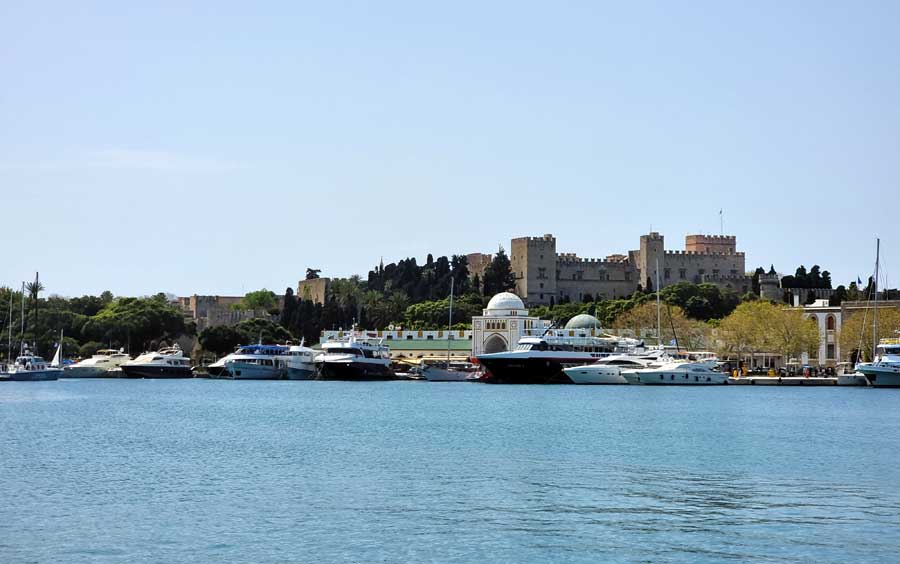
It’s easy to while away the hours here, watching the boats come and go.
Luxury yachts, local ferries, fishing boats, swimming and snorkelling trips for visitors and of course the huge cruise ships.
Nothing much happens. A good place to sit and unravel a little.
And of course, it’s where Colossus once stood – possibly.
The Colossus of Rhodes – or maybe not!
Colossus was a statue of the Greek sun god Helios, erected in 280 BCE to mark the successful end to a long siege.
We know it was huge – possibly as big as the Statue of Liberty – and was the tallest structure in the ancient world, one of its seven wonders.
The statue was badly damaged in an earthquake in 226 BCE and never restored.
But …
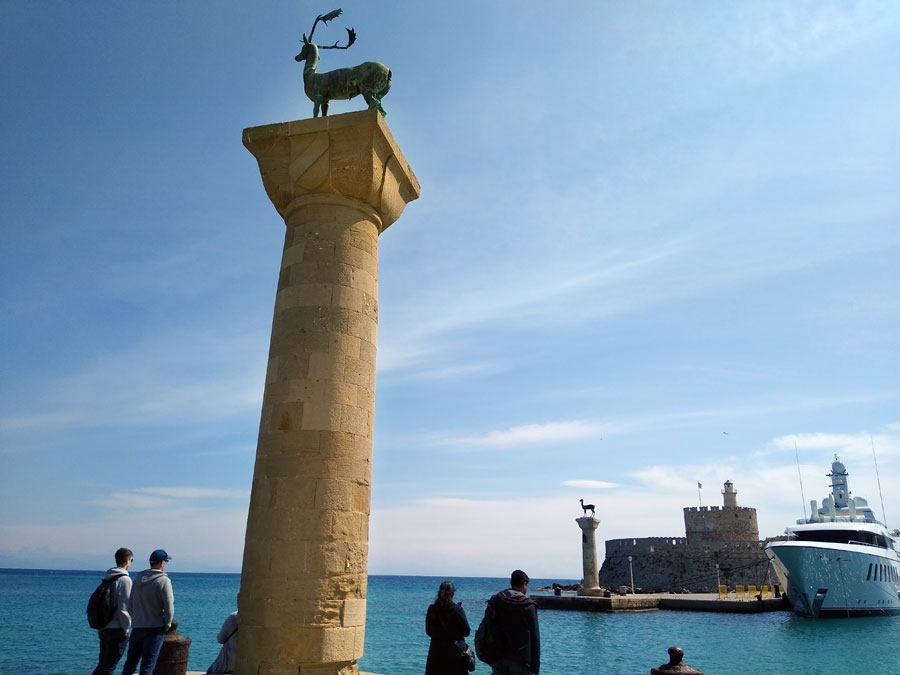
We also know that Colossus did not straddle the entrance to Mandraki Harbour – impossible and impractical – and no-one’s really sure where he actually stood.
To stave off any potential disappointment, there are two huge bronze columns instead, topped with the emblems of Rhodes – a stag and a doe called Elafos and Elafina – on either side of the harbour entrance.
The Rhodes windmills
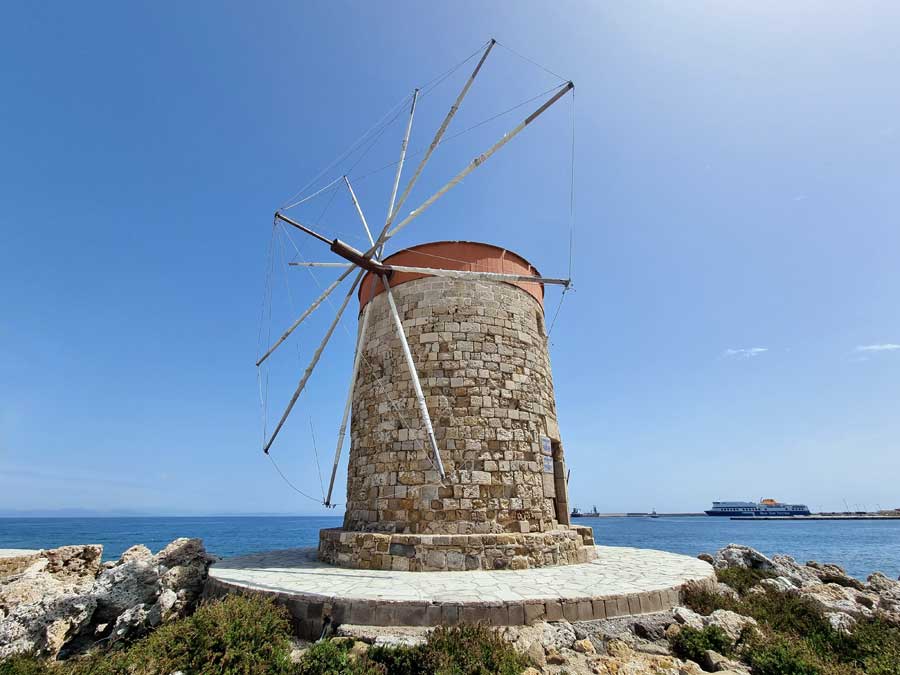
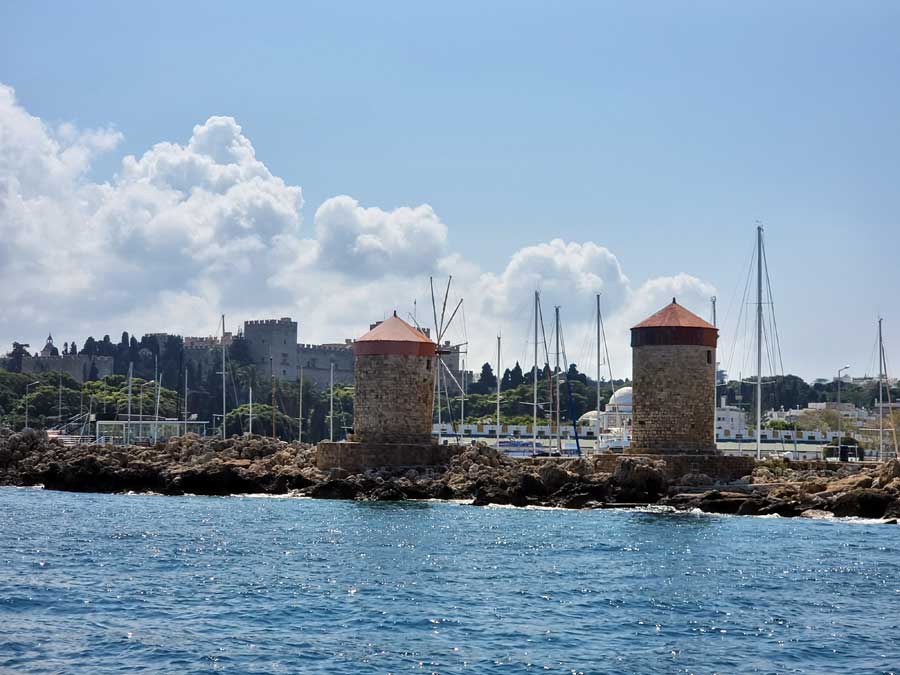
A stroll around the harbour is a must, even on a lazy do-nothing sort of holiday, and it doesn’t take long to reach theses iconic symbols of ancient Rhodes.
Back in the 4th century there were more than a dozen windmills on the harbour arm, sails turning, grinding the grain as it arrived on ships from all major trading ports.
Now just three remain, carefully restored and conserved, providing a beautiful silhouette against the skyline.
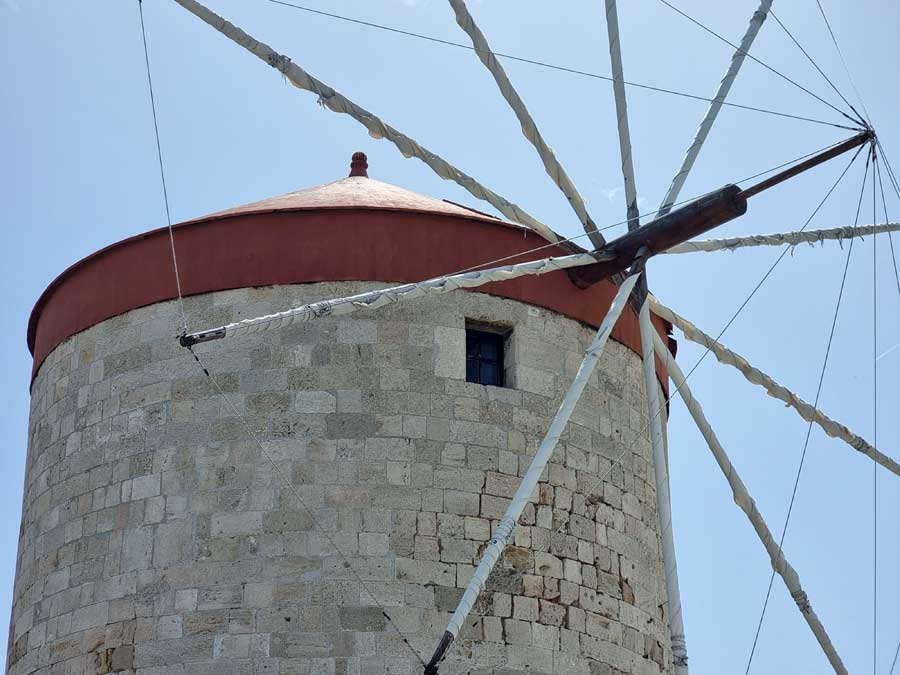
The interiors are closed to the public, except for one – very dark, dusty and full of bird droppings, but the outside is pretty enough for anyone.
Fascinating by day, atmospheric at sunset.
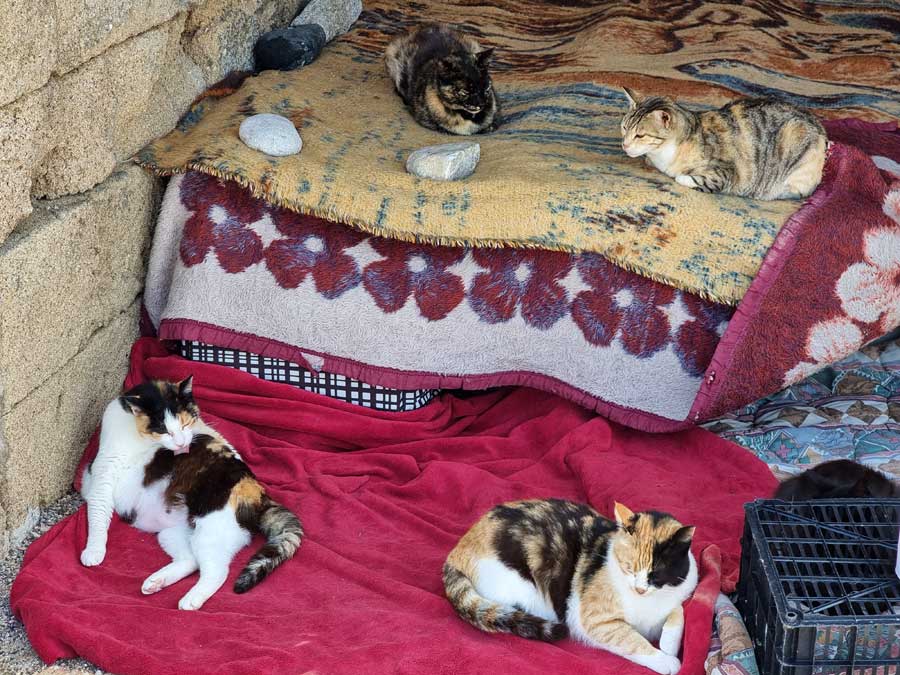
Just keep an eye out for the cat sanctuary in their shadow – Rhodes teems with semi-feral moggies, who all seem very well looked after.
St Nicholas Fortress
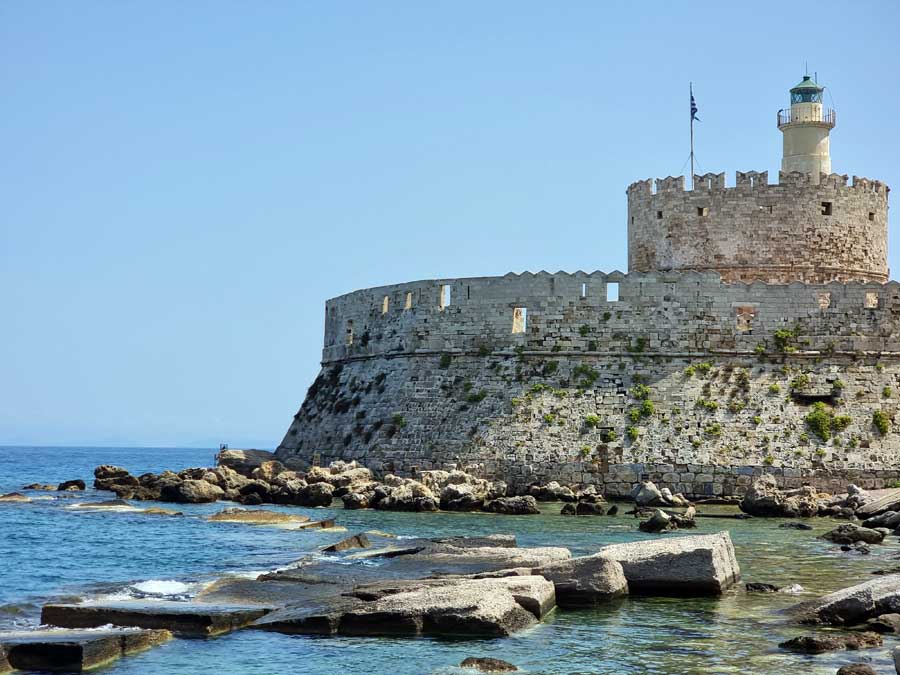
Past the windmills at the tip of the harbour arm sits St Nicholas Fortress, built in the mid 1400s when Mandraki Harbour was at the centre of the Knights Hospitaller’s military operations.
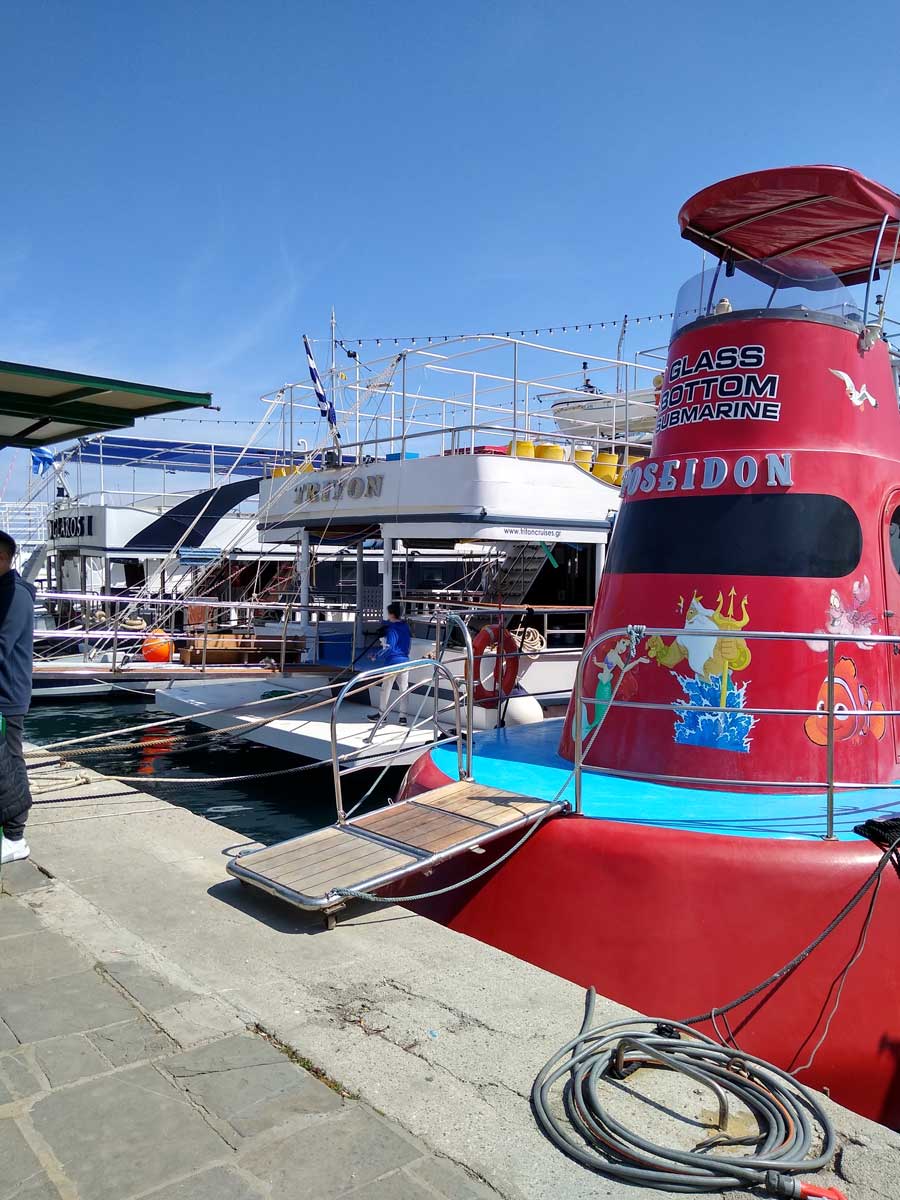
You can walk to it for free, gawping as you go at the dozens of luxury yachts moored along the quayside, but the best views can be had if you take one of the many boat trips around the harbour.
I don’t have very good sea legs and am slightly squeamish about fish, but even I managed a half hour excursion in a glass-bottomed boat.
The medieval city
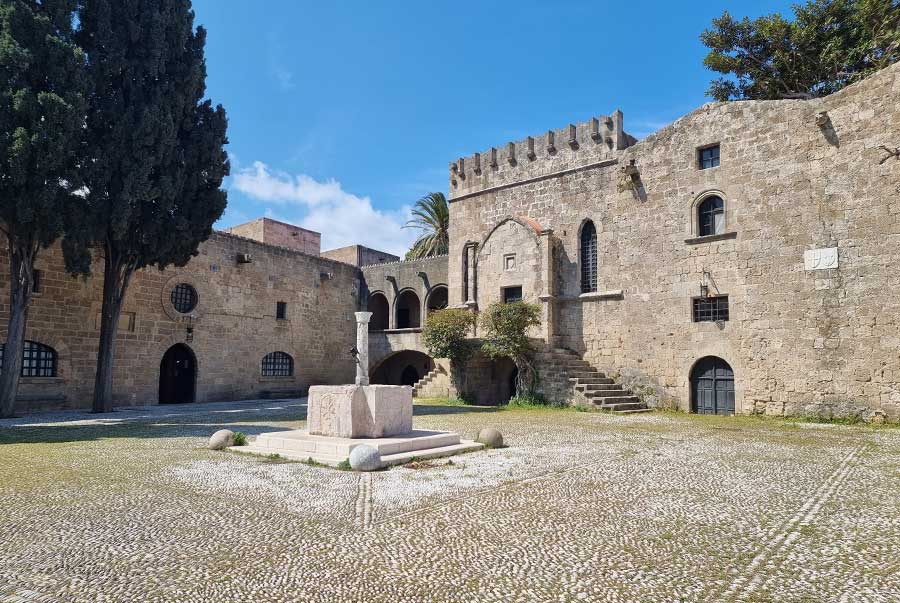
Now here’s where I am really in my element, taking time to just wander about, reading every available information board and standing still to take in all the sights, smells and sounds.
Rhodes has a history that stretches back for centuries, and much of it is still visible today. Shops occupy the same spaces they did years ago, when trade with Egypt made Rhodes a commercial and cultural centre.
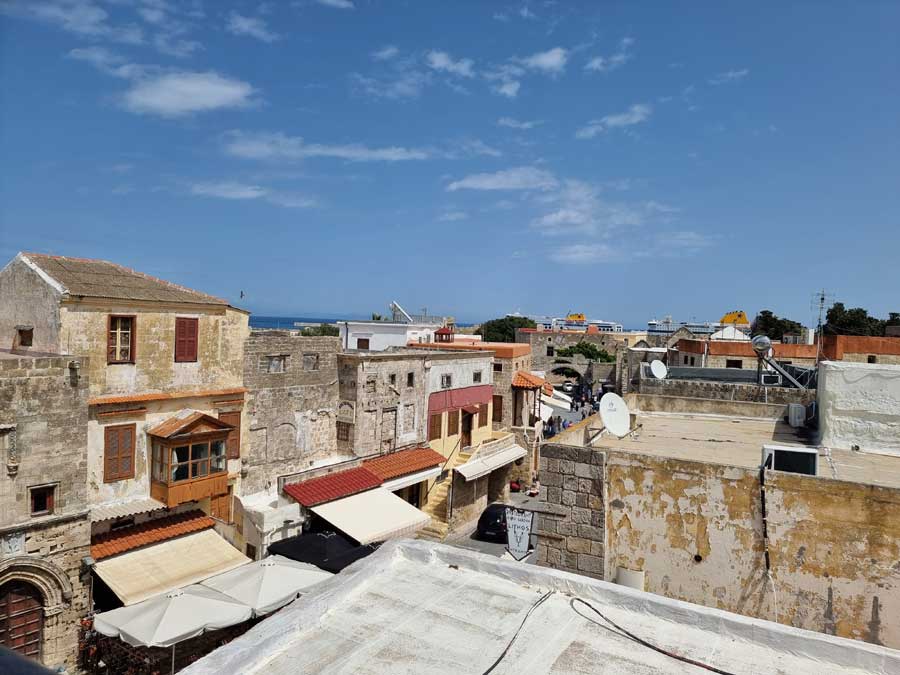
People still live in their homes above and beside the stores, standing hard against the ancient walls. Many restaurants have tiny rooftop terraces that afford views across the city and out to sea (and of course cocktails, or did I already mention them?)
In high season, the narrow streets are packed with travellers, scooters and the aforementioned cats who lord it over everyone.
But go in spring or autumn, and you’ll have cooler temperatures and quieter streets for your exploration.
Gates, gates and more gates
There are more gates in Rhodes than you can poke a stick at! Declared a World Heritage City by UNESCO in 1988, most of the old town wall is still intact.
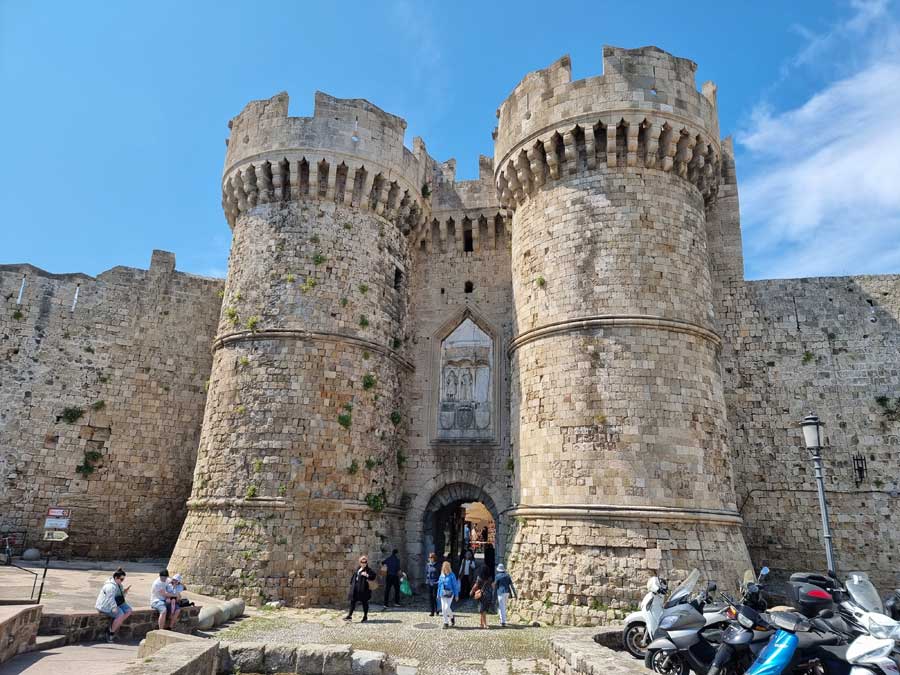
Arrivals on cruises and yachts will enter via Marine Gate, also known as The Sea Gate. It’s an imposing affair, built in 1478 and fortified with a series of devices designed to pour boiling oil on attackers.
Could be why it’s still standing today!
Close by, you’ll discover The Arnaldo Gate, a small entrance that gives on to the hospital of Saint John, which is now home to The Archaeological Museum.
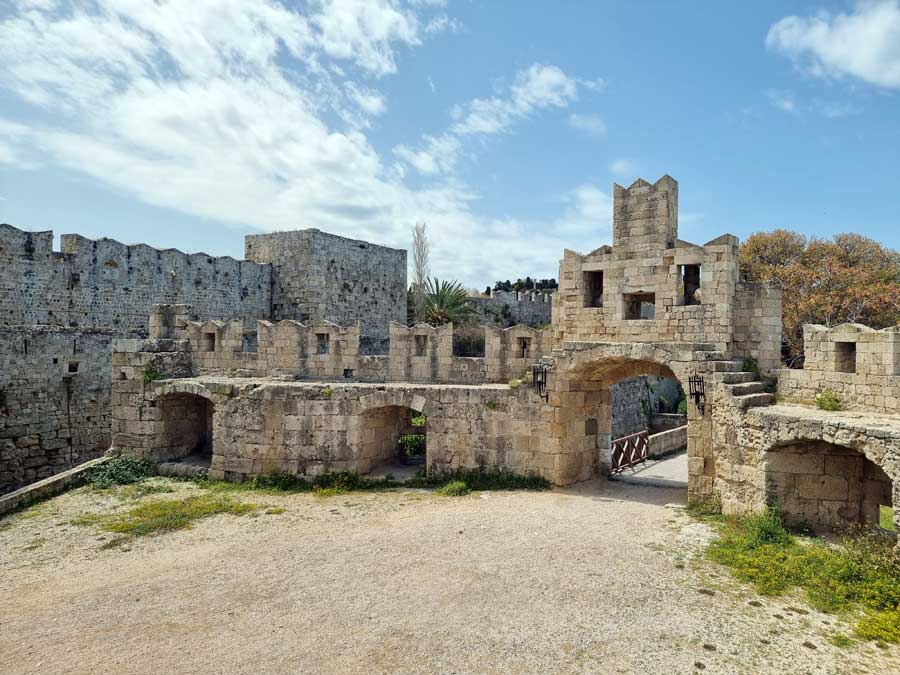
Just beside the museum is the most famous walkway in Rhodes, the Street of the Knights. High walls, tall arches and open courtyards, it’s been restored to the exact shape and size it was in the Middle Ages.
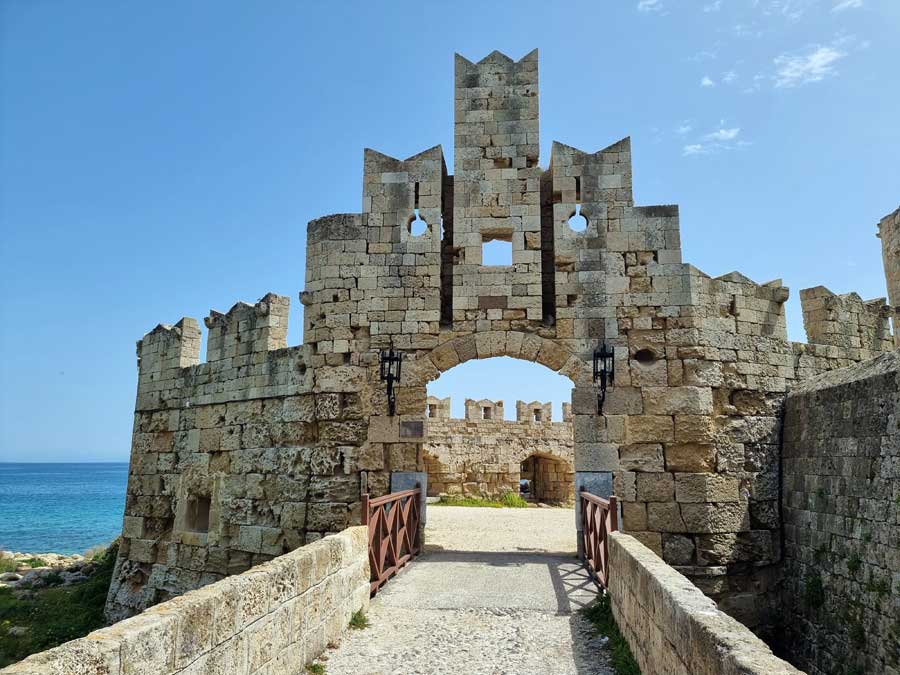
St Paul’s Gate is another sea-facing entrance, at the corner of Mandraki Harbour. Badly damaged during World War II, it’s been restored sufficiently to allow you to walk along its fortified walls and get great views out to sea.
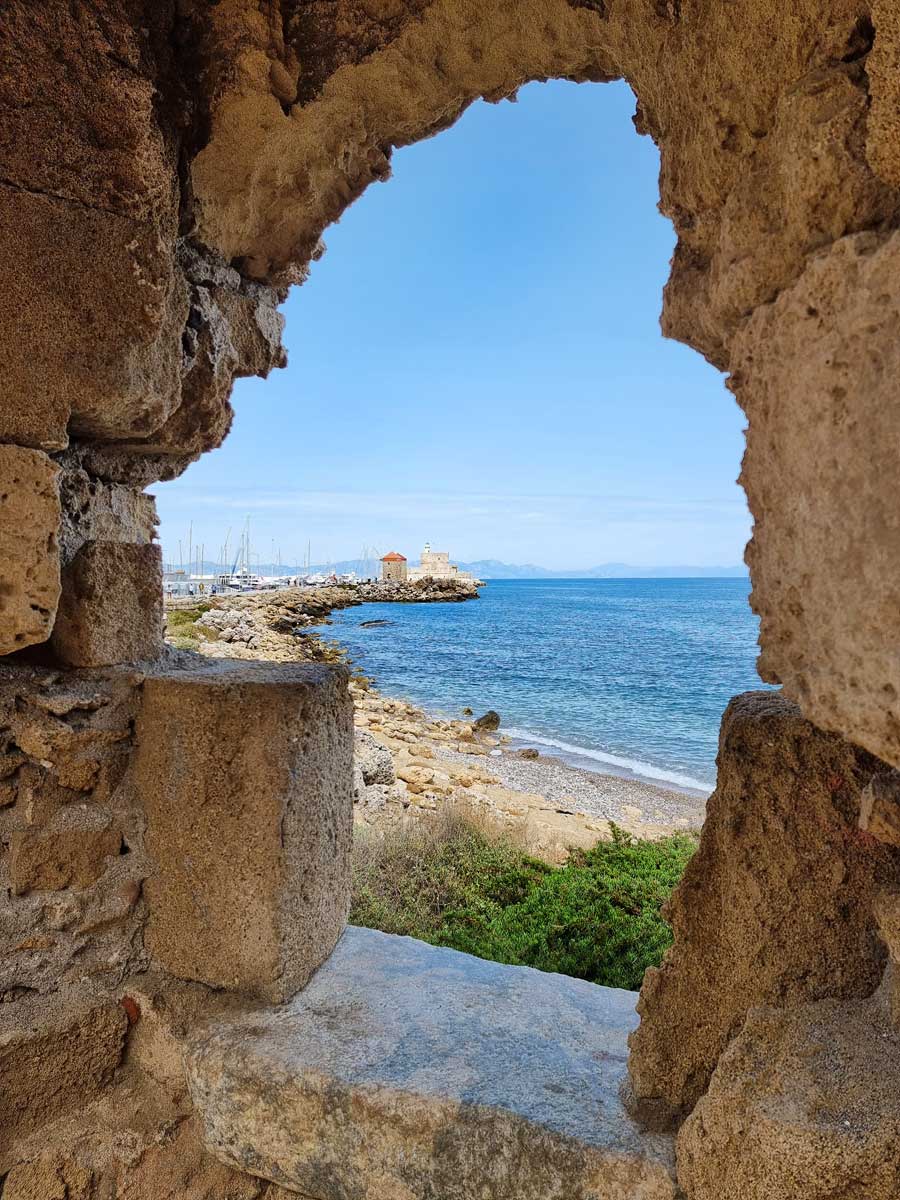
Another is St Anthony’s Gate, known by locals as Saint Francis’ Gate after the nearby church. The coat of arms above the entrance shows it dates back to the times of the Knights Hospitaller and their Grand Master Jean de Lastic.
The Palace of the Grandmaster
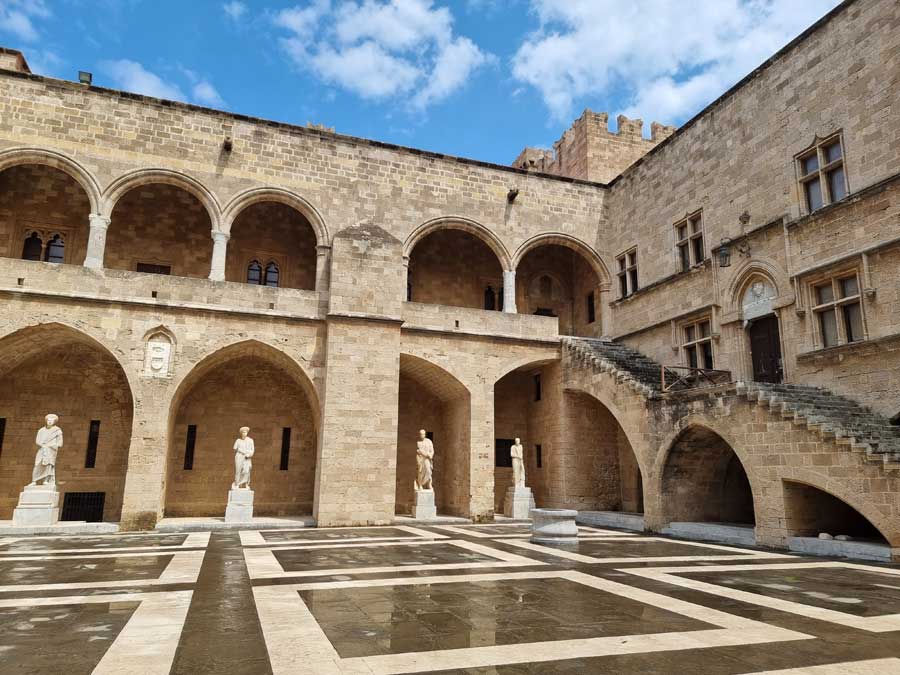
This is the jewel in Rhodes’ crown.
An imposing castle, built in the late 7th century as a Byzantine citadel, it stands on the site of an ancient temple to Helios.
Interestingly, some historians argue that this is actually where Colossus once stood, rather than at the waterside. Makes sense to me, but I’m no archaeologist!
Either way, in the early 1300s the Knights Hospitaller took over administration of Rhodes, and they turned the fortress into the Grandmasters Palace, until the island was captured by the Ottoman Empire in 1522, and it became a prison.
After centuries of war and destruction, restoration work began in the 1930s – there’s a detailed display inside – although some parts were lost during the process.
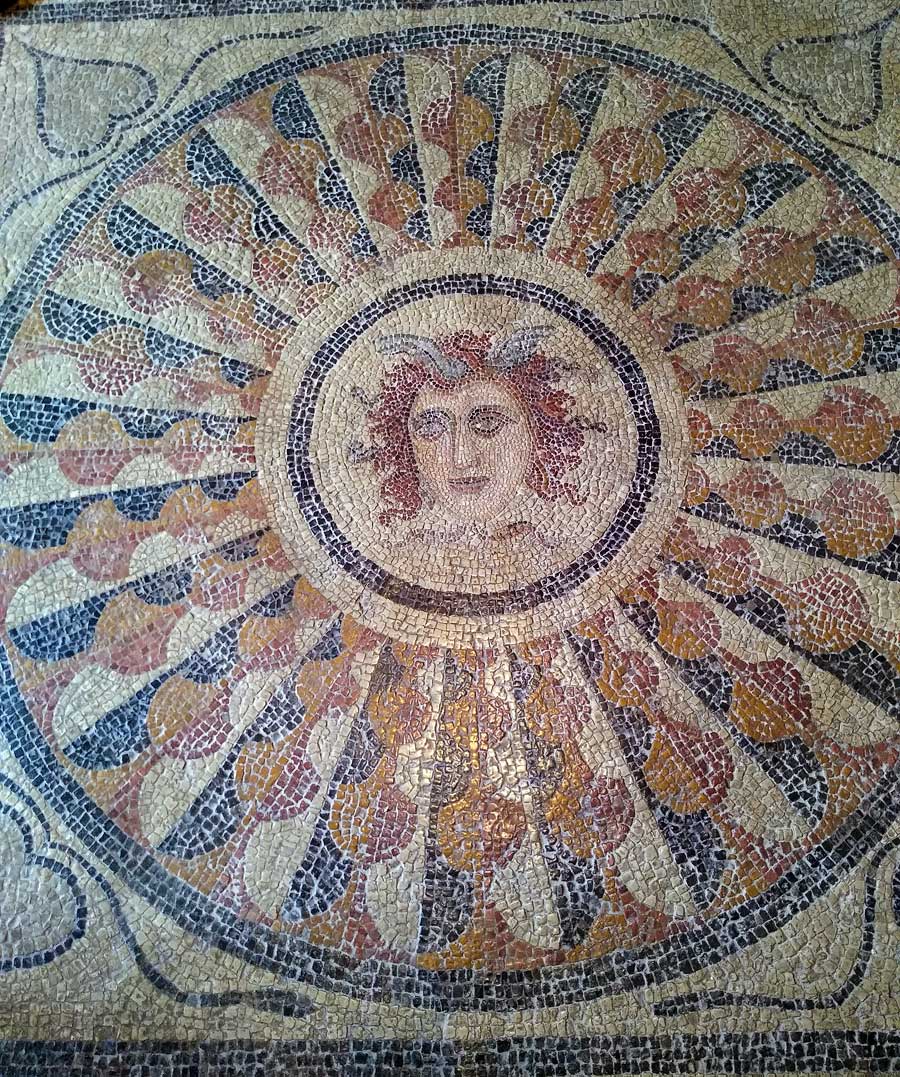
There are stunning mosaics, fascinating artefacts and a beautiful courtyard to explore, and if you pay for a combined ticket (10 euros in 2023) a walk along the top of the walls is included.
Moat Walk
We stumbled across this by accident, following a few locals, and discovered a peaceful way to see the oldest parts of Rhodes without having to dodge the mopeds that everyone uses to get about in the narrow, cobbled streets.
And it’s totally free.
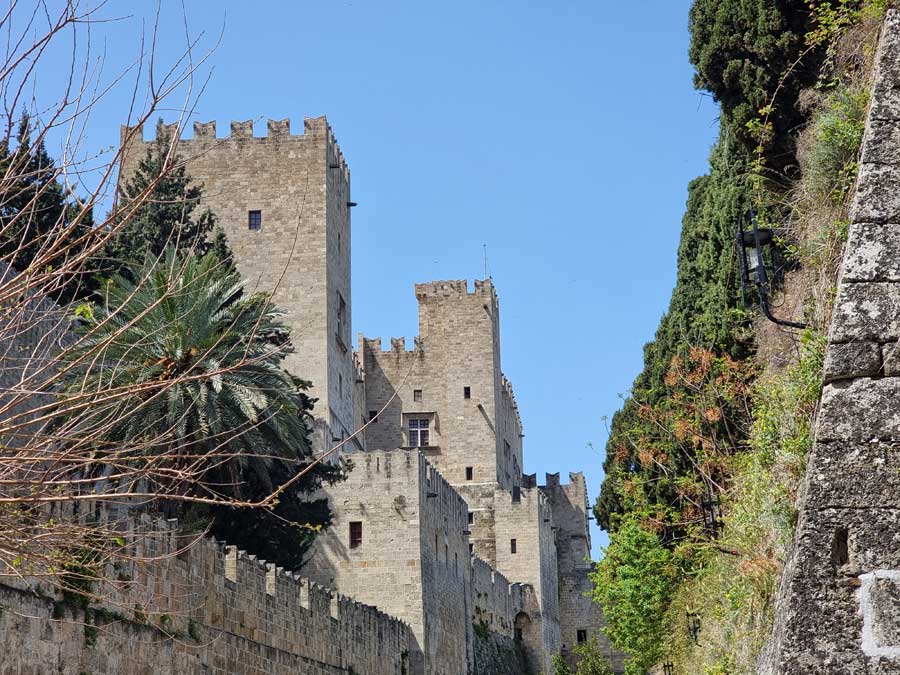
You can enter at a number of places, as the moat almost completely circles the old city.
It’s a lovely walk, about one and a half miles in total. The moat is deep and wide, with views of medieval towers and ancient bridges from below instead of above.
A very different perspective.
Open 24 hours a day, it’s popular with residents, visitors, photographers, drone filmmakers and, of course, cats!
Beaches and bays
The whole island is dotted with beautiful beaches and secluded bays, mostly on the western coast.
Lindos and Saint Paul’s, Ladiko (otherwise known as Anthony Quinn Bay, after the actor who fell in love with the island during filming the sixties’ blockbuster The Guns of Navarone) Tsambika and Kallithea are the best known.
There are plenty of hotels located in the most popular spots, or you can take excursions by coach or cool off with a snorkelling or swimming boat trip from Mandraki Harbour.
Even in early spring, with winds whipping the waters to swirling white peaks, there were plenty of hardy locals and visitors enjoying Elli Beach, near our hotel, on the peninsular just north of Rhodes City.
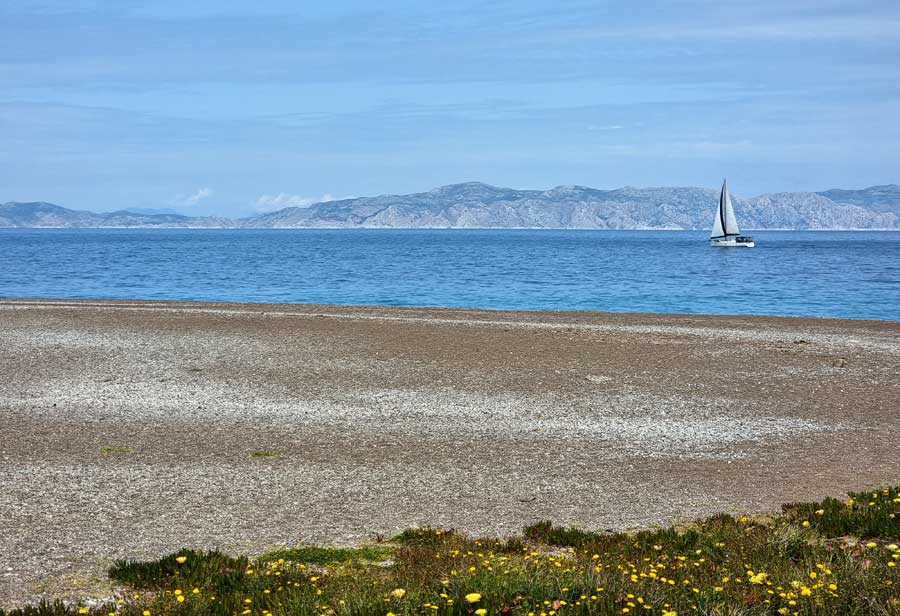
Too chilly for me, but the views across the turquoise sea to the Turkish coast are beautiful.
Acropolis, amphitheatre and racetrack of Rhodes
This was the best part of my mini-break. After a leisurely breakfast, we ventured a little way out of Rhodes itself, to discover the acropolis, theatre and racetrack that sit just above the old city.
Many people use the Hop On, Hop Off sightseeing tour bus, which takes in the Acropolis site and lets you spend as much time you like at each destination.
But if you can manage a bit of climb, take the slow route and stroll up to Monte Smith Hill, and you’ll be rewarded with stunning views along the way.
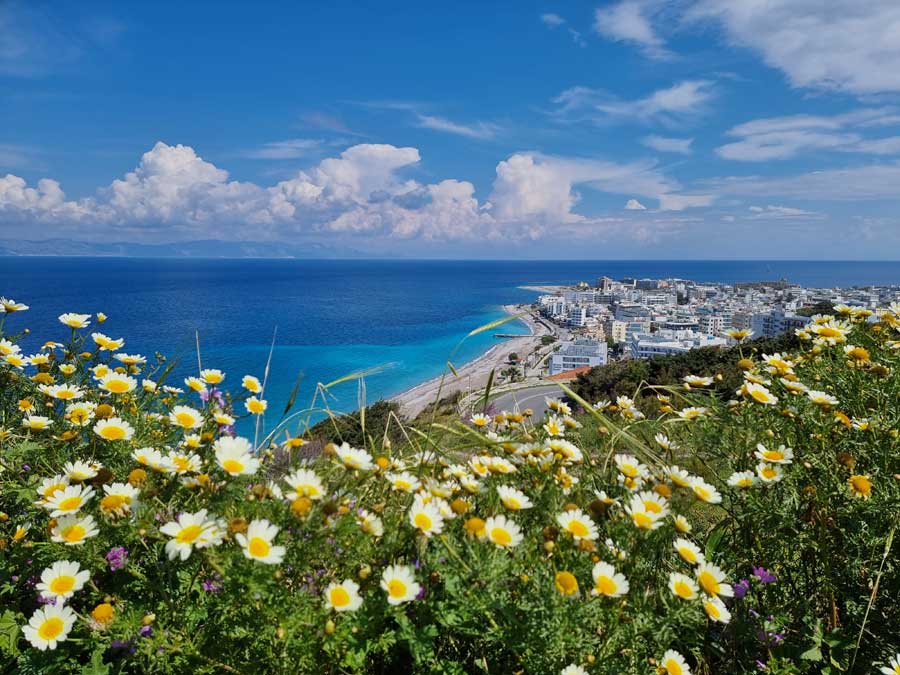
In 2023 the Acropolis is undergoing repair work and covered in scaffolding, but don’t let that put you off. Stroll through the tumbled stones, past the sleek and very healthy-looking colony of cats, and take the steps down to the amphitheatre and racetrack.
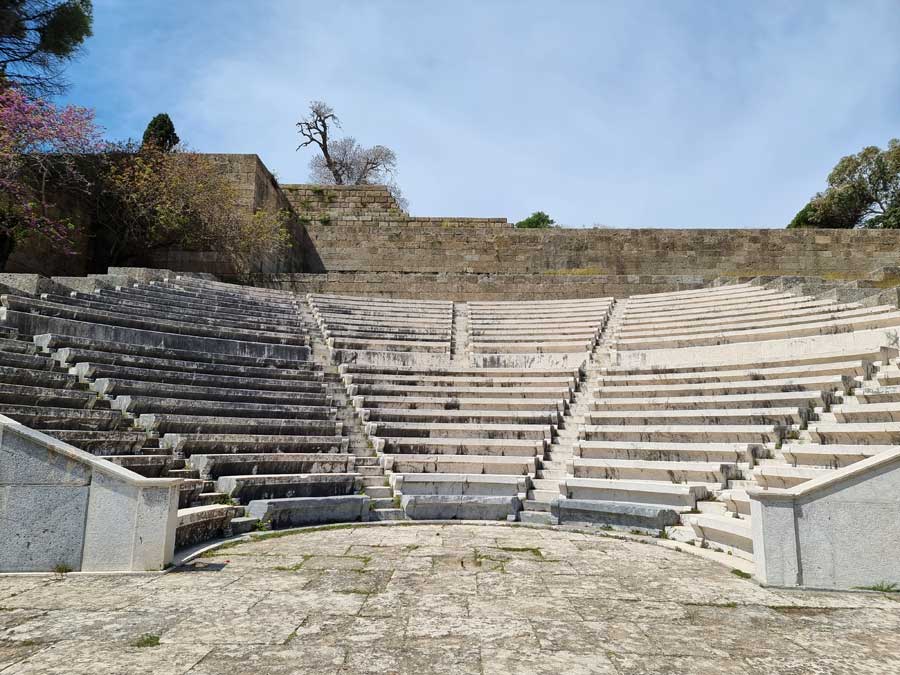
It’s peaceful, quiet and shady on a hot day. There are no information boards, chatty tour guides, or ticket booths, and you’re free to wander at will.
Some might find it a disappointment, others may wonder why more isn’t being done to preserve and renovate the ancient stones.
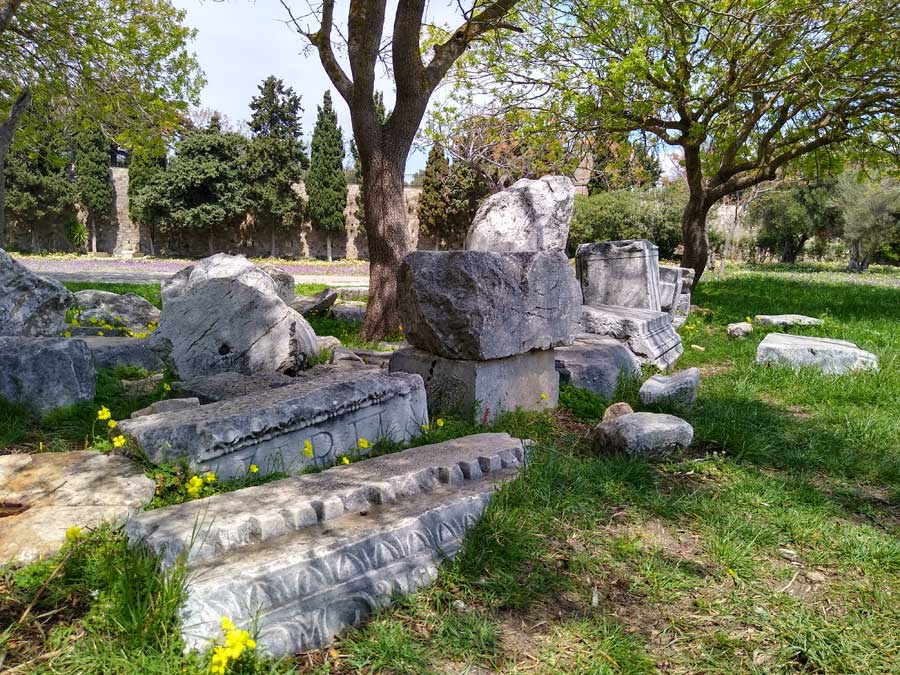
I like the fact that the past is just sitting there, un-curated, waiting to be discovered under the wildflowers.
Rhodes is my sort of place!
Getting to Rhodes
Unless you own a luxury yacht, you’re likely to reach Rhodes on a cruise or by air.
If cruising is your thing, you’re spoilt for choice, but there are also local ferries if you’d rather island-hop independently.
Flights from the UK take around 4 hours and the whole of the island is easily accessible from the airport.
There are taxis and special shuttle buses to all major resorts, but I found the local bus route to be cost-effective and fun, if a little crowded at times!
For more information on getting to and around Rhodes, see the Visit Greece website
Where to stay in Rhodes Old Town
In high season, there are hotels and apartments to suit every budget.
Out of season prices are much lower but beware if you are going at the very start of the season, many hotels won’t open, or have limited services, until after the Greek Easter which is later than in the UK.
Where to next?
• How to get the best out of an all-inclusive holiday
• 7 reasons to visit Crete
• Spring in Cyprus