
“We’re just a small husband-and-wife affair – nothing fancy”
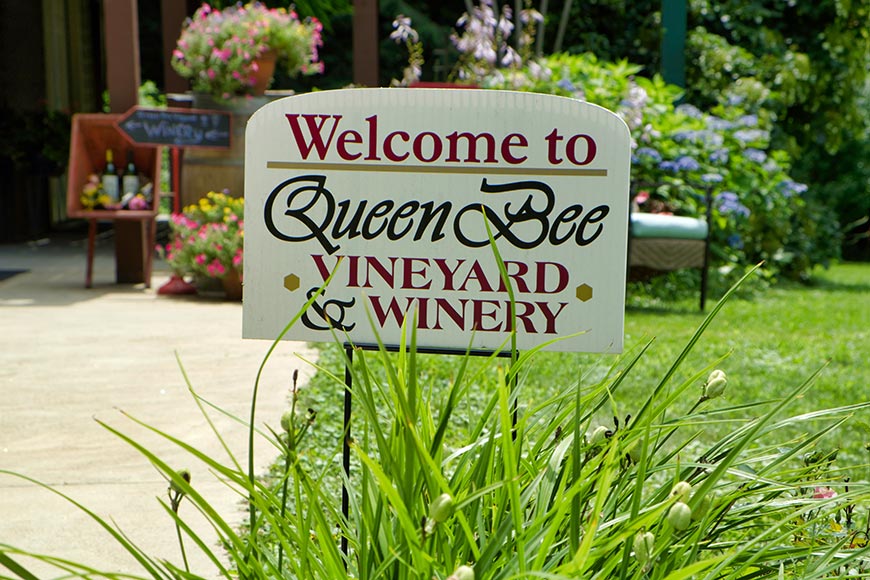
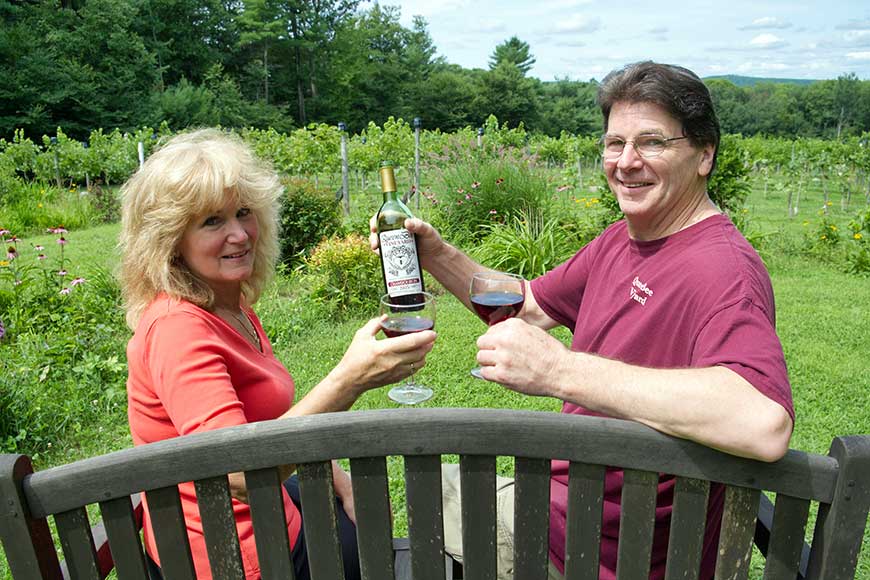
Roy McGuill is keen to make sure we know what to expect before our visit, concerned that his tiny vineyard in the rolling Massachusetts countryside won’t meet our expectations.
He needn’t have worried – the Queen Bee vineyard is delightful, Roy’s wines delicious.
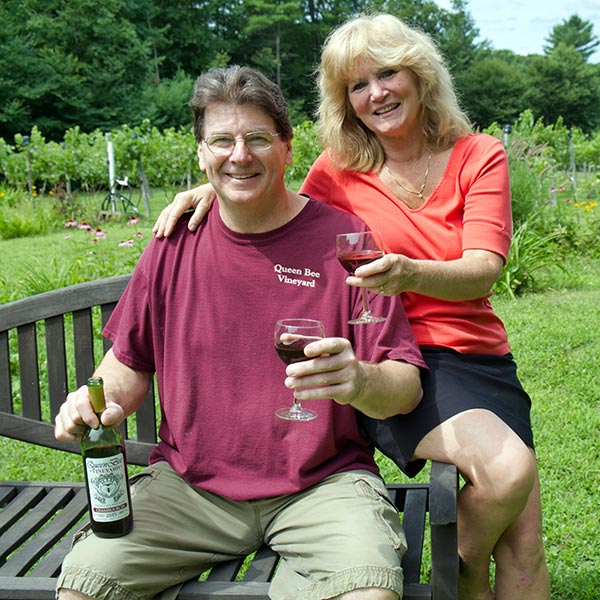
The couple have lived in Monson, a hamlet just off the main Massachusetts Turnpike, for 30 years.
“Nancy just loves flowers and growing things. Over the years I’ve cleared more and more of the trees to give her space. One day she said she wanted a pergola with a few vines on either side. I set to work and planted six table grape vines. She loved it, but her next words were. I want more vines.”
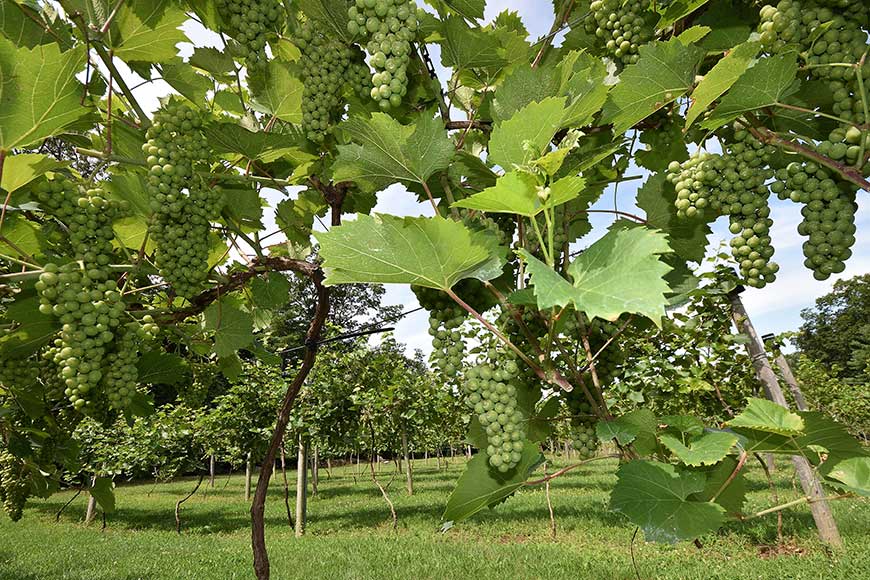
“I told my sister, who runs Quabbin Sky, a big vineyard up near New Salem. She said if I was going to plant more I should put in wine grapes not table ones. I knew a little bit about wine-making from helping out at her place and thought it might be fun to try it for myself. It’s just grown since then.”
Retiring from his postal service job a few years back gave Roy more time to work on the project, time he really needed as more and more trees had to be cleared, solid rock shifted, and huge wooden end poles buried securely in the ground to support the vines.
Now the hillside is covered with 600 vines of 12 different varieties, each planted, pruned and harvested by hand.

Cold climate wines
Their varietals are not familiar to us, although they are mainly of French or German origin, grafted on to American root stock.
Roy talks knowledgeably about them all – Edelweiss, which started life in America in the 1980s as a table grape before it was discovered it made a floral, semi-sweet wine, La Crosse, a light skinned hybrid white with a spicy aroma, Aurore, Chardonel, Traminette, Vidal and Vignoles – all good for producing wines in a cold climate.
And there was an array of reds which surprised us – Marquette, Chancellor, Vincent, Frontenac and Chambourcin.

As with all wine-making, each year is different. Roy creates his wines in small batches in his tiny winery.


“It’s trial and error for me as we do it on such a small scale. Sometimes a particular grape will fail and I won’t be able to produce anything from them that year. Sometimes I make up a batch that doesn’t seem quite right, so I’ll leave it fermenting for longer. You never really know, it might turn good in a year or two!”
The vineyard is named, jokingly, for Nancy, the original Queen Bee. Roy chuckles, “I’m in charge of all the heavy work, but Nancy looks after the vines and the fruits.”

Nancy – the original Queen Bee
As we wander through the vineyard Nancy is constantly checking the leaves and the budding fruits, pondering aloud when it will be time to get the netting up and noting everything that could get in the way of a good crop.
Pests are a perennial problem, though being in America they’re a little different to those that threaten English vineyards.
“Well we have deer of course, who damage the vines and groundhogs go for the roots. Wild turkeys love the grapes when they’re ripe and will rip out whole bunches if they can. Smaller birds get in under the netting and attack individual grapes and insects like yellow jackets can do a lot of damage. But it’s the crows we battle hardest against as they’re simply so intelligent and hard to stop.”

Roy chuckles as he relates their failed attempts to scare off the crows with a fake owl.
“The hawks kept diving at it, thinking it was a rival, but within half an hour the crows were happily sitting on its head. Took them no more than a few minutes to realise he wasn’t real!”
High above us, soaring in the skies over the spectacular Peaked Mountain, are turkey vultures and hawks.
On a warm summer’s day it’s the perfect place to talk wine but Roy and Nancy have to battle bitter winters and wild storms to keep their fruits from destruction. And of course if the summer gets too hot and dry it can ruin the whole crop.

Rules and regulations
And there are business limitations too.
American licensing laws vary from state to state and are very confusing for us Brits. Massachusetts has its own rules, not just the drinking age, about who can and can’t taste their wines.
Roy explains. “Over in Connecticut, they have a thriving wine tourism trade, but we’re a little slow to catch up. We have a ‘tasting license’ here which means we can only offer up to five wines at a time, for a small charge, and we have to serve them in the tasting area, not out on the grounds anywhere. If we had a ‘pouring license’ we could sell wines by the glass or bottle, but that would turn us from a small winery into something more like a bar, which would be too much for us and for our neighbours!”

Small and personal
So for now Roy and Nancy keep it small and personal, opening up just at weekends and by prior arrangement for private tastings.
As we head indoors to try a few, Roy is a little uncertain of our reaction.
“If you’re thinking of the big, fruity wines of California you’re going to be disappointed. What I do here is simple – I stay true to the grape and make wines that reflect their varieties. I make very little adjustments, simply adding the smallest amount, probably no more than a quarter teaspoon per gallon, of potassium metabisulphite to ensure they stay clear. I can’t use the term ‘organic’ but they’re what I call ‘low intervention wines’. I don’t add anything, I just let them ferment in their natural yeast and sugars.”
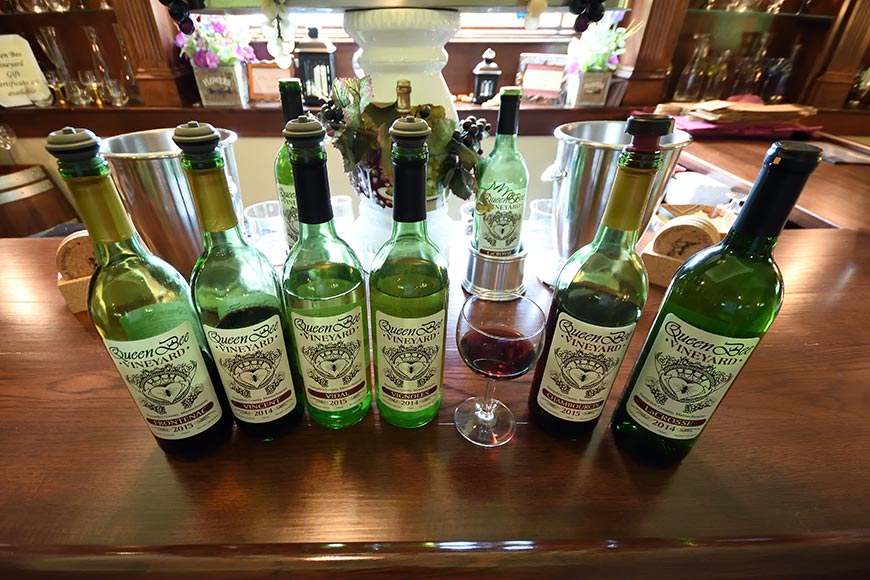
The end results are exactly as Roy describes, light wines that reflect the character of the grape.
Of the whites, we loved the Vidal and Vignoles, both excellent cold climate wines with a dry, crisp finish.
The reds surprised us with the red-and-black-fruit fullness of the Frontenac, a deep rich Vincent and best of all the black cherry, plum and hint of spice of the Chambourcin.
If you want to try them, a trip to America is what it will take because Roy and Nancy aren’t in the export business. But if you’re ever on a New England road trip we suggest you take a turn off that highway, drop down a gear and try them for yourself.
More information about wines in Massachusetts
As Roy told us, the wine industry is small in this state, with many wineries but fewer grape-to-bottle vineyards like Queen Bee and Quabbin Sky.
There’s more information on wineries and vineyards across the state here.
Unlike the UK and France, where tastings are usually free, you might be expected to pay a small amount for your sampling experience.
Disclaimer: We were invited to a private tasting by Roy and Nancy, but received no payment for this article. All views expressed are our own.

Where to next?
• Boston
• Carnglaze Caverns
• Up on the roof of Lincoln Cathedral
Just a lovely place to try the wines and have small talk with the ladies. We enjoyed our selfs! So glad we found you. We will be back.
Hi Michelle, So glad you agree with us about Queen Bee, a lovely place with some great wines. A real find on our American Road Trip.
Looks very interesting. May visit tomorrow 9/21 from CT.
Let us know if you go what you think of the wines. And say ‘Hi’ to Roy and Nancy from us!