

‘Of course, it’s unlikely he had such a magnificent moustache. Contemporary accounts make him sound small and a bit insignificant.’
We’re high above the nave in Lincoln Cathedral, getting up close and personal with its first founder, Bishop Remigius, and it’s not doing my acrophobia any good, especially as Pork Belly is hanging over the parapet any chance he gets to take photos!
But the stained-glass window is magnificent, all glowing colours and lush robes.
And that moustache.
Mesmerising.
Our guide on the Lincoln Cathedral Roof Tour is full of facts, fun and humour. He knows his stuff well enough to be slightly irreverent and sometimes speculative.
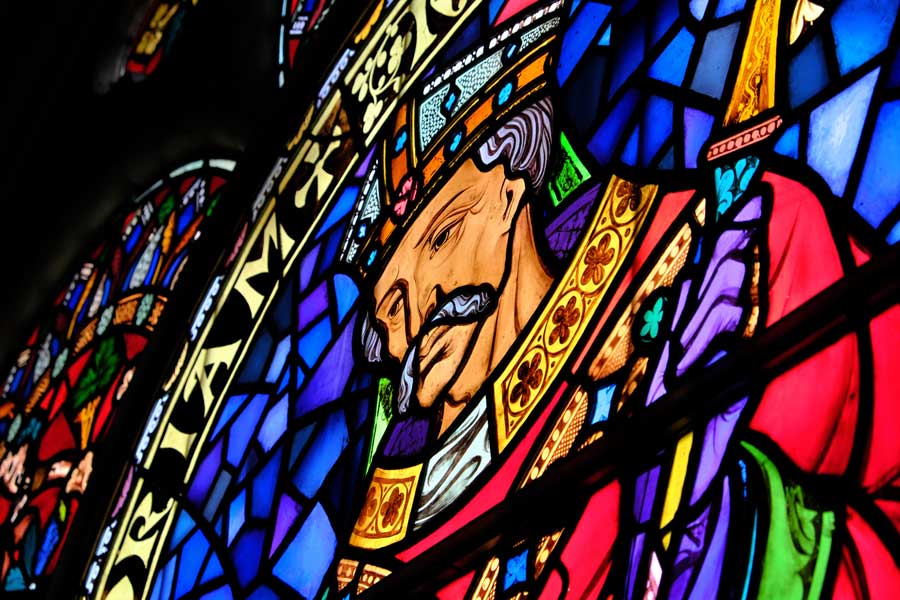
‘No-one’s really sure why Remigius got the job. He was a monk from Fecamp Abbey who came over with William the Conqueror. An almoner, so not very important in the scheme of things.’
‘But he seems to have been related to William in some way and was rewarded with a bishopric, then commissioned to build a cathedral here in Lincoln, right next to the castle.’
Lincoln Cathedral – triumph and disaster
Remigius may have rushed the job, completing the original cathedral in about 20 years, dying just two days before it was consecrated in 1092.
A few years later, fire blazed through the building, then an earthquake hit, destroying almost everything except the tower and the west front.
Some, including our guide, say shoddy workmanship may have been more to blame than the weather!
This is where a behind-the-scenes tour becomes even more fascinating.
Most visitors to Lincoln Cathedral will get to see the stonework, the old doorways and carvings of Biblical tales that date from the original build.
A tour of the cathedral floor, included in the admission price, will unveil a few more snippets of information.
But pay a little extra, and you will get more … so much more.
Behind the scenes at Lincoln Cathedral
Unusually for a roof tour, we start outside, looking up at the frieze on the front of the cathedral.
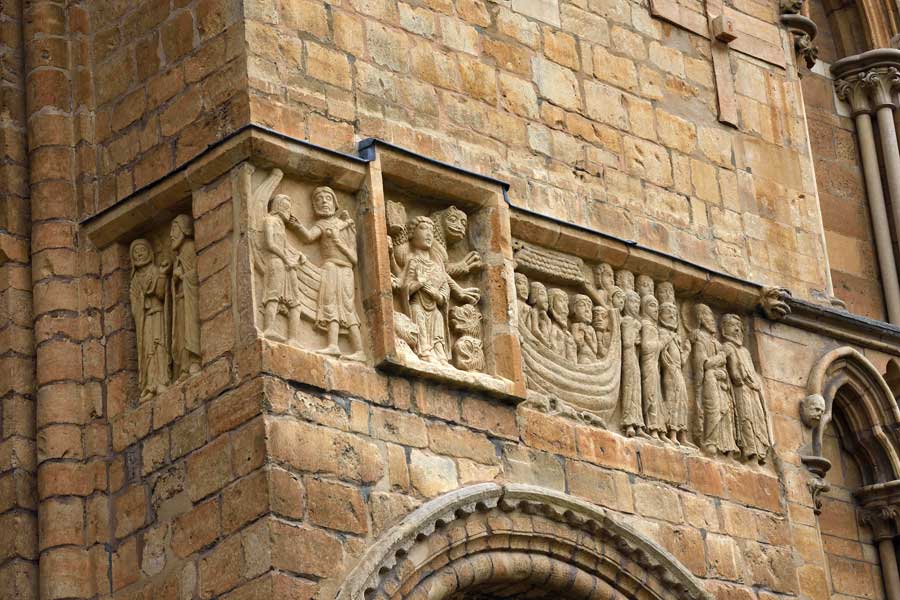
Then, jangling a huge bunch of keys, our guide takes us inside and unlocks the door to the Ringers’ Chapel.
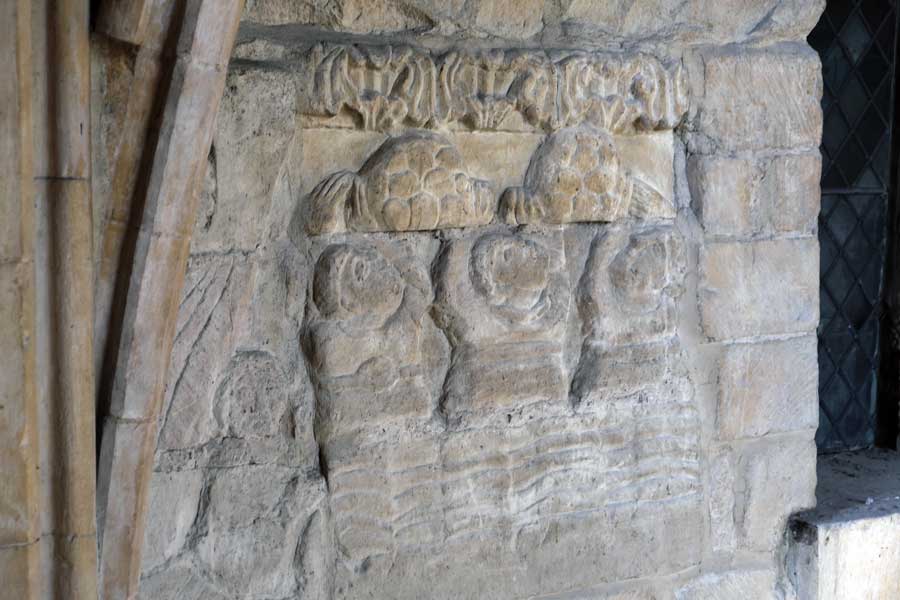
He shows us how the frieze extends from the front round to what was originally the side of the cathedral. Now covered up by the later additions, it’s only visible on a guided tour.
What was once brightly coloured has, even indoors, weathered into pale relief, but it’s extraordinary to see these carvings have survived wind, weather, fire and even lightning strikes for hundreds of years.
It’s here we get our safety instructions.
‘Mind your step, mind your head and take it slow. Oh, and if you’re not a fan of heights, don’t look down!’
The Guided Roof Tour is certainly not suitable for anyone with mobility problems, there are over 100 steps to the top. But, unless you suffer from specific health conditions, it’s open to all aged 14 and over.
Steep staircases and high, narrow passages await, but everything is so interesting I forgot for a moment that I really have no head for heights.
I just took my time and went with it.
There’s so much to take in, don’t be surprised if the tour, scheduled to take about 90 minutes, keeps you enthralled for more than 2 hours!
One member of the tour is designated the back-marker, responsible for switching off lights and closing doors behind us, the slam echoing through the cavernous spaces and adding to the atmosphere.
Hidden gems of Lincoln Cathedral
Leaving the side chapel, we stop at a small door in the oldest part of the tower, before climbing a broad set of stairs.
‘The wider the stairs, the more likely they were used by people of importance. This is probably the entrance Bishop Remigius would have used. Look how small it is! He clearly wasn’t a very big man!’
The sweep of the stairs, plenty big enough for armed soldiers, leads to an enclosed stone parapet that runs between the two, smaller towers at the front of the cathedral.
‘After the conquest things were pretty unsettled and the clergy had to be ready to defend themselves. Lincoln Castle was often besieged by rival factions, too busy to come and help, so the cathedral had its own methods of defence.’
‘Here there was once an opening where you could throw anything down on your attackers. And you’d stay safe up here behind these thick walls. But mostly it was used on saints days and celebrations to hang down long, colourful banners or scatter the crowds with petals. Feast days at the cathedral would have been a riot of colour and noise.’
Then it’s on to the more modern section – only 800 or so years old – that was the work of another Bishop, Hugh of Avalon, later canonised as Saint Hugh.
Saint Hugh at Lincoln cathedral
Taking on the ruins after the earthquake, Hugh had a very different, hands-on approach.
Legend has it he would sometimes work as a hod carrier for the builders and took a personal interest in progress.

The tour takes you onto the roof at two points, one giving spectacular views over the south of the city and the nearby Bishop’s Palace, where Hugh prayed and planned his masterpiece.
The other takes you out above the front entrance of the cathedral, looking west over Exchequer Gate towards Lincoln Castle, so close you can wave at the people doing the castle wall walk.
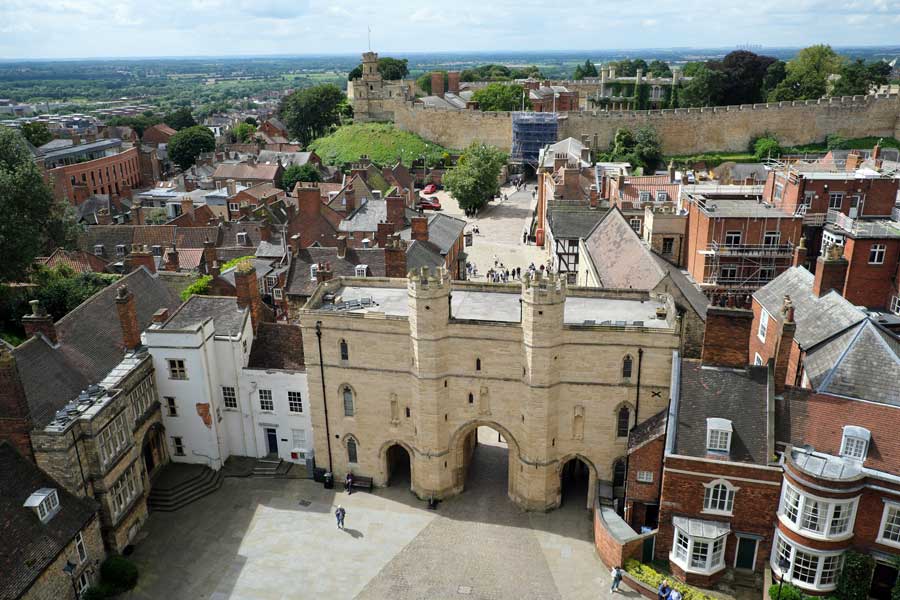
Here we get a view of St Hugh himself, his statue high up, arms raised in blessing.
Opposite him, on the northwest tower, stands a very different figure – a shepherd playing his pipes.
‘Now that’s another Hugh legend. One day, a shepherd approached the bishop with a donation towards the rebuilding of the cathedral. It wasn’t much, just a few coins, but Hugh realised it was all the man possessed. He vowed that since the shepherd had given his all, that he deserved a statue as well.’
Fiction or fact? Nobody knows.

What is clear is that Bishop Hugh was a much better architect than Remigius! The rebuild took advantage of the latest Gothic style, with pointed arches, ribbed vaults and flying buttresses which could support huge windows, perfect for stained-glass.
But our guide is quick to point out its imperfections, too. He tells us to look down the length of the nave. From this height, something becomes apparent that we hadn’t spotted from the floor. In all this Gothic perfection, the nave is irregular, doing a little wobble as it reaches the western end.
It seems an odd mistake for Bishop Hugh to make, but there is a theory.
‘We know that Hugh began rebuilding the cathedral from the eastern end, working his way towards the remaining western frontage. It’s possible that he originally intended to pull the old part down, rather than incorporate it, so didn’t need the vaulting to match.’
But Hugh died before the transept and nave were completed, so we’ll never know.
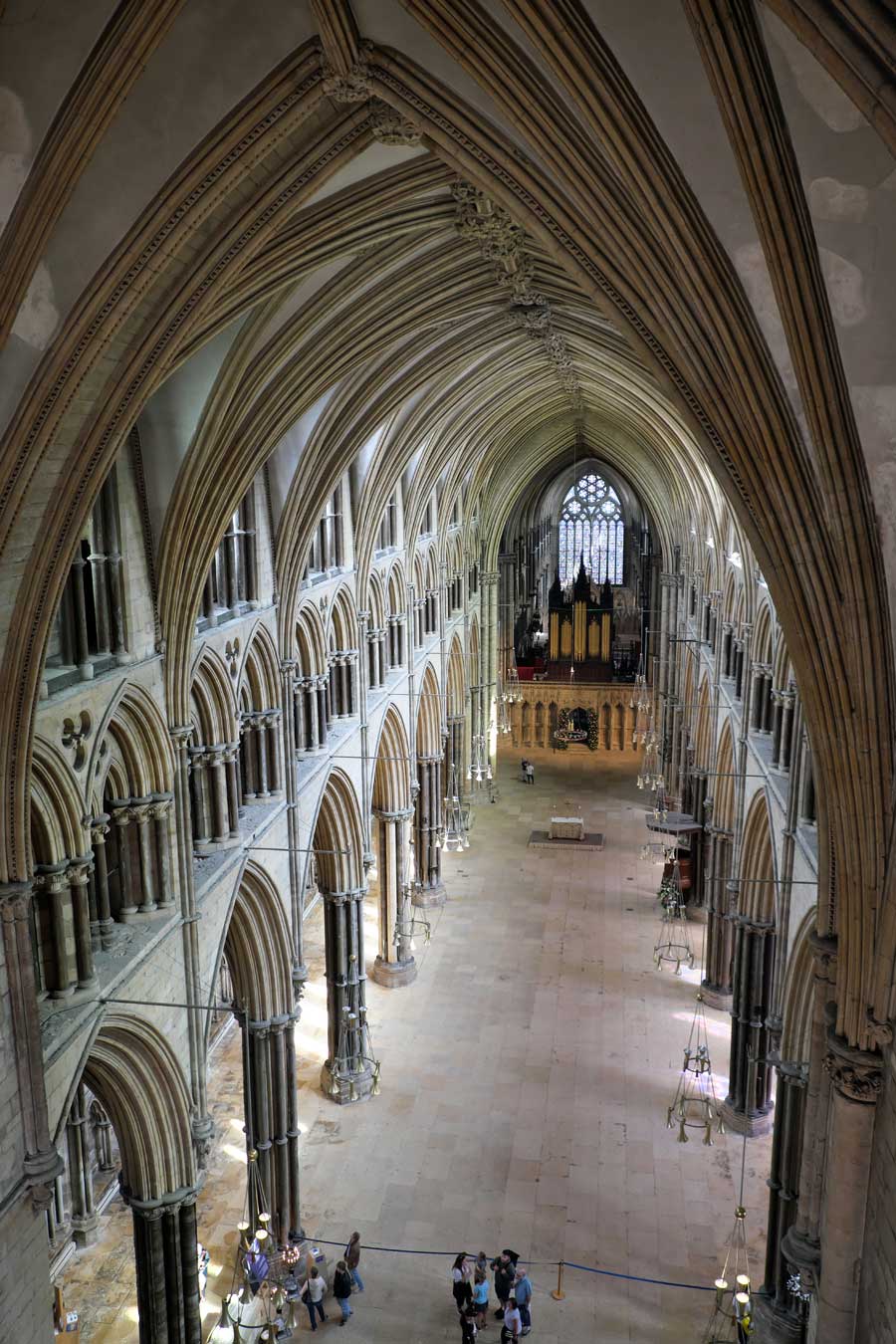
Whatever the reason, it’s rather wonderful that parts of Lincoln Cathedral date back over 950 years.
Restoration at Lincoln Cathedral
And the battle to maintain it has been going on for almost as long!
Its once soaring spires were removed in 1807 amid fears of a collapse and over the years, beams and metal structures have been put in place to strengthen the walls.
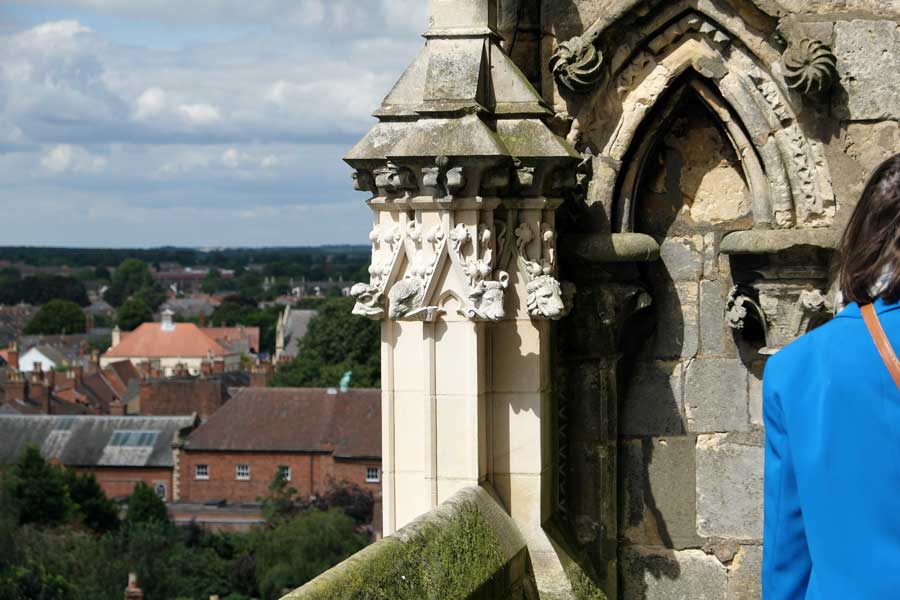
These signs of restoration are clear in the hidden parts of the cathedral uncovered on the Roof Tour, from the detailed stonework on the tower parapets to the huge supporting beams in the bell tower.

Up in the roof
A few more steps, narrower this time, bring us to the main attraction – a walk above the vaulted nave ceiling itself.

Huge oak beams, cut hundreds of years ago from Sherwood Forest, still support the roof as they have for centuries.
Along the wooden walkway, we find carvings and graffiti from the craftsmen who’ve built and maintained the great ceiling over the years.
If graffiti is your thing, Lincoln Cathedral has a guided graffiti tour too.

St Hugh’s legacy
After Hugh’s death, the work to beautify and improve the cathedral continued.
Small miracles began to be reported by people visiting his grave, and he was canonised in 1220. A whole new choir was built, worthy of St Hugh’s resting place.
Angels swoop and soar above, but keep your eyes peeled for the mischievous Lincoln Imp just above St Hugh’s shrine, because the devil is everywhere!
And those windows!
Masterpieces of medieval glass work, painstakingly conserved throughout the years.
The final part of the roof tour, takes you through a tummy-squeezing, vertigo-inducing passageway, to give you a dramatic, close-up view of the Dean’s Eye, a work of extraordinary medieval craftsmanship.
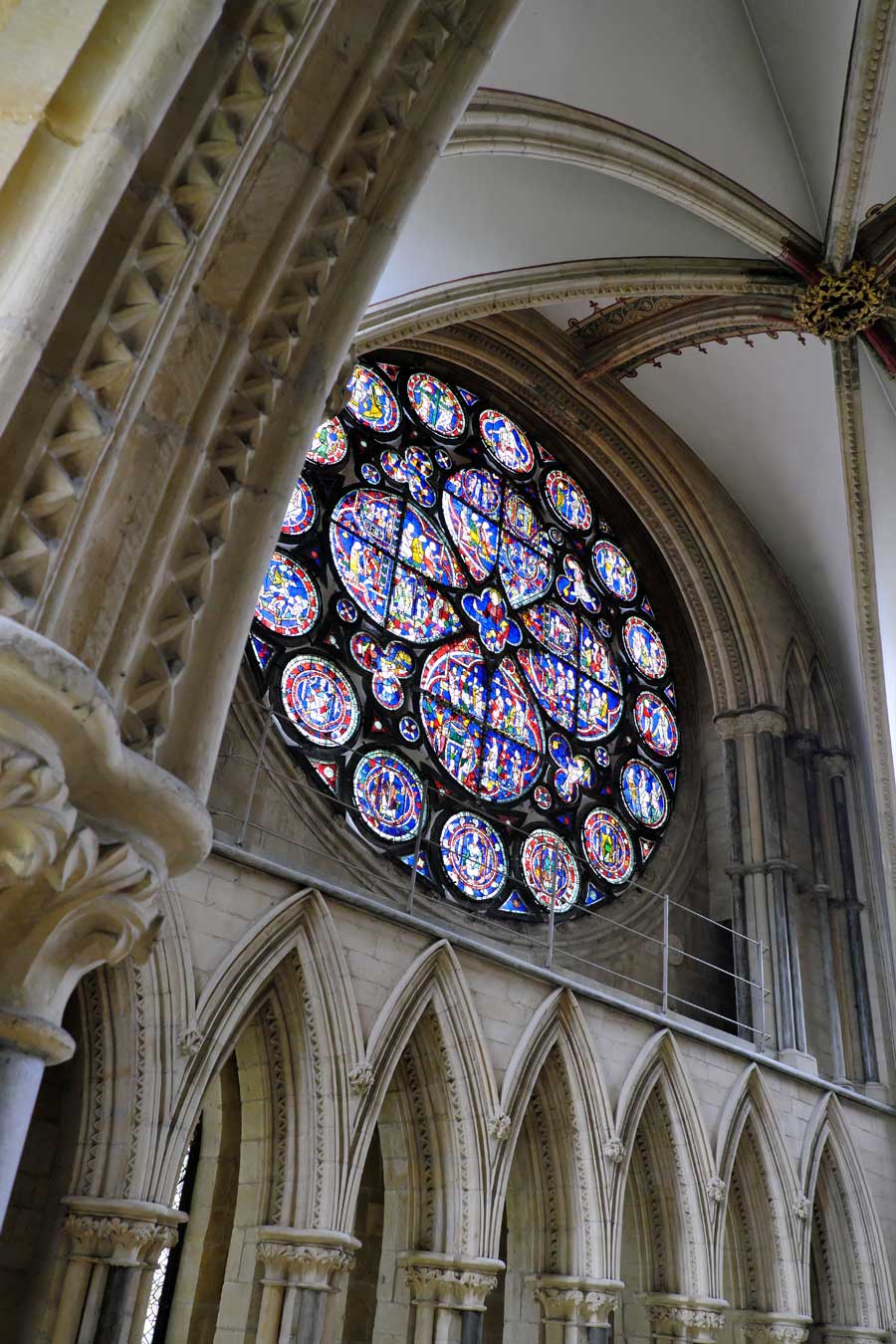
Even I, legs a bit jelly-like by this stage, had to stop and marvel at the intricate stonework and glowing glass. Pork Belly was, of course, the last one down!
The perfect end to the Lincoln Cathedral roof tour.

Visiting Lincoln Cathedral
There’s so much more to see, and if cathedrals are your thing, you’ll probably need to go back several times to take it all in.
The Roof Tour costs £7.50 per person in 2023. This is in addition to the cathedral admission price of £11 for adults, (16s and under are free).
For a full range of tours and opening hours, see Lincoln Cathedral website.
While you’re there, why not visit the Medieval Bishop’s Palace just beside the cathedral, where Bishop Hugh lived during the rebuild.
We were guests of Visit Lincoln and Lincoln Cathedral, but we think the tour is well worth the money for the informative and entertaining guides and the access to areas not usually seen.
Where to next?
• Secrets of Lincoln
• Fascinating things to see in Norwich cathedral
• The hidden canals of Antwerp