
Food Trends for 2026: Comfort, Culture and a Sense of Place
If recent years have taught us anything, it’s that food trends are no longer about novelty for novelty’s sake. As we head into 2026, the conversation has shifted towards dishes that offer comfort, authenticity and a clear sense of place. Diners are increasingly drawn to foods with history, recipes rooted in everyday culture rather than designed solely for social media, yet still open to reinterpretation.
Across menus and home kitchens alike, there’s growing enthusiasm for global comfort baking, naturally gluten-free grains, sweet-and-savoury flavour pairings and traditional recipes finally getting their moment outside their home countries. It’s less about chasing the next viral sensation and more about rediscovering foods that have been quietly perfecting themselves for generations.

Which is precisely why Salvadoran quesadillas feel so timely. A breakfast cake that isn’t a cake, a quesadilla that isn’t a quesadilla, and a dish that balances nostalgia, practicality and bold flavour in one golden, sesame-topped delight. They tick all the right boxes for where food culture is heading next.
If you hear the word quesadilla and immediately picture melted cheese stretching tastily between two tortillas, you can stop right there. Salvadoran quesadillas have absolutely nothing to do with that image, and frankly, they are all the more interesting for it.
They are sweet-and-salty cheesy cakes served at breakfast time or as a mid-morning snack. They’re comforting, a little unexpected, and quietly addictive, the sort of thing you plan to have “just one”, then mysteriously find yourself eating the whole batch.
In El Salvador, the quesadilla salvadoreña is a staple of bakeries, home kitchens, and coffee breaks. You’ll spot them sitting proudly in bakery windows, baked in large rectangular trays, their golden tops studded with sesame seeds, ready to be sliced and sold by the slab. Traditionally, they’re baked in brick ovens and served simply, without fuss, much like a good Victoria sponge: familiar, dependable, and quietly beloved.
Naturally gluten-free thanks to the use of rice flour, Salvadoran quesadillas manage to feel indulgent while sidestepping wheat altogether. Rice flour gives them a slightly different crumb to your average cake, softer and denser, which makes them ideal breakfast material. They don’t crumble dramatically, they don’t demand icing, and they won’t collapse if you eat them with one hand while holding a cup of coffee in the other. Practical baking at its finest.
Ours are a little fancier. Rather than baking one large slab and slicing it up like a loaf cake, we opted to make individual cakes instead. This is not how abuela would have done it, but then abuela probably didn’t have a collection of muffin tins or a food stylist’s eye for neat edges.
Cheese is, unsurprisingly, the defining ingredient. In El Salvador, quesadillas are traditionally made with queso duro blando, which literally translates as “hard soft cheese”, a name that feels deliberately designed to confuse outsiders. It’s a firm, salty, white cheese with enough structure to hold its own in baking, often paired with cuajada, a softer, curd-like fresh cheese that adds richness and moisture.
The result is that distinctive sweet-salty flavour that makes Salvadoran quesadillas so compelling. They are sweet, yes, but not pudding-sweet. The cheese reins things in, adding savoury depth and stopping the whole affair from wandering into cupcake territory. It’s this balance that makes them appropriate at breakfast, acceptable at elevenses, and dangerously easy to justify at any point in the day.
Another key traditional ingredient is crema salvadoreña. If you’re trying to picture it, think crème fraîche’s slightly less opinionated cousin. It’s thick, cultured, gently tangy, and not overly salty, designed to enrich without overwhelming. Combined with eggs, sugar, and cheese, it produces a batter that feels almost too simple for something so satisfying.
Outside El Salvador, ingredient substitutions are common, and even within the country there’s variation from household to household. Some bakers use Parmesan for its saltiness and availability; others prefer milder cheeses such as cottage cheese or farmer’s cheese. There’s no single correct answer, it all depends on how far you want to push the sweet-to-savoury ratio. Like many traditional recipes, it’s less a rigid formula and more a flexible framework.
Our version takes that flexibility and runs with it. These quesadillas are made with no cow’s milk products so that I could enjoy them too. Instead, Pork Belly opted for a crumbly sheep’s cheese with a good tang and an unexpected caramel undertone, the sort of cheese that tastes like it’s been thinking about dessert without fully committing. It brings enough salt to balance the sugar while adding its own character to the mix.
For the cream component, he used a blend of soya cream, soya milk, and lemon juice as a substitute for crema salvadoreña. The lemon provides the necessary acidity, mimicking that cultured tang, while the soya keeps things rich without tipping into heaviness. The end result is remarkably faithful in texture, if not in strict geographical allegiance.
Toppings are where Salvadoran quesadillas quietly show off. Traditionally, the batter is sprinkled generously with sesame seeds before baking, creating a lightly crunchy, nutty crust that contrasts beautifully with the soft interior. It’s subtle, but it matters, without that topping, something would feel missing.

To balance the sweetness of ours, Pork Belly went slightly off-piste and used gomashio instead, a mix of black sesame seeds and salt. It’s a small tweak, but an effective one. The black sesame adds depth and a faint bitterness, while the salt sharpens everything just enough to keep your taste buds alert. Consider it a respectful nod to tradition with a knowing wink.
Culturally, Salvadoran quesadillas occupy a similar space to banana bread or malt loaf in the UK: familiar, comforting, and endlessly adaptable. They’re eaten with coffee, with atol (a warm, thick drink made from corn or other grains), or simply on their own. They don’t shout for attention, but they reward it generously.
There’s also something quietly charming about a dish that shares its name with something entirely different. It’s a reminder that food doesn’t travel with a universal dictionary attached. Names shift, meanings overlap, and occasionally you end up with a cheese-based cake masquerading under the same title as a street-food classic. Confusing? Yes. Delicious? Absolutely.
So if you’re expecting tortillas and melted cheese, prepare to recalibrate. Salvadoran quesadillas are cakes, not snacks; baked, not fried; gently sweet, unapologetically cheesy, and far more versatile than their name suggests. Whether made traditionally in a brick oven or reimagined as individual, cows milk-free delights with sheep’s cheese and gomashio, they’re proof that some of the best culinary surprises come wrapped in familiar words, and that breakfast cakes should probably be taken far more seriously than they currently are.
By the way, the name “quesadilla” comes from the use of cheese, not from tortillas. This often surprises people outside Central America.
This recipe will make 24 individual cakes – they can be eaten warm from the oven or left to cool, equally delicious.
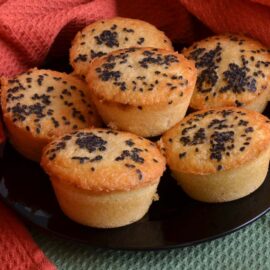
Salvadoran quesadillas
Ingredients
- 6 eggs
- 250 grams sugar
- 280 grams rice flour
- 1 tsp baking powder gluten free
- 1 pinch seasalt to taste
- 225 grams grated cheese we used Lord of the Hundreds ewe's milk cheese
- 225 mls soya cream
- 110 mls soya milk
- 1 tsp lemon juice
- 140 grams butter, melted goats butter or Flora vegan butter work well
- sesame seeds or gomashio a sprinkling for the top
Instructions
- Preheat oven to Gas Mark 4/350 degrees
- Grease 24 muffin tins and line the bottoms with greaseproof paper or baking parchment
- Whisk the eggs and sugar together until thick and creamy – enough to leave a slight trail when you lift the whisk
- Mix the rice flour, pinch of salt and baking powder until combined and put to one side
- Mix the soya cream, soya milk and lemon juice together and set aside
- Add the grated cheese to the egg mixture and beat until well blended – about 30 seconds should do
- Add about half the soya cream/milk/lemon juice mix to the egg mixture and beat
- Fold in half the rice flour mixture, then alternate until all the wet and dry ingredients have been well-blended into a smooth batter
- Add the melted butter to the batter and combine
- Fill the muffin tins with the batter about three quarters full – these cakes don’t rise a lot but do need a little space to grow
- Sprinkle with the gomashio or sesame seeds
- Bake for about 20 to 25 minutes until slightly golden on top
- Leave to cool for a few minutes before turning them out – this allows the cakes to shrink a little away from the sides of the tin and makes it easier to remove them
- These are delicious eaten warm straight from the oven or left to cool.
Other recipes you may like:
• Clementine and almond cake
• Vegan cherry and coconut cookies
• Coconut flour pancakes with blackberries
If you’ve enjoyed browsing our website, learned something new, or just had a smile because of what we do – we’d love your support to keep the good stuff brewing!