
Let your tastebuds experience the past with The Copper Pot’s sweet and spicy Historical Chocolate Box.
Can you imagine a life without chocolate?
It’s hard to believe that until Columbus reached Central America, few people had any idea of chocolate’s magnificent, marvellous, medical and mood-enhancing qualities.
It was the Mayans who first harnessed the power of the pod and the Aztecs who gave us the word ‘chocolate’ but it was very different to the chocolate we know and love today.

So what better way to discover chocolate’s heady history than a demonstration by an expert?
Archaeologist and food historian
Nick Trustram Eve is an archaeologist turned food historian who combines academic research with fascinating talks and demonstrations of food through the ages. He’s expert in everything from fancy Victorian trifles to one pot cooking over a campfire.
Through his online shop The Copper Pot he’ll bring a taste of the past into your own home.
On a sunny summer’s day, Nick invited us into his medieval-style tent for a demonstration of the history and art of making chocolate.

History of chocolate
The initial reaction to the discovery of chocolate wasn’t exactly favourable.
‘The first person to write about it was a chap called Belzoni who described it as ‘a drink fit for pigs’! At that time it was a savoury and spicy drink, made with water and served cold.’
Nick explains how the Mayans and Aztecs went to great lengths to create this treasured foodstuff. ‘To make great chocolate you need beans, dried and fermented, and a bit of manual labour.’

‘First you break the dried beans up into small pieces called cocoa nibs. Then you need two things; heat and pressure. The traditional way is to use a heated stone called a metate where the beans are ground down with a stone. They break down releasing the two main constituents of chocolate – cocoa solids and cocoa butter.’

A tasting at this stage reveals that it’s strong and bitter but quite recognisably chocolate.
‘The Aztecs flavoured their chocolate drink with chilli, vanilla and a native flower. When the Spanish arrived they added sugar and kept the vanilla and chilli. They replaced the Aztec flower with orange peel and added achiote, a paste made from annatto seeds, which gave the chocolate a sweet, peppery taste.’
Later more European flavours like cinnamon were added for their medicinal properties.
Food or drink?
‘At that time people still believed in the medieval idea of the body having four ‘humours’ which needed to be balanced. Foods were important in balancing the humours and therefore food was in itself considered medicinal.’
‘In fact there was a huge debate in the Church at that time about whether chocolate was a drink or a food – massively important if you were observing fast days. This debate went on for around 200 years!’
‘The English were slow on the uptake, probably because we were at war with Spain at that time, and chocolate doesn’t start appearing here until the late 1600s. ‘

‘By the 18th century the recipe had changed again and by 1741 the chocolate drink has long pepper replacing the chilli and cardamom instead of orange peel.’
‘Then the Victorians came along and tried to clean up foods. One of the side effects was to remove most spices from dishes and that includes chocolate. They kept the vanilla but nothing else.’
The next major change was to add milk because the fat brings out the flavour. By the 18th century hot chocolate was something close to what we’d recognise today, although much thicker.
The French experimented with chocolate pastilles (tablet shaped solid chocolate) in the 18th century and finally, in 1847, Fry and Sons made the first bar of chocolate.
And chocolate was here to stay.
The Copper Pot – purveyors of fine historical foods

But it’s not just chocolate. The Copper Pot is all about bringing recipes to life so that you can enjoy a real taste of the past, at home. Nick recreates authentic recipes using historical records from medieval times through to the Victorian era.
‘I absolutely loved it when I worked for the National Trust, at Wordsworth’s House. I would take the plants, fruits and herbs from the 18th century garden and bring them into the kitchen where I used cookbooks from that time to create foods to go on display in the dining room – fantastic jellies and creams; amazing desserts that visitors couldn’t believe were real.’
‘Then we started demonstrations and tastings in the kitchen and people wanted to go to the shop and buy a mix to make at home. The Copper Pot grew out of that.’
The recipes and research are accurate and authentic, but it’s enjoyable too.
‘I love wandering round events, with my tray of 18th century gingerbread. Instead of crying out how great it is I look all mournful and say things like ‘reasonably nice gingerbread’, ‘gingerbread, not as nice as grandmother makes’. ‘People react to that, and it’s much more fun!’

Unicorn poop!
Nick’s also veered a little off-history with his multi-coloured chocolate drops, Unicorn Torde.
‘The only authentic bit is the name. Torde is a medieval English word for dung and we know that unicorns poop out rainbows, so their torde would definitely look like this!’
Choosing what will make a successful recipe for use at home takes a lot of time and research.
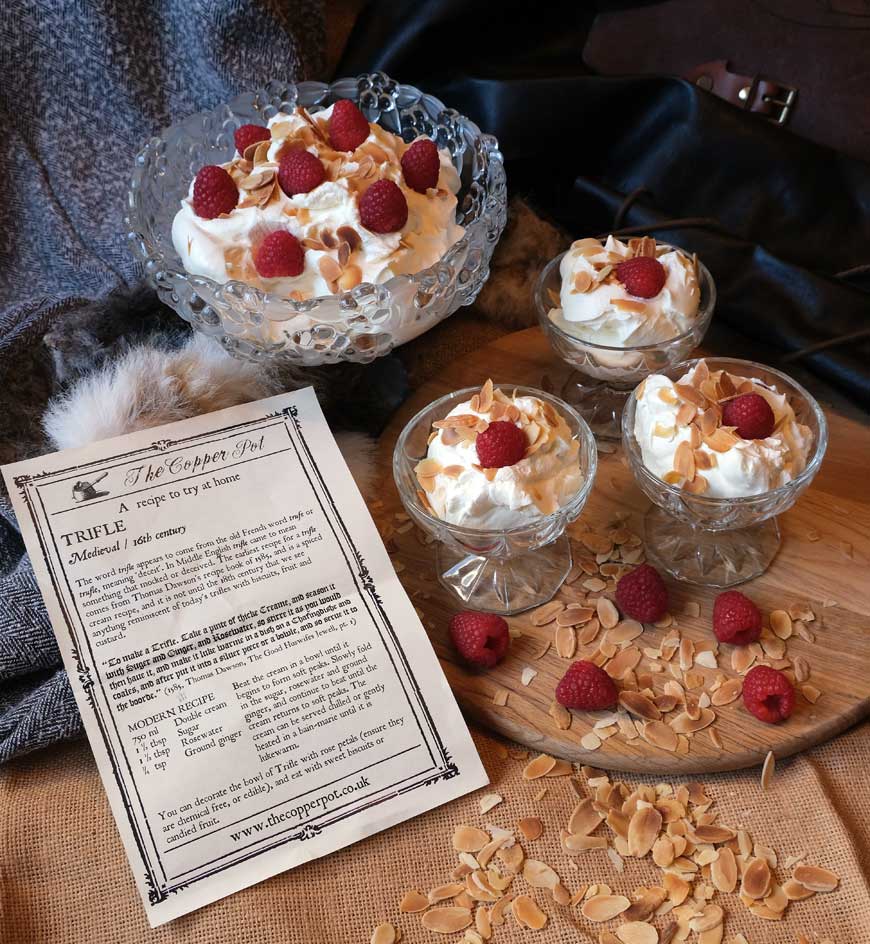
‘It needs to be something recognisable like a stew or spice mix. I then go through the recipe books for ingredients that are a little bit different, something you wouldn’t normally have in the kitchen. I make up the recipe and play with the quantities; old recipes say things like ‘take some of this, a bit of that’. I love the phrases they used – I think words like ‘gobbets’ should come back. It simply means a bite-sized piece that fits in your gob!’
‘Some of the earliest recipes are medieval from 1590s, most are Georgian and I do a few Victorian ones, though they can be a bit boring – that’s too modern for me!’

Not everything works as a DIY kit, but those that do are easy to follow. We had fun making Tudor Stew and pease pottage, messing about with trifles and we still have some spiced wine mixes to try.
• Tudors, manners, mead and stew
• 50 ways to make a trifle

If you’ve enjoyed browsing our website, learned something new, or just had a smile because of what we do – we’d love your support to keep the good stuff brewing!
Where to next?
• Agnes B Marshall, ice-cream pioneer
• A taste of honey
• Ghost towns of Britain