
The charcoal burner’s eyes gleam brightly in his soot stained face as he peers through the billowing smoke.
His enthusiasm shines brightly as he shares stories of the strange, isolated folk who used to live in Britain’s woodlands, plying their ancient trade.

It’s Rural Life weekend at Weald and Downland in West Sussex, and this fascinating open air museum is even more lively than usual.
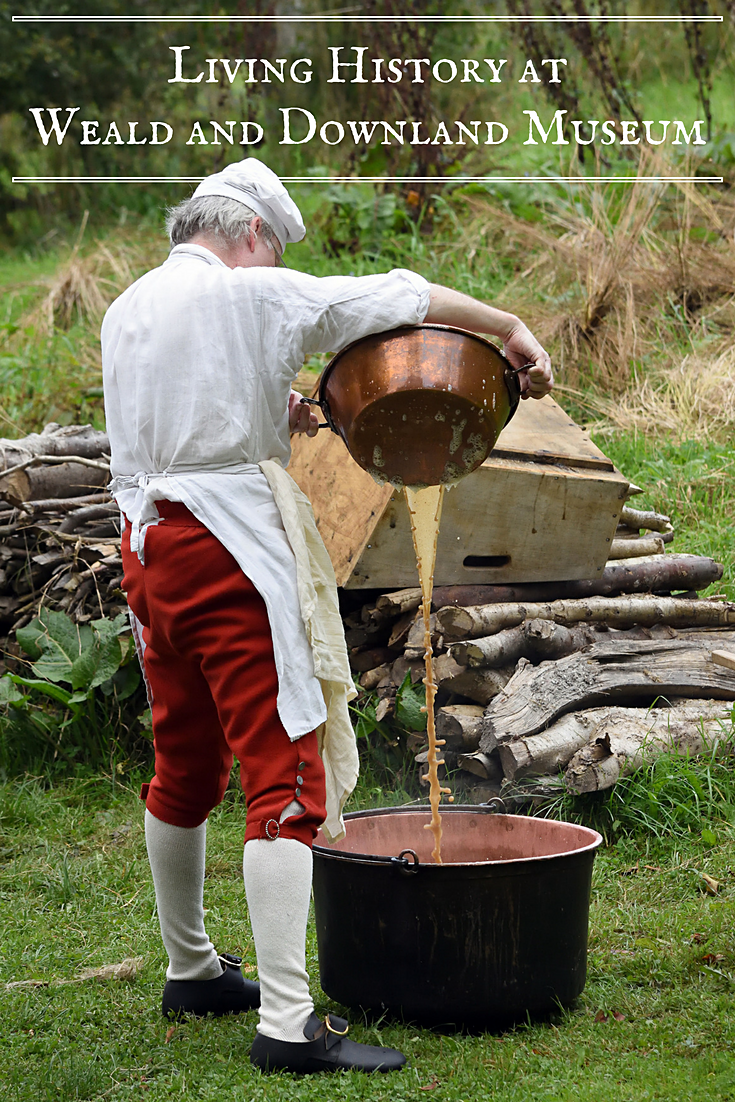
At Tindalls cottage, the rich smell of hot malt fills the air as the brew master oversees the alchemy that transforms water, barley, hops and yeast.
The resulting strong ale will vary as much as the seasons themselves.
The brewer’s assistant keeps the wood fires burning while another demonstrates the skills required to turn flax into linen thread for weaving.

Tudor cooking
Down in the Tudor kitchen, I’m offered a taste of peppery pottage prepared with herbs and vegetables grown in the tangled garden beyond.
Meanwhile, Pork Belly samples an early version of apple fritter, served piping hot from the open fire behind.


Of course, there are modern-day anomalies.
Anything to be consumed by the public must meet strict hygiene standards, and the temperature probe looks incongruous in the dark kitchen.
Health and safety rules prevent the “Stop Me and Buy One” ice-cream seller from riding his bike down the steep paths.
But it can’t stop the Tudor-garbed servant girl heartily splitting logs for the woodpile – for winter is coming.

The museum does its best to be self-sufficient, using its forty aces of beautiful landscape to good effect.
At various times of year you will see oxen drawing logs, Shire horses pulling heavy machinery and early tractors ploughing the fields.
Blacksmiths, carpenters and farmhands take turns to demonstrate their crafts.
The Lurgashall water mill grinds flour which you can buy in the shop and before long they will have a bakehouse and dairy on site too.
Medieval to Victorian times

But it’s the beautifully restored buildings – more than 50 of them spanning nearly 1,000 years of history – that make the place so special.
From Anglo-Saxon halls through medieval shops to Tudor banqueting rooms and Victorian cottages and school rooms, each is packed with information and atmosphere.


Many of them are fully furnished, giving the impression their owners have just stepped out the back to peg the washing on the line, visit the privy or pick something from the garden.
Whilst some of the early buildings are reconstructions, the majority are real homes, rescued from demolition and lovingly re-created at the museum.

The Tollgate stands at a crossroads, showing the minimal charges for animal drawn vehicles and the whopping whole shilling they wanted before they let a steam driven mechanism cross.
Out the back, the toll keeper’s bedroom is sparsely furnished, but his garden is well stocked, proving there were perks to being on duty 24 hours a day.

Brewing at Tindalls Cottage
Back at Tindalls cottage the brew master’s taking a break, with lunch spitting on a skillet on the open fire there’s a chance to relax.
Out comes the most extraordinary musical instrument – a hurdy-gurdy. The sound is a cross between a fiddle and a bagpipe, not the most tuneful until your ears become accustomed, but fascinating to watch.

In the market square, a carpenter is demonstrating the tools of his trade.
At Bayleaf Tudor Farmstead, serving maids wash the household linen with soapwort and hot water, leaving the clothes to dry in the warm autumn sun.

Historic gardens
The gardens are a treasure for any plant-lover, six different areas reflecting social status as well as historic era.
Tangled and overgrown to modern eyes, many plants we now call weeds were essential as tasty additions to the daily pottage, for medicines or to strew indoors to repel unwanted insects.
Each garden was carefully laid out to encourage growth and fruitfulness. Poorer families had to be self-sufficient and there was strict order amongst the borders to ensure a year round supply of edibles.

It’s this constant supply of facts, woven in with the hands-on family friendly tasks of bridge building, dressing up boxes and sieving grain, that makes the museum such a great day out.
The children’s play area is suitably rural with carved wood dragons and woven huts, dog walkers are welcome and there’s plenty of space for young ones to safely roam.

More information about Weald and Downland Museum
The Weald and Downland Living Museum is open all year round, with a number of special seasonal events. Their Christmas Fair is well worth a visit, and they charge reduced entrance fees for some activities.
For admission prices and events calendar, see their website.
Dogs on a lead are welcome and there are plenty of picnic spots. The on site Wattle and Daub café has a limited menu but uses fresh, local produce.
You can also buy heritage species of plants in the shop, along with the stone-ground flour produced at the mill.
Where to next?
• SS Great Britain
• Rye, East Sussex
• Ghost towns around the world