
This is a vintage recipe from Eliza Acton, the Sussex-born food writer who produced one of Britain’s first cookbooks aimed at the domestic reader. Modern Cookery for Private Families was published in 1845 and continues to influence top chefs today.
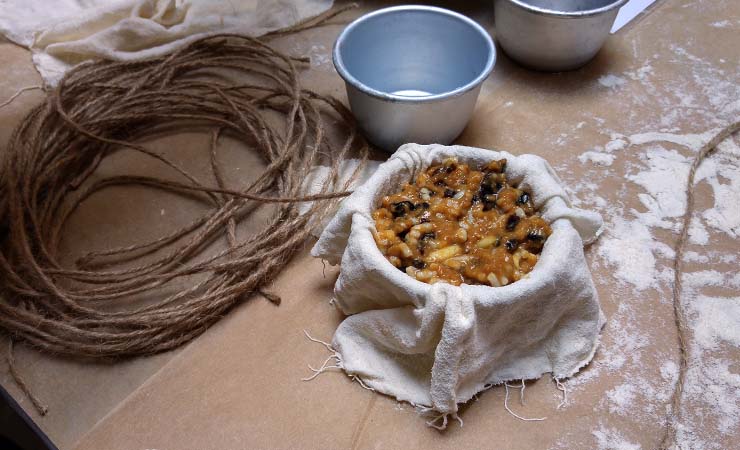
We watched mini-puddings being made to this exact recipe at Paul Couchman’s Christmas Pudding workshop in the restored kitchen of The Regency Town House in Hove.
It makes a rich and aromatic pud, less sticky than its modern day counterpart but just as delicious. These quantities make 32 individual puddings.

Plum Pudding
A traditional Christmas Pudding recipe from 1845
Ingredients
- 425 g plain flour
- 425 g fine lightly grated breadcrumbs
- 850 g suet vegetable suet works as well as animal based suet
- 850 g raisins
- 850 g currants
- 565 g minced apples
- 700 g sugar dark brown adds extra taste
- 260 g candied orange-rind
- 2 1/2 teaspoons grated nutmeg
- 2 1/2 teaspoons grated mace
- 5 pinches salt
- 500 mls brandy
- 15 whole eggs
- butter muslin cut into squares to make pudding cloths
Instructions
- Soak the fruit in the brandy for extra plumpness
- Put a big pan of water onto boil and place a china plate on the bottom to prevent the puddings from burning. The clattering of the plate as the water boils helps make sure a rolling boil is maintained
- Prepare the butter muslin by cutting it into 15×15 cm squares
- Drop the squares into the boiling water and leave them there whilst you prepare the pudding mix
- Empty the soaked fruit into a large bowl and add all the other ingredients.
- Stir well – traditionally from east to west, or clockwise, for good luck
- Take the cloths out of the water with tongs and (wear rubber gloves) wring out any excess water
- Lay the cloth on a clean work surface and generously flour the wet cloth. This will form the protective pudding skin.
- Drape the wet and floured cloths over an individual pudding bowl and pile the mixture into the centre.
- Flour the top before gathering the cloth edges together and tie the pudding cloth tightly with string (not twine as it will break)
- Wrap the string around the top several times, tying knots as you go and make sure you leave a string handle at the top to lift it with
- Lower the puddings gently into the pan of boiling water. Ensure the puddings are covered with water and place a lid on the pan or cover with a plate
- Keep adding more boiling water if needed and boil for an hour.
- The puddings can then be taken out, patted dry and stored in a cool pantry or fridge
- On the day you want to eat them, the puddings will need another hour of boiling.
- To serve, lift them out of the water, remove the string and open out the muslin.
- Place a plate that has been rinsed on cold water on the top and invert it. The moisture will help ease the pudding out onto the plate
Other recipes you may like:
• Eliza Acton’s Superlative Mincemeat
• Trench cake
• Swiss Toffee