
World War 1 was a hell-hole of mud, blood and fear. Only a package from home could help lift the spirits, especially if it contained a Trench cake.

That first Christmas in 1914 must have been bewildering for young soldiers of all nationalities.
The British force in France had been shattered by heavy defeats at Ypres, and a steady influx of newly drafted youngsters were arriving to shore up the regular army.
The dullness of trench warfare left these young men plenty of time to think, and they were so close to the enemy they could hear their conversations and smell their cooking.

Even before the famous Christmas truce, there were shouted exchanges and the swapping of gifts – although there was no guarantee you wouldn’t get a sniper’s bullet if you ventured too far into no man’s land.
Every little package from home would have been welcome – and that’s where the Trench cake came into its own.

History of Trench cake
It was a simple home-made fruit cake, with long-lasting ingredients.
Baked with love by families back home, it was sent out (for the princely sum of 1 shilling and fourpence) along with hand-knitted mittens and socks to the troops on the front-line.
A slice, eaten in a rare moment of calm, or shared with brothers-in-arms, brought a taste of home and memories of happier times.
The recipe itself reflected the shortages of the time. Butter, eggs and milk were scarce and often reserved for hospitals or the most vulnerable. Home bakers became inventive, using vinegar and baking soda to replace eggs and to give the cake its lift. Dried fruit, when available, was used sparingly, and cocoa or a little spice added warmth and flavour.
These small cakes became more than just food; they were tokens of affection, reminders that someone cared, and that home was waiting. The humble Trench cake came to symbolise the resilience of both those who fought and those who kept life going at home.
World War 1 Memorials
To really understand what World War 1 was like, a trip to the Somme Battlefields is a sobering experience.

The Somme Battlefields
The Somme Battlefields in northern France remain one of the most moving places to visit for anyone wishing to understand the scale and cost of the First World War. The peaceful countryside today gives little hint of the devastation that took place there in 1916, when more than a million men were killed or wounded in just a few months of fighting.
Visitors can walk through preserved trenches at the Newfoundland Memorial Park near Beaumont-Hamel, stand beneath the towering Thiepval Memorial to the Missing, or spend time at the Lochnagar Crater, left by one of the great mines exploded on the first day of the battle.
The Somme 1916 Museum in Albert and the many small cemeteries scattered across the rolling fields each tell their own quiet story of loss and endurance. It is a landscape that has become a lasting memorial to courage, sacrifice and the hope for peace.

In the UK, the Imperial War Museum in London is an excellent memorial, but there are others across the country, worth visiting all year round – not just on Remembrance Sunday.
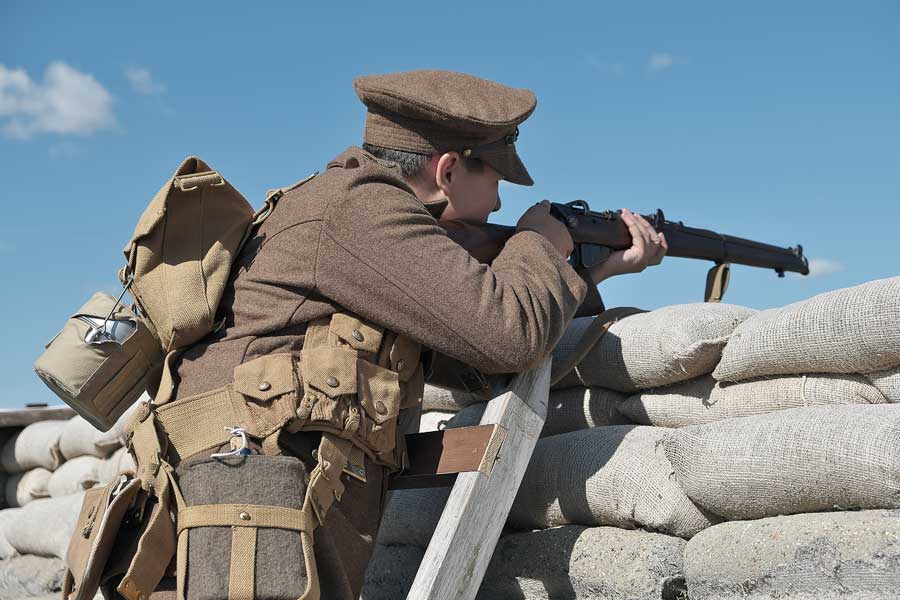
In West Sussex, at Shoreham Fort, volunteers have created a Memorial Trench for school and public visits. And on special heritage days, they will serve you a slice of authentic Trench cake.


Trench cake recipe
No eggs – because anyone with chickens in the backyard was expected to surrender their eggs to the war effort.
The farming magazine Poultry World launched the national Eggs for the Wounded campaign, announcing, ‘Every British hen should be on active service.’
Instead, the recipe uses vinegar and baking soda – working together to provide the necessary lift – and no more than a pinch or two of spices and a little dried fruit.
It was made to last and, provided it was well-wrapped in waxed paper, it could survive the long and winding road to the trenches.

The recipe may be simple, but when we baked it, a warm, sweet and spicy smell pervaded our home.
It cut well and held its shape, but was less moist and fruity than we would expect of a fruit cake today.
But I’d like to think a few slices would have brought some cheer to the troops so far from home in that 1914 Christmas.
Remembering them today
More than a hundred years later, we still pause to remember those who fought and fell in the Great War and in the conflicts that followed. Each November, people across the UK wear a red poppy, inspired by the flowers that grew on the battlefields of Flanders, as a simple act of remembrance.
The poppy became a lasting symbol after the war, inspired by the poem In Flanders Fields by Canadian doctor John McCrae. The sight of poppies growing among the graves of fallen soldiers came to represent both loss and renewal. The first silk poppies were sold in 1921 to raise funds for veterans, and the Royal British Legion soon adopted the flower as its emblem.
Remembrance Sunday, held on the nearest Sunday to 11 November, brings together communities, veterans and families to honour those who gave their lives. The two minutes’ silence at 11am remains one of the most poignant traditions of national life.
The Royal British Legion, founded in 1921, continues to support serving and ex-service personnel and their families, ensuring their sacrifices are never forgotten. Through their Poppy Appeal, they help to keep alive the memory of those who fought for our freedom, and the importance of peace.
Just as those simple Trench cakes once carried the love and gratitude of a nation across the sea to its soldiers.

Trench cake
Ingredients
- 8 oz/225g plain flour
- 4 oz/110g margarine
- 3 oz/75g currants
- 2 teaspoons cocoa
- 1/2 teaspoon baking soda
- 3 oz/75g brown sugar
- 1 teaspoon vinegar
- 1/4 pint milk
- Suggested extra flavourings – nutmeg ginger, grated lemon zest.
Instructions
- Preheat oven to 180C/350F/Gas 4.
- Grease and line a small cake tin (about 15-16 cm)
- Rub the margarine into the flour
- Add the dry ingredients and mix well.
- Dissolve the bicarb in the vinegar and milk
- Add the liquid to the dry ingredients and beat well
- Pour into the tin
- Bake in a moderate oven for about 1 hour. The original recipe says 2 hours, but ours was done in one.

Want more information about World War 1?
Read ‘How the world went to war in 1914‘ on the Imperial War Museum’s website
World War 1 images courtesy of Wiki Commons and PICRYL. We understand these to be public domain and available for reproduction. All other images copyright ©rosemaryandporkbelly.
Other recipes you may like:
• Langues de Chat biscuits
• Eliza Acton’s Plum Pudding
• Curried egg pie
This cake as historically made was just barely sweet and lacking in flavor. I updated it as follows: Soak the currants in 2 oz bourbon (I used four roses) and when you add the currants, add the bourbon too. Increase cocoa to 1 T. Increase sugar to 5 oz brown and 1 oz white. I added one egg. I changed the 1/4 pt milk to 4 oz vanilla or plain yogurt (sour cream or buttermilk would also work. I used the vinegar for lift insurance.) I used 1/2 t nutmeg, 1/2 t ginger, and just 1/4 t lemon extract because I was lazy and I don’t care for much lemon with chocolate, I think orange would be better if I hear this was a good cake.. After these additions, the batter changed from a pretty boring cake into a yummy bourbon ball. Yummy spoon licking. I baked it in a six inch round tin in a parchment cup I created by folding parchment again and again so that it had fine pleats like a muffin cup, then trimmed it across with pinking shears. It looked really neat and homemade. I baked it for possibily 45 minutes to an hour. The original cooking time is for a steamed recipe, not a baked one. It rose beautifully high and the top cracked into trenches, ironically. And it stayed pretty high when it cooled. This is a nice Christmas cake for a history fan in your family and a good hunter’s cake, or for a British friend who might have tried such a cake before. It would be tasty with butter and marmalade for breakfast or tea. The amount of spice is very suble. The reason for the low rating is the taste of the recipe as it was historically. I suppose that is not entirely fair of me, but the war is over. So after the war these recipes were typically improved when rationing was over.
Thanks Ruth, your version sounds delicious and definitely richer, sweeter and more like a modern day cake. Our recipe is, as you said, an original, historical version that commemorates the time when ingredients were in short supply, and it was designed to be sent on the long journey to the trenches.
can u use butter instead of margarine
Hi, yes butter will be fine, it will make the cake taste richer. The only reason for using margarine is because that was more widely available during the war years. Happy baking.
it tasted disgusting. But love the history 🙂
Really? Oh dear. We thought it was okay, considering its austere ingredients but have to agree with Val (see comment below) a bit of butter makes it much better!
Made rhis it was nice sliced and spread with butter.
Glad you tried it. For such an austere cake it does taste remarkably good. Of course a generous helping of butter is never a bad thing!